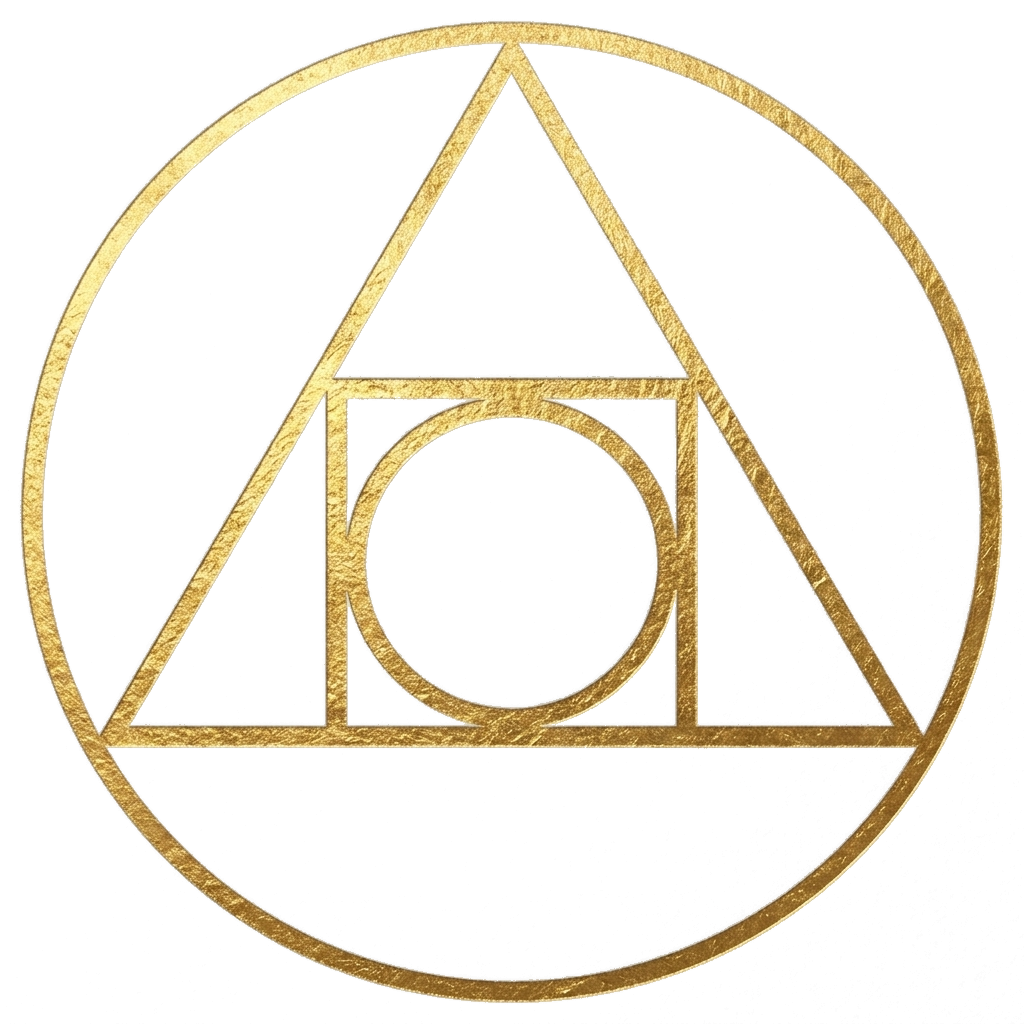
Philosopher's Stone
The lapis philosophorum — alchemy's supreme goal, the agent of universal transmutation that transforms base metal into gold, cures all disease, and confers spiritual perfection, representing the completion of the Great Work.
About Philosopher's Stone
The Philosopher's Stone — lapis philosophorum, the Stone of the Wise, the chrysopoeia, the Red Elixir — is the central symbol and supreme objective of the entire alchemical tradition. It is the agent of transmutation: the substance, state, or principle by which base metals are converted into gold, mortal bodies are healed of all disease, and the human soul is elevated to perfection. No other symbol in the Western esoteric tradition carries such concentrated aspirational weight. The Stone is at once a material substance, a spiritual attainment, and a cosmological principle — the point where matter, consciousness, and divinity converge into a single, all-transforming reality.
The concept of a universal transmuting agent first crystallized in the alchemical writings of Greco-Roman Egypt during the 2nd through 4th centuries CE, drawing on Egyptian metallurgical craft, Greek natural philosophy, Hermetic theology, and Gnostic soteriology. The Leiden and Stockholm papyri (c. 3rd century) preserve the earliest practical recipes for gold-making, while the writings attributed to Zosimos of Panopolis (c. 300 CE) first articulate the idea that transmutation of metals mirrors a transmutation of the soul. From Egypt, the tradition passed to the Islamic world, where Jabir ibn Hayyan (Geber, 8th century), al-Razi (Rhazes, 9th century), and Ibn Sina (Avicenna, 11th century) developed the sulfur-mercury theory of metals and the concept of al-iksir (the Elixir, from which the English word derives) into a sophisticated theoretical framework. Latin Europe received the Arabic corpus through translations in 12th-century Toledo and Sicily, producing a golden age of Western alchemy that reached its apex with figures like Albertus Magnus, Roger Bacon, Ramon Llull, Nicolas Flamel, and Basil Valentine.
The Philosopher's Stone stands apart from all other alchemical symbols because it is simultaneously the goal, the means, and the practitioner transformed. It is not merely something the alchemist seeks to create — it is what the alchemist becomes through the opus. This triple identity — product, process, and person — makes the lapis the most psychologically and spiritually rich symbol in Western esotericism, a fact recognized by Carl Gustav Jung, who devoted the final decades of his life to demonstrating that the alchemical opus was, at its deepest level, a symbolic language for the individuation of the psyche. The Stone persists in modern culture as a symbol of ultimate achievement, hidden knowledge, and the tantalizing possibility that matter and spirit are not separate domains but aspects of a single, transformable reality.
Visual Description
The Philosopher's Stone has no single fixed visual form — it is protean, and its many representations across six centuries of alchemical art constitute a symbolic vocabulary of extraordinary richness. The most common depiction is as a red stone or red powder (the rubedo), often shown as a radiant, luminous mass emitting golden rays, sometimes resting on a pedestal or held aloft by an adept. Red is the color of completion — the final stage of the opus magnum — and the Red Stone is the agent of transmutation proper. Alongside it, the White Stone (lapis albus) represents the intermediate stage of albedo, capable of transmuting metals into silver but not yet gold. Some texts speak of the Yellow Stone as a further intermediary.
The Rebis (from res bina, 'double thing') or Hermaphrodite is among the most iconic visual representations: a single figure with both male and female attributes — often a two-headed body, one head crowned as king, the other as queen — standing on a crescent moon or a winged globe. The Rebis symbolizes the coniunctio oppositorum, the conjunction of opposites (sulfur and mercury, Sol and Luna, masculine and feminine, fixed and volatile) that produces the Stone. The Rosarium Philosophorum (1550) and the Splendor Solis (1582) contain the most celebrated depictions of this figure.
The Phoenix rising from flames is another frequent emblem of the Stone, representing death and resurrection, the destruction of the old form and the emergence of the perfected substance from the fire of transformation. The Squared Circle (quadratura circuli) — a circle inscribed in a square, or a square within a circle, often with a triangle mediating between them — symbolizes the reconciliation of heaven (circle) and earth (square), the synthesis of the four elements into the quintessence that is the Stone itself. Michael Maier's Atalanta Fugiens (1617) contains a famous emblem of this figure with the instruction: 'Make of a man and a woman a circle, then a square, then a triangle, then a circle, and you will have the Philosopher's Stone.'
Other visual representations include the Pelican (a bird feeding its young with its own blood, symbolizing self-sacrifice and the circulation of the alchemical substance through repeated distillation), the Green Lion devouring the Sun (raw, untamed natural force consuming the gold of consciousness before yielding the Stone), the Ouroboros (the serpent eating its own tail, representing the cyclical, self-contained nature of the opus), and the Cosmic Egg (the alchemical vessel as womb of creation). In later Rosicrucian and Masonic imagery, the Stone is sometimes depicted as a radiant jewel or glowing crystal at the center of geometric patterns, emphasizing its nature as concentrated, perfected light.
Esoteric Meaning
At the deepest level of alchemical teaching, the Philosopher's Stone is not a substance to be found or manufactured in any external laboratory — it is the transformed consciousness of the adept, the fruit of inner work so complete that the practitioner's entire relationship to matter, mind, and spirit has been fundamentally altered. The opus magnum (Great Work) is the process by which this transformation occurs, and its stages — nigredo (blackening, putrefaction, descent into the unconscious), albedo (whitening, purification, emergence of clarity), citrinitas (yellowing, the dawning of solar consciousness), and rubedo (reddening, the full integration of all opposites) — map a path of psychological and spiritual development that parallels initiatory processes across every major tradition.
The Stone is the product of the coniunctio oppositorum, the conjunction or 'sacred marriage' of all opposites: masculine and feminine, active and passive, sulfur and mercury, Sol and Luna, body and spirit, conscious and unconscious. This is not a blending that erases distinctions but a higher synthesis that holds both poles in dynamic, creative tension — what the Hermetic tradition calls the 'reconciliation of the irreconcilable.' The Rebis, the hermaphroditic figure, is the visual emblem of this state. In Hermetic philosophy, drawn from the Emerald Tablet's axiom 'as above, so below,' the Stone represents the point where macrocosm and microcosm are recognized as one, where the alchemist's inner work mirrors and participates in the creative processes of the cosmos itself.
Carl Gustav Jung's monumental study of alchemy — spanning Psychology and Alchemy (1944), Alchemical Studies (1967), and Mysterium Coniunctionis (1955-56) — demonstrated that the alchemical opus is best understood as a symbolic projection of the individuation process: the integration of the unconscious with consciousness, the ego with the Self. For Jung, the lapis philosophorum is the Self — the archetype of wholeness, the center and totality of the psyche, which transcends and includes the ego. The nigredo corresponds to the confrontation with the shadow; the albedo to the integration of the anima/animus; the rubedo to the emergence of the Self as the organizing principle of the personality. Jung found in alchemy what he could not find in orthodox Christianity: a symbolic system that honored the body, the feminine, and the darkness as essential components of wholeness rather than obstacles to be overcome.
The Red Tincture and the White Tincture represent two aspects or degrees of the Stone's power. The White Tincture (tinctura alba) transmutes base metals into silver and corresponds to lunar consciousness — intuitive, receptive, purified but not yet fully active. The Red Tincture (tinctura rubea) transmutes into gold and corresponds to solar consciousness — fully realized, radiating, capable of transforming everything it touches. Together they constitute the complete Stone, embodying the alchemical principle that perfection requires both the lunar (feminine, mercurial) and solar (masculine, sulfuric) poles in full expression.
Across traditions, the Stone finds its parallels in the supreme attainments of other paths: moksha in Vedantic Hinduism (liberation from the cycle of birth and death), bodhi in Buddhism (awakening to the nature of reality), fana in Sufism (annihilation of the ego in the divine), deificatio or theosis in Christian mysticism (divinization of the human person), and the Taoist jindan (golden elixir of immortality). In each case, the attainment involves a death-and-resurrection pattern: something must die (the ego, the illusion of separate selfhood, the attachment to form) before something greater can emerge. The Philosopher's Stone is the Western esoteric tradition's most vivid and sustained meditation on this universal pattern of transformation.
Exoteric Meaning
In its most literal and historically widespread interpretation, the Philosopher's Stone is the substance capable of transmuting base metals into gold — the chrysopoeia that motivated centuries of practical laboratory work. Alchemists from Zosimos to the 18th century genuinely believed that a material agent existed (or could be created) that, when projected onto molten lead, tin, or mercury in minute quantity, would catalyze its transformation into pure gold. The 'projection' — the moment of casting the powdered Stone onto the base metal — is the climactic event in countless alchemical narratives. Nicolas Flamel, the 14th-century Parisian scrivener, is perhaps the most famous claimant to have achieved the projection, and his legend (enriched by the Livre des figures hieroglyphiques attributed to him) became a cornerstone of alchemical lore.
Equally prominent in the exoteric tradition is the Stone's identity as the Elixir of Life (elixir vitae, panacea universalis) — a universal medicine capable of curing all disease, restoring youth, and conferring extraordinary longevity or even physical immortality. This medicinal aspect connects Western alchemy to Chinese alchemical traditions, where the jindan (golden elixir) and the practices of waidan (external alchemy) sought physical immortality through the ingestion of prepared substances — often with fatal results, as mercury and arsenic compounds poisoned numerous Chinese emperors and Taoist practitioners. The aurum potabile (drinkable gold) was the European equivalent: a preparation of dissolved gold believed to restore the body to perfect health.
In modern culture, the Philosopher's Stone has become one of the most widely recognized symbols of hidden knowledge and miraculous transformation. J.K. Rowling's Harry Potter and the Philosopher's Stone (1997) introduced the concept to a global audience, drawing on the Flamel legend. Paulo Coelho's The Alchemist (1988) uses the alchemical quest as a metaphor for following one's personal legend. The Stone appears in video games (the Fullmetal Alchemist anime and manga series builds its entire narrative around the lapis), film, music, and contemporary art. In popular science, the dream of transmutation found unexpected vindication in the 20th century: nuclear physics demonstrated that elements can indeed be transmuted through nuclear reactions, and in 1980, Glenn Seaborg successfully transmuted bismuth into gold using a particle accelerator — though at a cost far exceeding the value of the gold produced. The ancient dream, it turned out, was not physically impossible — merely economically absurd.
Usage
The Philosopher's Stone functions across multiple domains of use, both historical and contemporary, spanning laboratory practice, spiritual discipline, artistic expression, and cultural symbolism.
In Alchemical Practice, the Stone was the terminus of the opus magnum — a sequence of laboratory operations that could take years or decades. The practitioner worked with a prima materia (first matter) — variously identified as lead, antimony, iron pyrite, urine, dew, or even the alchemist's own body — subjecting it to calcination, dissolution, separation, conjunction, fermentation, distillation, and coagulation (the seven classical operations). The vessel (athanor or philosophical furnace) was itself a symbol of the alchemist's body and psyche. The completed Stone, once obtained, was 'projected' onto base metals by wrapping a small quantity in wax and casting it onto the molten metal. Alchemical texts insist that the Stone's power is multiplicative: each 'multiplication' or 'augmentation' increases its potency, such that progressively smaller quantities can transmute progressively larger amounts of base metal.
In Spiritual and Contemplative Practice, the Stone serves as a focal symbol for meditative work on inner transformation. Hermetic and Rosicrucian orders use the stages of the opus as a framework for spiritual development: the initiate works through the nigredo (confronting shadow, mortality, and dissolution of ego-structures), albedo (purification, clarity, emergence of the subtle body), and rubedo (integration, embodiment, radiant wholeness). Contemporary alchemical practitioners — both those working with physical substances and those working purely with inner processes — continue to use the Stone as the orienting goal of their practice.
In Art and Iconography, the Stone has generated one of the richest bodies of symbolic imagery in Western culture. The great alchemical emblem books — the Splendor Solis, the Rosarium Philosophorum, the Mutus Liber (1677, the 'Silent Book' conveying the entire opus in images without text), Michael Maier's Atalanta Fugiens (which pairs 50 emblems with 50 musical fugues) — are masterpieces of visual and symbolic art. The Stone's imagery has influenced artists from Hieronymus Bosch to Joseph Beuys, and its symbolism permeates the work of writers from Dante to Umberto Eco.
In Psychological Practice, following Jung, the Stone and the stages of the opus are used as a map of psychological transformation. Jungian analysts work with the alchemical stages as metaphors for therapeutic process: the nigredo of depression and breakdown, the albedo of insight and differentiation, the rubedo of integration and vitality. James Hillman, Marie-Louise von Franz, and Edward Edinger have all extended Jung's alchemical psychology into clinical and cultural analysis.
In Architecture
The Philosopher's Stone and its associated alchemical imagery have left a significant imprint on sacred and secular architecture across Europe, though often in encoded or concealed forms that require initiatic knowledge to read.
The great Gothic cathedrals — most famously Notre-Dame de Paris — have long been interpreted as alchemical monuments. Fulcanelli's Le Mystere des Cathedrales (1926) argues that the sculptural programs of Notre-Dame, Amiens, and Bourges encode the entire alchemical process in stone: the portals depict the stages of the opus, the gargoyles represent the volatile and corrosive substances of the laboratory, and the rose windows embody the completed Stone as a mandala of perfected light. Whether or not the medieval builders intended these readings, the cathedrals' emphasis on the transformation of raw stone into luminous, transcendent space resonates powerfully with the alchemical vision of matter perfected.
Prague, under the patronage of the alchemist-emperor Rudolf II (r. 1576-1612), became the alchemical capital of Europe. The Zlata ulicka (Golden Lane) in Prague Castle, where alchemists are said to have worked, and the astronomical clock of the Old Town Hall, with its cosmological imagery, are physical monuments to the city's alchemical heritage. Rudolf's court attracted John Dee, Edward Kelley, Tycho Brahe, and Johannes Kepler, and the architecture of Baroque Prague bears traces of Hermetic and Rosicrucian symbolism throughout.
In Masonic architecture, the Stone appears as the 'Perfect Ashlar' — the rough stone (representing the uninitiated candidate) that is shaped by the working tools of the Craft into a perfect cube, fit for the Builder's use. Masonic lodges and temples worldwide incorporate this symbolism, along with related alchemical motifs: the checkered floor (the union of opposites), the blazing star (the quintessence), the pillars of Jachin and Boaz (the binary that must be reconciled). The Masonic concept of building the inner temple from the rough stone of the self is a direct inheritance from the alchemical tradition.
The Palazzo Vecchio in Florence contains Francesco I de' Medici's Studiolo (1570-72), a small private chamber decorated with paintings by Vasari and his workshop depicting the four elements and the alchemical arts — a room designed as a three-dimensional alchemical emblem, with the patron himself as the adept seeking the Stone at its center.
Significance
The Philosopher's Stone occupies a position of unparalleled centrality in the Western esoteric tradition. It is the organizing symbol around which the entire discipline of alchemy coheres — without it, alchemy dissolves into mere metallurgy on one hand or vague mysticism on the other. The Stone holds together the tradition's two poles: the physical and the spiritual, the laboratory and the oratory, the transformation of matter and the transformation of the soul.
Historically, the quest for the Stone drove some of the most important developments in pre-modern chemistry and pharmacology. Alchemists' systematic work with distillation, sublimation, calcination, and solution laid the groundwork for modern chemistry. Paracelsus (1493-1541) redirected the alchemical quest from gold-making toward medicine, developing the concept of iatrochemistry (chemical medicine) that transformed European healthcare. Robert Boyle, often called the father of modern chemistry, was deeply engaged with alchemical thought and conducted transmutation experiments. Isaac Newton devoted more writing to alchemy than to physics or mathematics, and his unpublished alchemical manuscripts (released by Keynes in 1936) reveal that the quest for the Stone was central to his intellectual life. The Stone, in this sense, is a symbol that helped give birth to modern science even as science eventually rejected it.
Philosophically, the Stone represents the Western tradition's most sustained exploration of the relationship between matter and spirit. Against the dualism that has dominated Western thought since Descartes — the split between res cogitans (thinking substance) and res extensa (extended substance) — alchemy insists that matter is alive, ensouled, and capable of perfection. The Stone is the proof and embodiment of this claim: matter raised to its highest state is indistinguishable from spirit. This anti-dualist vision connects alchemy to contemporary developments in philosophy of mind, ecology, and process thought, and helps explain the Stone's enduring fascination in a culture that increasingly questions the mechanistic worldview.
Psychologically, through Jung's work, the Stone has become the Western tradition's richest symbol of individuation — the lifelong process of becoming who one truly is. The Stone is the Self realized: not a static perfection but a dynamic wholeness that includes shadow, contradiction, and mortality within its radiance. This psychological reading has given the Philosopher's Stone a second life in the 20th and 21st centuries, making it one of the few medieval symbols that remains genuinely operative — not as a museum piece but as a living guide to the inner life.
Connections
The Philosopher's Stone stands at the crossroads of multiple traditions, texts, and symbolic systems, functioning as a nexus point where alchemical, Hermetic, mystical, and philosophical currents converge.
The Emerald Tablet (Tabula Smaragdina) is the foundational text of the Stone's philosophical framework. Its famous axiom — 'That which is below is like that which is above, and that which is above is like that which is below, to accomplish the miracles of the One Thing' — establishes the principle of correspondence between macrocosm and microcosm that underlies all alchemical work. The 'One Thing' of which the Tablet speaks has been universally identified with the Stone itself. The Tablet's instructions for separating 'the subtle from the gross, gently, with great ingenuity' describe the alchemical operations that produce the lapis.
The Corpus Hermeticum provides the theological and cosmological ground for the Stone's possibility. The Hermetic vision of a living cosmos, permeated by nous (divine mind) and structured by sympathies and correspondences, is what makes transmutation conceivable: if all matter participates in a single divine intelligence, then the transformation of one substance into another is not a violation of natural law but an expression of nature's deepest tendency toward perfection. The Hermetic concept of palingenesis (spiritual rebirth) parallels the death-and-resurrection pattern of the alchemical opus.
Hermeticism as a living tradition provided the initiatory context within which alchemical work was understood. The alchemist was not merely a technician but a Hermetic initiate, working within a sacred cosmology where laboratory operations and spiritual exercises were inseparable. The Hermetic Orders of the Renaissance — from Ficino's Platonic Academy to the Rosicrucian brotherhoods to the Golden Dawn — all placed the Stone at or near the center of their symbolic systems.
The Stone's parallels to the supreme attainments of other traditions are not superficial analogies but structural homologies rooted in shared patterns of human transformation. In Vedantic Hinduism, moksha (liberation) involves the recognition that Atman (the individual self) is Brahman (the universal Self) — a recognition that transmutes the 'base metal' of ego-identification into the 'gold' of universal consciousness. In Buddhism, bodhi (awakening) involves seeing through the illusion of a fixed, separate self — a dissolution (nigredo) that reveals the luminous emptiness (albedo) from which compassionate action (rubedo) spontaneously arises. In Sufism, fana (annihilation of the ego in God) followed by baqa (subsistence in God) mirrors the alchemical pattern of solve et coagula — dissolve and reconstitute — with the practitioner as both vessel and substance. In Chinese internal alchemy (neidan), the jindan (golden elixir) is cultivated through meditation, breath work, and the circulation of qi through the body's energy channels, producing an 'immortal embryo' that survives physical death — a process strikingly parallel to the Western opus.
These cross-tradition connections suggest that the Philosopher's Stone, far from being a quaint medieval fantasy, points to a universal human experience: the possibility of radical transformation, the intuition that consciousness and matter are more intimately related than ordinary experience suggests, and the conviction that sustained, disciplined inner work can produce changes in the practitioner that are as real and as consequential as any change in the external world.
Further Reading
- C.G. Jung, Psychology and Alchemy (1944) — The foundational text linking alchemical symbolism to depth psychology. Jung demonstrates that the opus magnum is a projection of the individuation process, with the Stone as the Self.
- C.G. Jung, Mysterium Coniunctionis (1955-56) — Jung's magnum opus, a massive study of the coniunctio oppositorum as the central mystery of alchemy and of psychological wholeness.
- Titus Burckhardt, Alchemy: Science of the Cosmos, Science of the Soul (1960) — A concise, lucid exposition of alchemy as a traditional science of spiritual transformation, written from within the Traditionalist/Perennialist perspective.
- Mircea Eliade, The Forge and the Crucible (1956) — A comparative study of alchemy across cultures — Mesopotamian, Chinese, Indian, and European — tracing the symbolism of metallurgical transformation to archaic initiatory patterns.
- Lawrence M. Principe, The Secrets of Alchemy (2013) — A rigorous modern history that takes seriously both the laboratory and spiritual dimensions of the alchemical tradition, correcting popular misconceptions.
- Stanton J. Linden, The Alchemy Reader: From Hermes Trismegistus to Isaac Newton (2003) — An excellent anthology of primary alchemical texts in English translation, spanning two millennia.
- Marie-Louise von Franz, Alchemy: An Introduction to the Symbolism and the Psychology (1980) — A Jungian analyst's close reading of key alchemical texts, making the symbolism accessible to modern readers.
- Fulcanelli, Le Mystere des Cathedrales (1926) — The mysterious adept's reading of Gothic cathedral symbolism as encoded alchemical instruction, a classic of 20th-century esotericism.
Frequently Asked Questions
What does the Philosopher's Stone symbolize?
At the deepest level of alchemical teaching, the Philosopher's Stone is not a substance to be found or manufactured in any external laboratory — it is the transformed consciousness of the adept, the fruit of inner work so complete that the practitioner's entire relationship to matter, mind, and spirit has been fundamentally altered. The opus magnum (Great Work) is the process by which this transformation occurs, and its stages — nigredo (blackening, putrefaction, descent into the unconscious), albedo (whitening, purification, emergence of clarity), citrinitas (yellowing, the dawning of solar consciousness), and rubedo (reddening, the full integration of all opposites) — map a path of psychological and spiritual development that parallels initiatory processes across every major tradition.
Where does the Philosopher's Stone originate?
The Philosopher's Stone originates from the Hellenistic alchemical (Greco-Egyptian; concept developed across Arabic and European traditions) tradition. It dates to c. 3rd century CE — present. It first appeared in Greco-Roman Egypt, Islamic world, Europe, China.
How is the Philosopher's Stone used today?
The Philosopher's Stone functions across multiple domains of use, both historical and contemporary, spanning laboratory practice, spiritual discipline, artistic expression, and cultural symbolism.