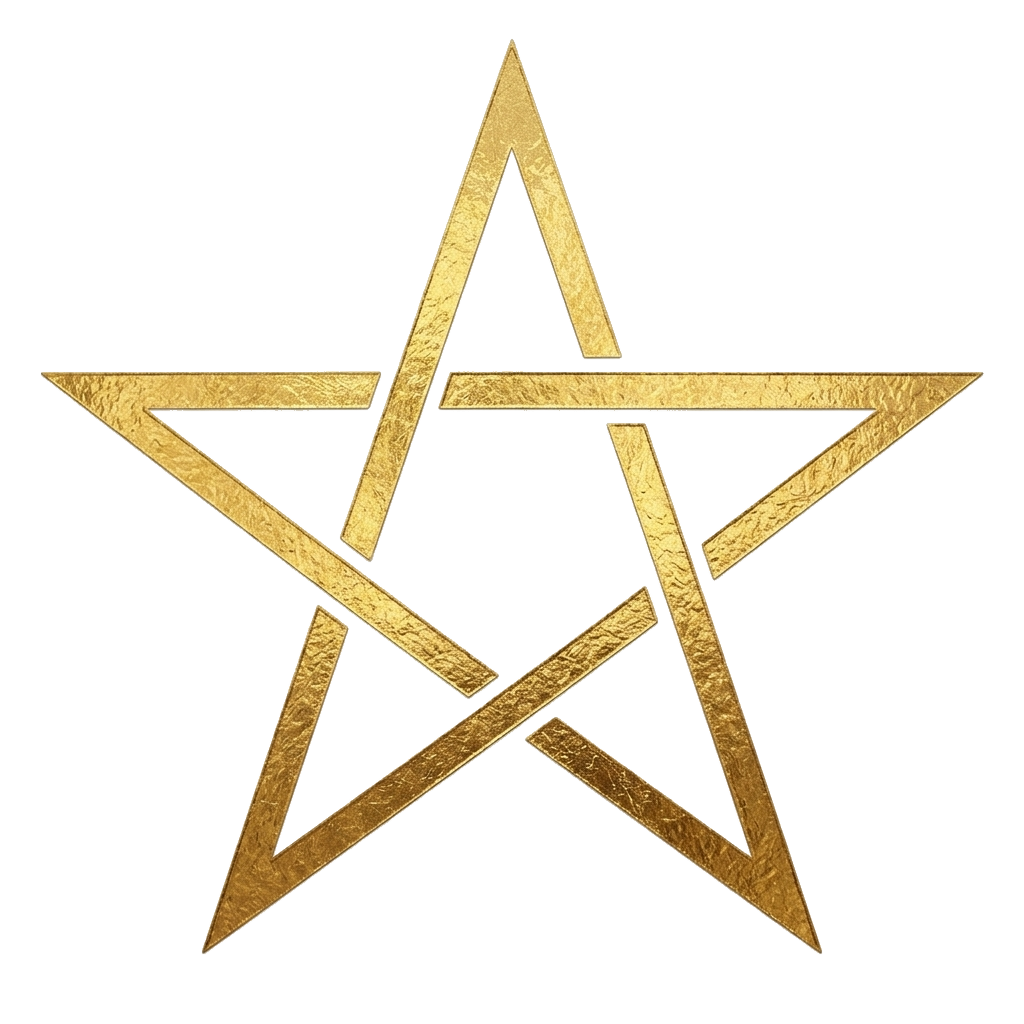
Pentagram
The five-pointed star — one of the most ancient and misunderstood symbols in human history, signifying the golden ratio, the five elements, the human microcosm, and the triumph of spirit over matter.
About Pentagram
The pentagram is a five-pointed star drawn with five straight strokes, one of the oldest and most universal geometric symbols in human civilization. Its earliest known appearances date to approximately 3000 BCE in Sumerian Uruk, where it functioned as a logogram in cuneiform script — the word UB, meaning 'corner' or 'region,' with the five points representing the cardinal directions plus the heavenly zenith. From these pragmatic Mesopotamian origins, the pentagram traveled through Egyptian, Greek, Roman, Islamic, Christian, and modern esoteric traditions, accumulating layer upon layer of meaning until it became one of the most symbolically dense figures in the Western canon.
What distinguishes the pentagram from other geometric symbols is its intimate relationship with the golden ratio (phi, approximately 1.618). Every intersection of the star's lines divides the segments in golden proportion, and the diagonals of the inner pentagon themselves form a smaller pentagram, creating an infinite recursive descent — a geometric fractal that the Pythagoreans recognized as a signature of divine intelligence embedded in nature. This mathematical property made the pentagram a bridge between the visible and invisible worlds: a symbol that was simultaneously rigorously rational and irreducibly mysterious.
No symbol in the Western tradition has undergone a more dramatic reversal of public perception. For millennia the pentagram was overwhelmingly positive — a sign of health, protection, cosmic harmony, and divine truth used by Christians, Muslims, and Jews alike. The association with evil is almost entirely a product of nineteenth-century occultism and twentieth-century popular culture. Eliphas Levi's 1855 illustration of Baphomet inscribed within an inverted pentagram, combined with Hollywood horror imagery, compressed thousands of years of sacred geometry into a single sinister caricature. Understanding the pentagram's true history is an exercise in recovering symbolic literacy from the distortions of moral panic.
Visual Description
Point-up pentagram. The standard orientation places a single point at the apex with two points at the base, forming a figure that resembles a human standing with arms and legs extended — the microcosmic human. In this orientation, spirit (the top point) presides over the four material elements (earth, water, fire, air at the remaining points), symbolizing the triumph of consciousness over matter, will over instinct, the higher self governing the lower nature. The Pythagoreans drew it in a single continuous stroke, beginning at the top and moving clockwise, a method that emphasizes the figure's unity — five lines, five angles, one unbroken gesture.
Point-down pentagram (inverted). When the pentagram is rotated so that two points face upward and one faces down, the symbolic valence shifts. Two horns rise above a single chin, evoking the head of a goat — an association that Eliphas Levi cemented in 1855 by inscribing the Goat of Mendes (Baphomet) within the inverted star in his Dogme et Rituel de la Haute Magie. In this reading, matter dominates spirit and the animal nature overrules the rational soul. However, the inverted pentagram is not universally negative: in some Wiccan traditions, the second-degree initiation uses an inverted pentagram to signify the descent of spirit into matter — incarnation, not corruption. Context determines meaning.
Pentacle (pentagram inscribed in a circle). When a circle encloses the pentagram, the resulting figure is properly called a pentacle. The circle represents wholeness, eternity, and the boundary between sacred and profane space. The five points touching the circle symbolize the five elements unified within the cosmic whole. In ceremonial magic, the pentacle is the primary protective symbol — drawn on parchment, inscribed on rings, traced in the air with a ritual blade. The circle contains and focuses the star's power while preventing unwanted forces from entering the enclosed space.
Golden ratio proportions. The pentagram is the geometric embodiment of phi (φ ≈ 1.618034). Each of the five isosceles triangles formed by the star's points has a base-to-side ratio of 1:φ. The diagonals of the inner regular pentagon intersect each other in golden ratio, and those diagonals form a smaller pentagram, whose inner pentagon's diagonals form a still smaller one, ad infinitum. This self-similar recursion makes the pentagram a natural fractal — a property the Pythagoreans found so significant they adopted it as the secret sign of their brotherhood, calling it Hygieia (health) and using it as a mark of mutual recognition.
Esoteric Meaning
The five elements. Across nearly every esoteric tradition that employs it, the pentagram maps the five classical elements. In the Western Hermetic tradition, the top point represents Spirit (Akasha, Quintessence), with Air and Water at the upper left and right, and Earth and Fire at the lower left and right. This arrangement encodes a precise metaphysical hierarchy: Spirit transcends and integrates the four material elements. In the Golden Dawn system, the Lesser Banishing Ritual of the Pentagram uses this elemental attribution to purify and consecrate ritual space — the magician traces pentagrams in all four cardinal directions, invoking archangels and sealing the working area with elemental balance.
The human microcosm — Agrippa's figure. Heinrich Cornelius Agrippa's 1533 De Occulta Philosophia contains the iconic image of a human figure inscribed within a pentagram, arms and legs extended to the five points, head at the apex. This is the homo ad pentagrammaton — the human being as a living pentagram, a microcosm reflecting the macrocosmic order. Each point corresponds to a limb or the head, and by extension to an element and a sense. Agrippa's figure directly influenced later depictions including Leonardo da Vinci's Vitruvian Man (inscribed in circle and square rather than pentagram) and became foundational to the Western magical understanding of the human body as a temple of cosmic forces.
The golden ratio and Pythagorean Hygieia. The Pythagorean brotherhood adopted the pentagram as their supreme symbol, calling it Hygieia — health, wholeness, the harmony that arises when all parts stand in right proportion. The five vertices were labeled with the Greek letters Υ-Γ-Ι-ΕΙ-Α, spelling Hugieia. For the Pythagoreans, the golden ratio was not merely a mathematical curiosity but evidence of a divine logos pervading nature — visible in the spiral of nautilus shells, the branching of plants, the proportions of the human body. The pentagram concentrated this cosmic proportion into a single figure, making the invisible order of reality visible to the initiated eye.
Planetary and alchemical correspondences. In medieval and Renaissance magic, each point of the pentagram was assigned a planet: Saturn, Jupiter, Mars, Venus, and Mercury — the five visible wandering stars that the ancients distinguished from the fixed stars. Alchemically, the pentagram represented the Quintessentia — the fifth essence beyond earth, water, fire, and air — the subtle substance that alchemists sought to extract through purification of matter. The Hermetic axiom 'as above, so below' finds geometric expression in the pentagram: the upper triangle (spirit descending) mirrors the lower figure (matter ascending), and their intersection is the human being standing at the crossroads of heaven and earth.
Kabbalistic and Hermetic attributions. In the Golden Dawn system and subsequent Thelemic traditions, the pentagram is associated with the Hebrew letter Shin (ש) and the formula of Yeheshuah (YHShVH) — the Tetragrammaton with Shin inserted, representing Spirit descending into the four-lettered name of God. Each point also maps to a sephirah on the Tree of Life, with the topmost point at Kether (Crown) and the remaining four at the elemental sephiroth. Aleister Crowley expanded this system extensively, assigning the pentagram to the Microcosm (the individual will) as distinct from the hexagram (the Macrocosm, the universal order), creating a complementary pair that structures all ceremonial work.
Exoteric Meaning
The inverted pentagram and Satanic misconception. The modern association between the pentagram and Satanism is largely a twentieth-century phenomenon with roots in Eliphas Levi's nineteenth-century illustrations. Levi drew a sharp moral distinction between the upright pentagram (which he called the sign of the Microcosm, representing human will aligned with divine purpose) and the inverted pentagram (which he associated with the Goat of Mendes and black magic). Anton LaVey adopted the inverted pentagram with a goat's head — the 'Sigil of Baphomet' — as the symbol of the Church of Satan in 1966, and Hollywood horror films of the 1970s and 1980s cemented the equation of any pentagram with diabolism in the popular imagination. This flattening erases millennia of positive sacred use.
Military and governmental usage. Far from its occult associations, the pentagram (usually as a five-pointed star) is among the most common symbols in military and national iconography. The United States military uses a white five-pointed star on virtually all its equipment and insignia — tanks, aircraft, uniforms — a convention dating to the American Revolution. The Congressional Medal of Honor is an inverted pentagram. The five-pointed star appears on the flags of over forty nations, including the United States, the European Union, Morocco, Ethiopia, China, Turkey, Israel (as part of the hexagram), and many others. In this secular context, the star typically represents sovereignty, unity, or the guiding light of the state.
Christian usage — historical. Before the modern occult revival, the pentagram was a thoroughly Christian symbol. In medieval Christianity, the five points represented the five wounds of Christ (hands, feet, and side), and the star was carved into church architecture, embroidered on vestments, and used in manuscript illumination as a protective device. The fourteenth-century English poem Sir Gawain and the Green Knight devotes an entire stanza to the 'pentangle' on Gawain's shield, explicitly linking its five points to five sets of Christian virtues — the five senses, the five fingers, the five wounds, the five joys of Mary, and the five knightly virtues of generosity, fellowship, purity, courtesy, and compassion. This is perhaps the most detailed symbolic exegesis of the pentagram in all of medieval literature.
Islamic geometry. The five-pointed star features prominently in Islamic geometric art and architecture, where it is known as the khamsa (five). It appears in the intricate tile patterns (zellige) of Moroccan mosques, the carved stucco of the Alhambra, and the metalwork of Mamluk Egypt. In Islamic context, five resonates with the Five Pillars of Islam, the five daily prayers, and the five members of the Prophet's household (Ahl al-Bayt). The Ottoman Empire used the five-pointed star alongside the crescent moon, a combination that persists on the flags of Turkey, Pakistan, Tunisia, Algeria, and other Muslim-majority nations. The star's geometric perfection aligned with Islamic theological aesthetics, which see mathematical order as a reflection of divine unity (tawhid).
Usage
Ritual and ceremonial magic. The pentagram is the single most important ritual symbol in the Western magical tradition. The Lesser Banishing Ritual of the Pentagram (LBRP), developed by the Hermetic Order of the Golden Dawn in the 1880s, remains the foundational daily practice for ceremonial magicians worldwide. The practitioner faces each cardinal direction in turn, traces a pentagram in the air with a ritual implement (dagger or wand), vibrates a divine name, and invokes an archangel. The Supreme Ritual of the Pentagram extends this practice with elemental-specific pentagrams — each element has its own invoking and banishing form, traced beginning from the point assigned to that element. Thelemic practitioners adapted these rituals with modified god-names and gestures, but the pentagram's centrality persists.
Wiccan and Neopagan practice. In Wicca and related Neopagan traditions, the pentacle (circled pentagram) is one of the primary altar tools, typically a flat disk inscribed or painted with the star. It represents the element of Earth and is used to consecrate objects, as a surface for preparing ritual items, and as a general protective talisman. Wiccans wear pentacle jewelry openly as a badge of religious identity — the upright pentagram representing the five elements with spirit predominant. The three degrees of Wiccan initiation each have associated pentagram positions: first degree (upright), second degree (inverted, representing descent of spirit into matter), third degree (upright with additional symbolism). Drawing pentagrams at the quarters is a standard element of Wiccan circle-casting.
Talismanic and protective use. Across cultures and centuries, the pentagram has functioned as an apotropaic (evil-averting) device. In ancient Babylon, pentagrams were inscribed at the entrances to storerooms to protect goods. Medieval Europeans carved pentagrams into doorways, window frames, and cradles to ward off evil spirits — examples survive in vernacular architecture across England, Germany, and Scandinavia. In German folklore, the pentagram was called the Drudenfuss (Drude's foot), believed to trap night-demons. Goethe incorporated this tradition into Faust: Mephistopheles is initially trapped in Faust's study because a pentagram on the threshold blocks his exit, though he escapes through a gap where one line is imperfectly drawn — a vivid literary illustration of the symbol's binding power and the consequences of imprecise execution.
Mathematical and scientific contexts. Beyond spiritual and ceremonial use, the pentagram has played a significant role in mathematics, science, and design. Euclid's Elements (Book IV, Proposition 11) provides a construction for the regular pentagon, from which the pentagram derives. The golden ratio embedded in the pentagram has been studied continuously from the Pythagoreans through Renaissance mathematicians (Luca Pacioli's De Divina Proportione, illustrated by Leonardo da Vinci) to modern fractal geometry and chaos theory. The pentagram's five-fold symmetry appears in nature — starfish, many flowers, the cross-section of an apple — and in chemistry, where the carbon rings in organic molecules sometimes exhibit pentagonal geometry. The Penrose tiling, discovered in the 1970s, uses pentagonal symmetry to create aperiodic patterns that anticipated the discovery of quasicrystals.
In Architecture
Sir Gawain and the Green Knight. The most elaborate literary treatment of the pentagram in medieval literature appears in this anonymous fourteenth-century English alliterative romance. The poet devotes stanza 27 — an extraordinary digression of nearly 50 lines — to explaining why Gawain bears the 'pentangle' (the poet's own coinage) on his shield. Each of the five points is linked to a group of five virtues: the five senses (through which Gawain never fails), the five fingers (which never falter), the five wounds of Christ (Gawain's courage), the five joys of Mary (painted inside the shield), and the five knightly virtues of fraunchyse (generosity), felawshyp (fellowship), clannes (purity), cortaysye (courtesy), and pite (compassion). The poet emphasizes the 'endless knot' quality — that each line connects to every other, making the five fives an indivisible whole. This is the most theologically and symbolically sophisticated deployment of the pentagram in medieval literature.
Gothic churches and cathedrals. Pentagrams appear throughout Gothic ecclesiastical architecture, carved into stone, worked into stained glass, and incorporated into floor plans. The west rose window of Amiens Cathedral features a prominent pentagram. Pentagrams are carved into column capitals and choir screen tracery at Chartres, and they appear in the stonework of numerous English parish churches. In these contexts, the five points almost invariably represent the five wounds of Christ or the five-fold mysteries of the faith. Far from indicating any occult influence, these pentagrams reflect mainstream medieval Christian iconography — the symbol's association with evil would not develop for several more centuries.
Washington, D.C. The street plan of Washington, D.C., laid out by Pierre Charles L'Enfant in 1791 with revisions by Andrew Ellicott, contains an inverted pentagram formed by the intersection of Connecticut Avenue, Vermont Avenue, K Street, Massachusetts Avenue, and Rhode Island Avenue, with its southern point at the White House. Conspiracy theorists have long cited this as evidence of Masonic or occult influence in the nation's founding. The historical reality is more nuanced: L'Enfant was not a Freemason (though George Washington and many founding fathers were), and the 'pentagram' is actually incomplete — Rhode Island Avenue does not fully close the figure. Nevertheless, the prevalence of five-pointed star symbolism in American national iconography (the Great Seal, military insignia, the flag's fifty stars) does reflect the Enlightenment-era appreciation for geometric harmony that Freemasonry helped transmit from classical antiquity.
Pompeii, Babylon, and the ancient world. Archaeological evidence of the pentagram in architecture stretches back millennia. Pentagram graffiti appears on the walls of Pompeii. Babylonian clay tablets and jar handles bear pentagram stamps, likely as inventory markers or seals of authority. In ancient Greece, pentagrams appear on coins from the city of Pitane (in Mysia) dating to the fourth century BCE. The Pythagorean community at Croton reportedly used the pentagram as an identifying mark on their dwellings and correspondence. These ancient architectural and material culture appearances predate any association with magic or religion — the pentagram's original function was mundane, mathematical, or civic, and its spiritual meanings accrued over centuries of contemplation.
Significance
The pentagram occupies a unique position in the history of symbols: it is simultaneously one of the oldest, one of the most mathematically rigorous, and one of the most emotionally polarizing signs in the human repertoire. Its significance lies in its capacity to bridge domains that modernity tends to separate — mathematics and mysticism, geometry and theology, the rational and the numinous. When the Pythagoreans recognized that the golden ratio pervades both the pentagram and the living world — spiraling in shells, branching in plants, proportioning the human body — they were not confusing science with religion. They were pointing to something that modern chaos theory and fractal geometry have independently confirmed: that self-similar patterns recur across scales of nature in ways that suggest deep structural principles underlying apparent complexity.
The pentagram's cultural history is also a case study in symbolic hijacking. A figure that served as a Christian protective device for over a thousand years became, within roughly a century of Eliphas Levi's 1855 illustration, the primary icon of Satanism in the Western popular imagination. This transformation reveals how symbols function: not as carriers of fixed meaning, but as vessels that communities fill with their own anxieties, aspirations, and cosmologies. The 'evil pentagram' is a modern invention overlaid onto an ancient form. Recovering the pentagram's full history — Sumerian, Pythagorean, Christian, Islamic, Hermetic, scientific — is an act of cultural archaeology that restores depth to a symbol that popular culture has flattened into a cliche.
For practitioners in living traditions — Wiccan, Hermetic, Thelemic, and others — the pentagram remains a working tool, not a historical artifact. The daily practice of the Lesser Banishing Ritual of the Pentagram, performed by thousands of practitioners worldwide, treats the symbol as a functional technology for ordering consciousness and clarifying intention. Whether this function is understood psychologically (as a focusing technique for the mind), energetically (as a manipulation of subtle forces), or spiritually (as an invocation of divine names and archangelic presences), the pentagram's practical centrality in Western esotericism is undiminished. It endures because it works — and because its mathematical elegance ensures that each fresh encounter with the symbol reveals new layers of proportion, recursion, and meaning.
Connections
Hermetic Order of the Golden Dawn — The Golden Dawn systematized the pentagram's ritual use more thoroughly than any previous organization. Their Lesser and Supreme Rituals of the Pentagram, elemental attributions, and integration of the pentagram with the Tree of Life became the standard framework for all subsequent Western ceremonial magic. Every modern magical order that uses the pentagram — from Thelema to the Builders of the Adytum to chaos magic — works with variations of Golden Dawn pentagram technique.
Pythagorean Brotherhood — The Pythagoreans transformed the pentagram from a Mesopotamian administrative mark into a symbol of cosmic harmony and divine proportion. Their recognition of the golden ratio within the star's geometry, their adoption of the pentagram as the brotherhood's secret sign (Hygieia), and their understanding of number as the substrate of reality laid the philosophical foundation for every subsequent esoteric interpretation of the symbol.
Freemasonry — The five-pointed star (the 'Blazing Star') is a central symbol in Masonic lodges, typically displayed on the floor of the lodge room. In Masonic symbolism, it represents divine providence, the five points of fellowship, and geometric perfection. The Masonic transmission of Pythagorean geometry through the medieval stonemason guilds is one of the principal channels through which the pentagram's sacred mathematical associations survived from antiquity into the modern era.
Sacred Geometry — The pentagram is one of the foundational figures of sacred geometry, alongside the circle, the vesica piscis, the hexagram, and the Flower of Life. Its five-fold symmetry is unique among regular star polygons in that it cannot tile the Euclidean plane periodically — a property that connects it to Penrose tilings, quasicrystals, and the mathematical frontier of aperiodic order. The pentagram demonstrates that sacred geometry is not merely decorative mysticism but engages with genuine mathematical structures of considerable depth and ongoing scientific relevance.
Further Reading
Historical and scholarly works: Eliphas Levi, Dogme et Rituel de la Haute Magie (1855) — the source of the modern inverted-pentagram/Baphomet association and a foundational text of the French occult revival. Heinrich Cornelius Agrippa, De Occulta Philosophia (1533) — contains the famous figure of man inscribed in the pentagram. Israel Regardie, The Golden Dawn (1937) — the definitive reference for Golden Dawn pentagram rituals and elemental attributions. Mario Livio, The Golden Ratio: The Story of Phi (2002) — an accessible mathematical history of phi and its relationship to the pentagram, from the Pythagoreans to modern science.
Primary texts and literary sources: The anonymous Sir Gawain and the Green Knight (c. 1375), ed. J.R.R. Tolkien and E.V. Gordon — the most detailed medieval exegesis of the pentagram's Christian symbolism. Goethe, Faust, Part One (1808) — the famous scene where Mephistopheles is trapped by the pentagram on Faust's threshold. The Key of Solomon (Clavicula Salomonis) — the most influential medieval grimoire, extensively employing pentagram talismans for spirit work.
Practical and contemporary works: Donald Michael Kraig, Modern Magick (1988) — a widely used practical manual that teaches the Lesser Banishing Ritual of the Pentagram step by step. Scott Cunningham, Wicca: A Guide for the Solitary Practitioner (1988) — covers Wiccan pentacle use and circle-casting. Lon Milo DuQuette, The Magick of Aleister Crowley (2003) — explains Thelemic adaptations of pentagram rituals. John Michael Greer, The New Encyclopedia of the Occult (2003) — comprehensive reference entries on the pentagram, pentacle, and related symbols.
Frequently Asked Questions
What does the Pentagram symbolize?
The five elements. Across nearly every esoteric tradition that employs it, the pentagram maps the five classical elements. In the Western Hermetic tradition, the top point represents Spirit (Akasha, Quintessence), with Air and Water at the upper left and right, and Earth and Fire at the lower left and right. This arrangement encodes a precise metaphysical hierarchy: Spirit transcends and integrates the four material elements. In the Golden Dawn system, the Lesser Banishing Ritual of the Pentagram uses this elemental attribution to purify and consecrate ritual space — the magician traces pentagrams in all four cardinal directions, invoking archangels and sealing the working area with elemental balance.
Where does the Pentagram originate?
The Pentagram originates from the Mesopotamian (earliest known use as Sumerian logogram); Pythagorean (as mathematical/mystical symbol) tradition. It dates to c. 3000 BCE — present. It first appeared in Mesopotamia, Greece, Europe, worldwide.
How is the Pentagram used today?
Ritual and ceremonial magic. The pentagram is the single most important ritual symbol in the Western magical tradition. The Lesser Banishing Ritual of the Pentagram (LBRP), developed by the Hermetic Order of the Golden Dawn in the 1880s, remains the foundational daily practice for ceremonial magicians worldwide. The practitioner faces each cardinal direction in turn, traces a pentagram in the air with a ritual implement (dagger or wand), vibrates a divine name, and invokes an archangel. The Supreme Ritual of the Pentagram extends this practice with elemental-specific pentagrams — each element has its own invoking and banishing form, traced beginning from the point assigned to that element. Thelemic practitioners adapted these rituals with modified god-names and gestures, but the pentagram's centrality persists.