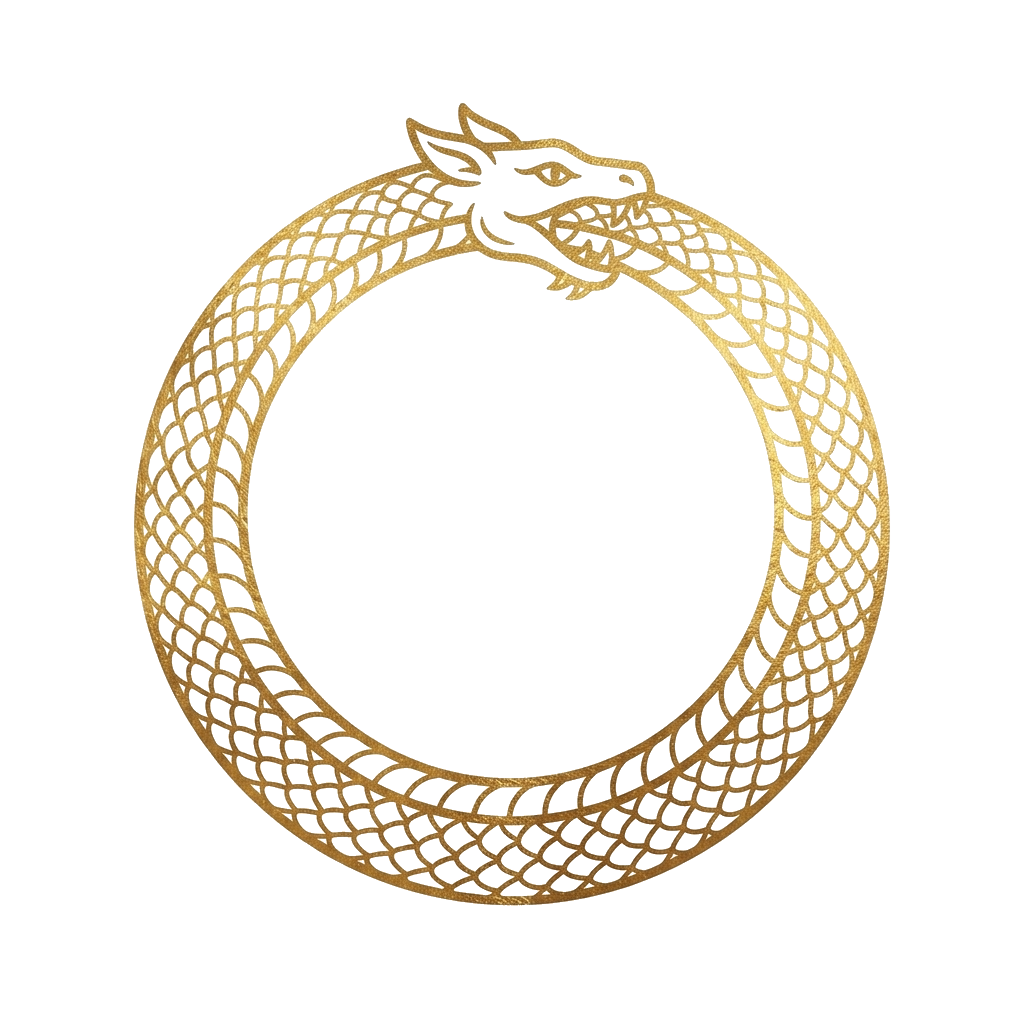
Ouroboros
The self-devouring serpent — humanity's oldest symbol of eternal return, self-renewal, and the unity of all opposites.
About Ouroboros
A serpent or dragon devouring its own tail, forming an unbroken circle — the Ouroboros first appears in the tomb of Tutankhamun (14th century BCE) on the second gilded shrine, where two serpents encircle the pharaoh's mummiform figure. The image first appears in ancient Egypt around 1600 BCE and recurs with striking consistency across civilizations that had no direct contact with one another, suggesting it arises from something fundamental in human consciousness rather than mere cultural transmission. The word itself derives from the Greek οὐροβόρος, from οὐρά (oura, "tail") and βόρος (boros, "eating"), though the symbol predates its Greek name by over a millennium. In its most essential form, the Ouroboros depicts the paradox of self-consumption and self-renewal as a single, continuous act — destruction and creation revealed as one motion.
The earliest known depiction appears in the Enigmatic Book of the Netherworld, found in the tomb of Tutankhamun (c. 1323 BCE), where two serpents holding their tails in their mouths enclose the head and feet of a mummy-like figure representing the unified Ra-Osiris. This funerary context is significant: from its very first appearance, the Ouroboros was associated with the mystery of death and rebirth, the cyclical journey of the sun through the underworld, and the eternal return of life from apparent dissolution. The symbol appears throughout the Egyptian Amduat texts and was later adopted by Phoenician culture before passing into Greek philosophical and mystical traditions, where it became central to Hermetic and Orphic thought.
Across the ancient world, parallel serpent-circle images emerged independently. In Norse mythology, Jörmungandr — the Midgard Serpent — encircles the entire world ocean, holding its tail in its mouth, maintaining the boundary between cosmos and chaos until Ragnarök. Hindu and Buddhist traditions depict cosmic serpents in circular or coiled forms, most notably the Kundalini serpent coiled at the base of the spine. Chinese tradition features the dragon swallowing its tail as an emblem of the Tao's self-completing nature. In Mesoamerican cultures, Quetzalcoatl — the feathered serpent — was sometimes depicted in circular, self-consuming form. The Ouroboros is not one tradition's symbol borrowed by others; it is a universal image that humanity keeps rediscovering.
Visual Description
In its most iconic form, the Ouroboros depicts a serpent or dragon curved into a perfect circle, its jaws clamped upon the tip of its own tail in an act of perpetual self-consumption. The creature's body forms an unbroken ring with no beginning or end — a visual negation of linearity. In Egyptian renderings, the serpent is often relatively naturalistic, sometimes appearing as two serpents — one light, one dark — encircling a central figure, emphasizing the duality-within-unity theme. Greek alchemical manuscripts, particularly the Chrysopoeia of Cleopatra (c. 3rd century CE), show the Ouroboros as a thicker, more stylized serpent, frequently half-black and half-white or half-green and half-red, with the inscription hen to pan ("the all is one") at its center. This bicolor rendering directly prefigures the yin-yang symbol and emphasizes the union of opposites — life and death, creation and destruction, masculine and feminine, the volatile and the fixed.
Medieval and Renaissance alchemical illustrations expanded the visual vocabulary considerably. The serpent sometimes becomes a winged dragon, adding the element of air and spirit to the earthy serpent. Some depictions show the Ouroboros as a figure-eight or lemniscate form — two loops rather than one — which connects it to the infinity symbol and the double nature of mercury in alchemical theory. In Norse art, Jörmungandr is rendered as an enormous sea serpent, often elaborately interlaced in the knotwork style, encircling the disc of Midgard. Hindu and Buddhist depictions frequently show the serpent in a more coiled, three-dimensional form — spiraling rather than simply circular — which connects to the Kundalini serpent's upward movement through the subtle body. In Mesoamerican art, the feathered serpent Quetzalcoatl in circular form adds plumage and elaborate headdress elements. Modern representations tend toward clean, geometric renderings — the serpent reduced to its essential circular form, sometimes rendered as a simple ring of scales.
Esoteric Meaning
The Ouroboros is not merely a symbol of cycles or eternity — it is a direct pointing-out instruction regarding the nature of consciousness itself. The serpent consuming its own tail enacts the fundamental paradox that awareness is both the observer and the observed, the knower and the known, the subject that creates the object which in turn defines the subject. This is the mystery at the heart of every contemplative tradition: the seeker is the sought. In Hermetic philosophy, this is expressed as the Monad — the One that knows itself by dividing into knower and known, then reuniting in the act of self-knowledge. The Ouroboros is this process made visible. The Emerald Tablet's declaration that "its father is the Sun and its mother the Moon" describes exactly the alchemical Ouroboros: the solar (conscious, active) and lunar (unconscious, receptive) principles generating each other in an endless creative circuit.
In alchemical tradition, the Ouroboros represents the prima materia — the chaotic, undifferentiated substance that is both the starting point and the hidden goal of the Great Work. This is the most counterintuitive of its teachings: the raw material of transformation is already the perfected result, merely unrecognized. The entire alchemical opus — nigredo (blackening), albedo (whitening), citrinitas (yellowing), rubedo (reddening) — is a circular journey that returns the practitioner to exactly where they started, but with the eyes of understanding opened. The Ouroboros thus encodes the esoteric principle that spiritual practice does not create something new but reveals what was always already present. This corresponds precisely to the Vedantic teaching of tat tvam asi — "thou art that" — and to the Zen understanding that samsara and nirvana are not two different places but two ways of seeing the same reality.
The Ouroboros also carries profound teachings about the relationship between time and eternity. The serpent's body traces the circle of time — the seasons, the cycles of birth and death, the wheel of samsara — while the point where mouth meets tail is the eternal now, the gap between past and future where cyclical time dissolves into timeless presence. In Gnostic cosmology, this point is the passage through the boundary of the Archons, the escape from the determinism of the planetary spheres. In Kundalini yoga, it is the moment when the serpent power completes its circuit through all seven chakras and dissolves the illusion of separation between individual and cosmic consciousness. Every tradition that has worked with the Ouroboros arrives at this same recognition: the circle is not a trap but a teaching device, and the way out is not to break the circle but to realize that you are the circle — that the one who travels and the path traveled and the destination are a single, undivided reality.
Exoteric Meaning
At the most accessible level, the Ouroboros represents the cycle of life, death, and renewal — the observation that all things in nature move in circles. Seasons return, generations repeat the patterns of their predecessors, empires rise and fall, and what is consumed by time is eventually regenerated from the same substance. It is a symbol of eternity and immortality, conveying the intuition that although individual forms perish, the underlying life force is indestructible and endlessly self-renewing. In popular culture and common understanding, the Ouroboros functions as an emblem of infinity, wholeness, and the interconnectedness of all things — the recognition that every ending contains the seed of a new beginning, and that the universe is a self-sustaining system requiring no external creator or sustainer to perpetuate itself.
Usage
The Ouroboros has been employed across an extraordinary range of practical, ceremonial, and institutional contexts throughout history. In alchemical practice, it was the supreme emblem of the opus circulare — the circular work of transformation — and appeared on nearly every significant alchemical manuscript from the Hellenistic period through the Renaissance. The Chrysopoeia of Cleopatra (c. 3rd century CE), one of the oldest surviving alchemical texts, places a half-black, half-white Ouroboros at the center of its diagrammatic instructions. Michael Maier's Atalanta Fugiens (1618) and the Rosarium Philosophorum feature the Ouroboros prominently as the alpha and omega of the alchemical process. It appeared on alchemical vessels, laboratory doors, and title pages as both a protective talisman and a reminder of the work's essential nature.
In Freemasonry and related fraternal orders, the Ouroboros became a prominent symbol from at least the 18th century onward, representing eternity, the unity of the lodge, and the cyclical nature of the degrees of initiation. It appears on Masonic rings, aprons, tracing boards, and temple decorations, often encircling other symbols such as the compass and square or the all-seeing eye. The Theosophical Society incorporated the Ouroboros into its official seal, surrounding a Star of David, ankh, swastika (in its original sacred meaning), and the Aum symbol — positioning the self-devouring serpent as the container for all spiritual traditions.
In heraldry and statecraft, the Ouroboros has served as a national and institutional emblem. It appears on the coat of arms of the Italian city of Catanzaro, in Greek military insignia, and on the emblems of various European noble houses. The United Nations' International Year of Peace (1986) medal featured an Ouroboros. In medicine, the Ouroboros is sometimes conflated with or used alongside the Caduceus and the Rod of Asclepius, particularly in pharmaceutical contexts where the cycle of disease and healing is emphasized. Perhaps most unexpectedly, the Ouroboros entered the history of modern science when the German chemist August Kekulé reported in 1865 that a daydream of a snake seizing its own tail led him to propose the circular structure of the benzene molecule — a foundational discovery in organic chemistry that shaped the entire field.
In Architecture
The Ouroboros appears in architectural contexts spanning from ancient temples to modern public buildings, though often in subtle or easily overlooked positions that reward careful observation. In Egypt, Ouroboros motifs appear in temple carvings at Dendera, Edfu, and Philae, where they typically frame or enclose other divine figures, reinforcing their cosmological function as the boundary of the manifest world. The ceiling of the Hathor Temple at Dendera features serpentine circular motifs in its famous zodiac relief. In Roman-period architecture throughout the Mediterranean, the Ouroboros appears on mosaic floors, doorway lintels, and sarcophagi — a notable example survives in the floor mosaics at the Roman villa at Lullingstone in Kent, England, where a chi-rho monogram is encircled by an Ouroboros, blending pagan and Christian symbolism.
In medieval and Renaissance Europe, the Ouroboros appears in cathedral stone carvings, manuscript illuminations painted on church walls, and alchemical laboratories. The facades of Gothic cathedrals — particularly those at Chartres, Notre-Dame de Paris, and Amiens — incorporate serpentine circular motifs in their tympana and column capitals, often in proximity to images of the Last Judgment, reinforcing the cyclical eschatology that the Ouroboros represents. Alchemical workshops and apothecaries frequently displayed the symbol above their doors or on their signboards. In Masonic temple architecture from the 18th century onward, the Ouroboros appears on ceiling medallions, tile floors, and over entrance arches — fine examples survive in Masonic halls across Britain and the northeastern United States, including the Grand Lodge in Philadelphia. In the modern era, the Ouroboros has been incorporated into university buildings, scientific institutions, and public monuments. The Kekulé Monument in Bonn, Germany commemorates the benzene discovery with serpentine imagery. The symbol also appears in the architectural ornament of several Theosophical Society buildings, including Adyar headquarters in Chennai, India, where it forms part of the organization's carved seal above the main hall entrance.
Significance
A serpent devouring its own tail — the image is so economical that its meaning registers before the intellect engages. The Ouroboros encodes the entire mystery of cyclical existence in a single gesture: endings become beginnings, destruction feeds creation, and apparent opposites resolve into unity. It appears at the foundations of Western alchemy, at the heart of Hermetic philosophy, within the cosmologies of Norse and Hindu civilization, and even in the structure of modern organic chemistry (August Kekulé's famous dream of the benzene ring). Its persistence across millennia and cultures marks it as what Carl Jung called an archetype of the collective unconscious — not merely a cultural artifact but a direct expression of a deep psychic truth about the nature of reality.
The Ouroboros refuses to resolve into a simple meaning. It is simultaneously a symbol of eternity and of temporal cycles, of wholeness and of the void, of the highest spiritual attainment and the most primordial matter. In alchemical tradition, it represents both the prima materia — the raw, undifferentiated chaos from which all things arise — and the lapis philosophorum, the perfected Philosopher's Stone at the end of the Great Work. This paradox is the point: the Ouroboros teaches that the beginning and the end are the same substance, viewed from different stages of the transformative journey. Every wisdom tradition that has worked seriously with this symbol has arrived at the same conclusion — that the deepest truth about existence is circular, not linear, and that what appears to be a journey outward is always, simultaneously, a return to the source.
Connections
The Ouroboros connects to virtually every major current in the world's wisdom traditions, serving as a visual key that unlocks correspondences between systems separated by thousands of miles and years. In Hermetic tradition, the Ouroboros is the primary glyph of the axiom "as above, so below" from the Emerald Tablet — the serpent's body traces the boundary where inner and outer, macrocosm and microcosm, meet and merge. The Corpus Hermeticum describes the cosmos as a living, self-sustaining organism, and the Ouroboros is its perfect emblem. In Gnostic cosmology, the Ouroboros — sometimes called the Agathos Daimon — marks the boundary of the material world, the edge of the Demiurge's creation, and simultaneously the threshold through which the pneumatic soul must pass to return to the Pleroma.
The serpent eating its tail resonates powerfully with the Hindu concept of Kundalini — the coiled serpent energy sleeping at the base of the spine that, when awakened, rises through the chakra system to unite with cosmic consciousness at the crown. This is the Ouroboros enacted within the body: the serpent completing its circuit, the individual merging with the universal. In yogic philosophy, this maps directly to the union of Shakti and Shiva — the dynamic and static principles of reality consuming each other in the bliss of non-dual awareness. Norse tradition encodes the same principle in Jörmungandr, whose release of its own tail triggers Ragnarök — the dissolution of the world that precedes its renewal — an exact parallel to the alchemical solve et coagula.
In alchemical practice, the Ouroboros is arguably the single most important symbol. It appears on the earliest Greek alchemical manuscripts (the Chrysopoeia of Cleopatra, c. 3rd century CE) with the inscription hen to pan — "the all is one." It represents the circular nature of the alchemical opus: the substance being transformed is also the agent of transformation. The Caduceus — the twin serpents of Hermes — can be understood as the Ouroboros split into its polar components, the ascending and descending currents that must be united. In Chinese Taoist thought, the symbol maps to the dynamic interplay of yin and yang — the familiar taijitu symbol is, in essence, an Ouroboros seen from above, the two polarities chasing and consuming each other in perpetual rotation. The Buddhist wheel of samsara shares the same deep structure: the cycle of birth, death, and rebirth that is also, when understood correctly, the doorway to liberation.
Further Reading
- The Book of Symbols: Reflections on Archetypal Images — Archive for Research in Archetypal Symbolism (ARAS). Comprehensive Jungian analysis of the Ouroboros and its psychological significance.
- Mysterium Coniunctionis — Carl G. Jung (1955-56). Jung's magnum opus on alchemical symbolism, with extensive treatment of the Ouroboros as the symbol of individuation and psychic wholeness.
- The Origins of Alchemy in Graeco-Roman Egypt — Jack Lindsay (1970). Detailed examination of the Ouroboros in early alchemical manuscripts including the Chrysopoeia of Cleopatra.
- Aion: Researches into the Phenomenology of the Self — Carl G. Jung (1951). Traces the Ouroboros through Gnostic, alchemical, and Christian symbolism as an image of the Self.
- The Serpent Power: The Secrets of Tantric and Shaktic Yoga — Arthur Avalon (Sir John Woodroffe, 1919). Classic study of Kundalini and the serpent symbolism in Hindu tantra.
- The Greek Magical Papyri in Translation — Hans Dieter Betz, ed. (1986). Primary sources showing the Ouroboros in Greco-Egyptian magical practice.
- Alchemy and Mysticism — Alexander Roob (1997). Rich visual compendium of alchemical imagery with extensive Ouroboros representations from medieval and Renaissance manuscripts.
Frequently Asked Questions
What does the Ouroboros symbolize?
The Ouroboros is not merely a symbol of cycles or eternity — it is a direct pointing-out instruction regarding the nature of consciousness itself. The serpent consuming its own tail enacts the fundamental paradox that awareness is both the observer and the observed, the knower and the known, the subject that creates the object which in turn defines the subject. This is the mystery at the heart of every contemplative tradition: the seeker is the sought. In Hermetic philosophy, this is expressed as the Monad — the One that knows itself by dividing into knower and known, then reuniting in the act of self-knowledge. The Ouroboros is this process made visible. The Emerald Tablet's declaration that "its father is the Sun and its mother the Moon" describes exactly the alchemical Ouroboros: the solar (conscious, active) and lunar (unconscious, receptive) principles generating each other in an endless creative circuit.
Where does the Ouroboros originate?
The Ouroboros originates from the Ancient Egyptian (earliest known depiction in the Enigmatic Book of the Netherworld, tomb of Tutankhamun, c. 1323 BCE) tradition. It dates to c. 1600 BCE — present. It first appeared in Egypt, Greece, Scandinavia, India, China, Europe.
How is the Ouroboros used today?
The Ouroboros has been employed across an extraordinary range of practical, ceremonial, and institutional contexts throughout history. In alchemical practice, it was the supreme emblem of the opus circulare — the circular work of transformation — and appeared on nearly every significant alchemical manuscript from the Hellenistic period through the Renaissance. The Chrysopoeia of Cleopatra (c. 3rd century CE), one of the oldest surviving alchemical texts, places a half-black, half-white Ouroboros at the center of its diagrammatic instructions. Michael Maier's Atalanta Fugiens (1618) and the Rosarium Philosophorum feature the Ouroboros prominently as the alpha and omega of the alchemical process. It appeared on alchemical vessels, laboratory doors, and title pages as both a protective talisman and a reminder of the work's essential nature.