Om
The primordial sound of creation — the most sacred syllable in Hinduism, Buddhism, and Jainism, encoding the entire structure of consciousness and reality in a single vibration.
About Om
Om (also written Aum, and rendered in Devanagari as ॐ) is the seed syllable of Indian spirituality — the sound that, according to Vedic teaching, preceded creation itself. It is not merely a word or a sound — it is understood to be the vibratory substrate of the cosmos itself, the sonic seed from which all of manifest reality unfolds and into which it ultimately dissolves. Every major tradition born on the Indian subcontinent treats Om as foundational: the Vedas open with it, the Upanishads devote entire treatises to its analysis, the Yoga Sutras name it as the direct signifier of Ishvara, and the Buddhist and Jain canons absorbed it into their own liturgical and meditative frameworks.
The syllable functions simultaneously as mantra, cosmological map, and contemplative technology. When chanted aloud, it moves through three phonetic phases — A (ah), U (oo), and M (mm) — each mapped to a distinct state of consciousness, a cosmic function, and a layer of the self. The silence that follows the final vibration points to a fourth dimension beyond all three: turiya, pure awareness without object. This four-fold architecture, elaborated most precisely in the Mandukya Upanishad, makes Om not just a sacred sound but a complete epistemological and ontological framework compressed into a single breath.
Across millennia, Om has migrated far beyond the borders of India. It appears in Tibetan Buddhist practice (often as the opening syllable of Om Mani Padme Hum), in Sikh scripture (as Ik Onkar, the opening of the Guru Granth Sahib), in Jain liturgy, and in virtually every school of yoga practiced worldwide. Its visual glyph — the Devanagari character ॐ — has become one of the most universally recognized spiritual symbols on Earth, appearing on temple walls, meditation halls, jewelry, and sacred art across dozens of cultures.
The philosophical depth of Om is inexhaustible. It is identified with shabda brahman — the absolute reality as sound — and with pranava, the cosmic hum that sustains all vibration. The Chandogya Upanishad calls it the udgitha, the essence of the Sama Veda's chant. The Yoga Sutras (1.27-28) declare it the word (vachaka) of Ishvara, and that its repetition (japa) with contemplation of its meaning leads to the dissolution of all obstacles on the spiritual path. Patanjali does not present this as metaphor — he presents it as direct technology for the transformation of consciousness.
Visual Description
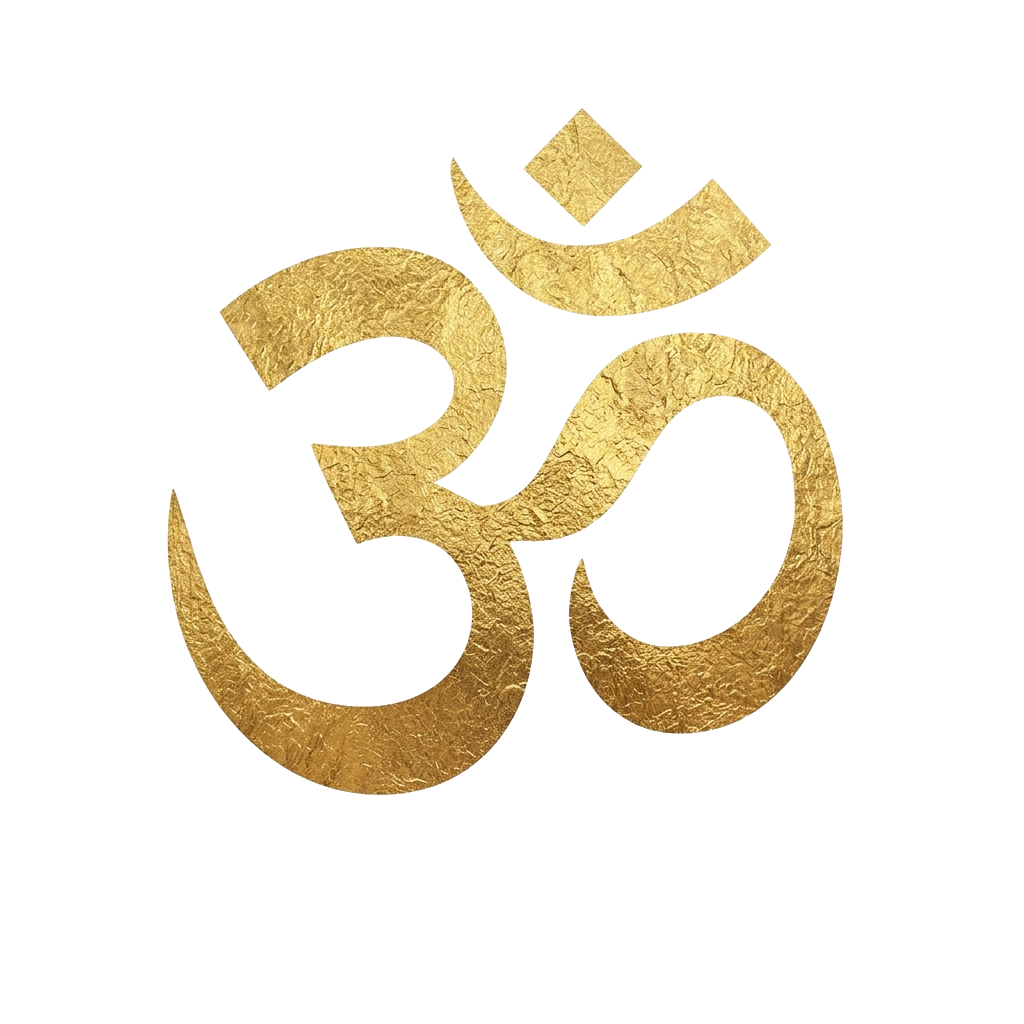
The most widely recognized form of Om is the Devanagari character ॐ, a flowing ligature composed of four distinct visual elements, each carrying symbolic weight. The large lower curve, sweeping from left to right and curling upward, represents the waking state (jagrat) — the largest portion of ordinary human experience, vast and outward-turned. The smaller curve extending from the upper left, which sits between the large curve and the topmost flourish, represents the dream state (svapna) — subtler than waking, suspended between the gross world and the formless depths of sleep.
The upper curve, flowing from the junction point toward the right, represents deep dreamless sleep (sushupti) — the state of undifferentiated consciousness where the individual self temporarily merges with the causal body. This curve is visually distinct from the other two, often rendered with a more compressed, inward shape, suggesting the withdrawal of awareness from all objects.
Above these three curves floats a dot (bindu) cradled by a crescent (chandrabindu or nada). The crescent represents maya — the veil of illusion that separates the three ordinary states from the transcendent fourth. The dot represents turiya, the fourth state: pure consciousness, unconditioned, beyond all duality, the silent witness that pervades and transcends waking, dreaming, and deep sleep alike. The dot does not touch the crescent — it hovers above it — symbolizing that turiya is not blocked by maya but simply lies beyond its reach.
In Tibetan script, Om appears as ༀ, a character with its own distinct calligraphic tradition, often rendered in gold on thangka paintings and monastery walls. In the Gurmukhi script of Sikhism, the related concept appears as Ik Onkar (ੴ), the opening glyph of the Guru Granth Sahib, which extends Om's meaning into radical monotheism — one God, one sound, one reality. Across all scripts, the visual form carries the same message: the entirety of existence, from gross matter to pure awareness, can be traced back to a single vibratory source.
Esoteric Meaning
The esoteric meaning of Om unfolds across multiple layers of depth, each one opening into the next like nested chambers of a temple. At the most fundamental level, Om is understood as the pranava — the primordial vibration that precedes and generates all sound, all language, and all manifest phenomena. It is not a representation of the divine but the divine made audible: shabda brahman, the absolute reality in its aspect as sound.
The Mandukya Upanishad, the shortest and in many ways the most profound of the principal Upanishads, is devoted entirely to the analysis of Om. It identifies the syllable's three phonetic components — A, U, and M — with the three states of consciousness that every being cycles through: jagrat (waking), svapna (dreaming), and sushupti (deep sleep). But the Mandukya's radical contribution is the declaration of a fourth state, turiya, which is not a state at all but the unchanging awareness within which the other three arise and dissolve. Turiya is represented by the silence after the M — the space between Om and the next breath. It is the self (atman) identical with the absolute (brahman), and the entire purpose of chanting Om is to experientially traverse these four dimensions of consciousness.
In Vedantic metaphysics, the three sounds also map onto the three fundamental cosmic functions: A = srishti (creation, associated with Brahma), U = sthiti (preservation, associated with Vishnu), M = laya (dissolution, associated with Shiva). Om thus encodes the entire cycle of cosmic manifestation in a single exhalation. The Chandogya Upanishad calls Om the udgitha — the most essential sound of the Sama Veda — and declares that one who truly knows the udgitha knows the hidden thread connecting all worlds.
In the tantric traditions, Om is the bija mantra (seed syllable) of the Ajna chakra, the third-eye center between the eyebrows. Chanting Om with focused attention on this point is understood to activate the command center of consciousness, dissolving the boundary between subject and object. In some Shaiva Tantra lineages, Om is further analyzed into its component vibrations — nada (the resonance), bindu (the concentrated point), and kala (the creative potency) — each representing increasingly subtle layers of the manifestation process.
The Yoga Sutras of Patanjali (1.27-28) identify Om as the vachaka (designator) of Ishvara, the cosmic intelligence. Patanjali states that the repetition of Om (tajjapas) with meditation on its meaning (tadartha bhavanam) leads to pratyak cetana adhigamah — the turning inward of consciousness and the removal of all obstacles. This is not devotional worship but a precise yogic technique: the vibration of Om serves as a vehicle for awareness to trace sound back to its source in silence.
In Buddhist esotericism, Om functions as the opening gate of the vajra body. The famous mantra Om Mani Padme Hum begins with Om to establish the practitioner's body, speech, and mind in alignment with the enlightened state before the remaining syllables unfold their specific purifying functions. In Tibetan Buddhist practice, Om is associated with the body aspect of the Buddha, while Ah corresponds to speech and Hum to mind — together forming the trikaya (three bodies) in sound.
Exoteric Meaning
At the most accessible level, Om is the universal sound of the sacred. It is the syllable spoken at the beginning and end of prayers, rituals, and sacred recitations across Hinduism, Buddhism, Jainism, and Sikhism. For the vast majority of practitioners throughout history, Om serves as a marker of sacredness — a way of framing any act of worship, study, or meditation as set apart from ordinary activity.
In Hindu worship, Om opens and closes virtually every prayer, hymn, and ritual invocation. The Taittiriya Upanishad states: Om iti Brahma, Om itidam sarvam — "Om is Brahman, Om is all this." For the householder lighting a lamp at the family shrine, chanting Om before a prayer is not an exercise in metaphysics but an act of reverence — a way of connecting the small moment of devotion to the vast reality behind it. Temple priests begin every mantra with Om, and the syllable is inscribed above doorways, on ritual implements, and at the head of sacred texts.
In everyday Indian culture, Om carries a sense of auspiciousness and divine presence. It appears at the top of wedding invitations, at the beginning of letters, on the first page of students' notebooks, and on the dashboards of taxis and trucks. It is at once the most profound philosophical statement and the most ordinary gesture of faith — a bridge between the absolute and the everyday that millions cross without thinking, yet which carries them nonetheless.
In the global yoga movement, Om has become the quintessential sound of practice. Yoga classes around the world open and close with three Oms chanted in unison, creating a shared vibratory field that marks the boundary between the pace of daily life and the interior space of the practice. For many Western practitioners, Om is their first encounter with sacred sound — the gateway through which the entire landscape of mantra, meditation, and contemplative practice becomes accessible.
Usage
Om is employed across an extraordinary range of spiritual, ritual, and contemplative contexts. Its versatility reflects its fundamental nature: because it is understood as the root of all sound, it naturally finds a place in every practice that uses sound as a vehicle.
Mantra and Japa: The most widespread use of Om is as a mantra — a sacred sound repeated with focused attention. In the practice of japa (repetitive chanting), Om may be chanted aloud (vaikhari), whispered (upamshu), or repeated mentally (manasika). Traditional practice prescribes 108 repetitions using a mala (prayer beads), though a single, deeply contemplated Om is considered more powerful than a thousand uttered mechanically. The vibration of Om is said to purify the nadis (energy channels), calm the nervous system, and draw the mind inward toward its source.
Meditation: Om serves as a primary object of meditation across multiple traditions. In the Mandukya method, the practitioner meditates on each component (A, U, M, and silence) sequentially, using the sound as a map to traverse the four states of consciousness. In yoga nidra, Om is often used as the transitional sound between waking and the hypnagogic state. In Transcendental Meditation and related traditions, though specific mantras are assigned, the practice traces its lineage back to the Vedic science of Om.
Ritual and Liturgy: Every Vedic ceremony, puja, homa (fire ritual), and samskara (life-cycle rite) begins with Om. It is the mangalacharana — the auspicious opening — of sacred recitation. In Buddhist liturgy, Om opens countless dharanis and mantras. In Jain practice, Om (as a composite of five sacred sounds: A-A-A-U-M, representing the five supreme beings) is central to the Namokar Mantra.
Temple and Sacred Architecture: Om is inscribed on temple gateways, carved into lintels, etched onto bells, and painted on walls. In South Indian temples, the gopuram (tower) often bears Om prominently. In Tibetan monasteries, Om (as part of Om Mani Padme Hum) is carved into mani stones by the millions, placed along pilgrimage routes and stacked into walls. The sound is sometimes integrated into architectural acoustics — temples designed so that a chanted Om resonates and amplifies within the space.
Healing and Therapeutic Use: In Ayurvedic and yogic healing traditions, Om is used therapeutically. Its vibration at approximately 136.1 Hz (sometimes called the frequency of the year, based on Earth's orbital period) is used in sound healing, singing bowl practice, and nada yoga. Modern research has explored Om chanting's effects on the vagus nerve, heart rate variability, and neurological coherence, with preliminary studies suggesting measurable calming effects on the autonomic nervous system.
In Architecture
Om's presence in sacred architecture spans thousands of years and an enormous geographic range. In Hindu temple architecture, Om appears as both decorative and consecrating element. The shikhara (spire) of North Indian temples and the vimana (tower) of South Indian temples frequently bear Om carved in stone at their pinnacle or entrance, establishing the entire structure as a manifestation of sacred sound made solid. The garbhagriha (inner sanctum) — the womb-chamber at the heart of the temple — is conceived as the silent point (bindu) from which Om emanates, with the surrounding mandapa (halls) and prakara (enclosing walls) representing the expanding ripples of its vibration.
In Tibetan Buddhist architecture, Om is omnipresent. Mani wheels — cylindrical drums containing scrolls printed with Om Mani Padme Hum thousands of times — line the exterior walls of monasteries and stupas, turned by pilgrims as they circumambulate. Mani stones carved with Om are stacked into vast walls along mountain passes and pilgrimage routes throughout the Himalayas, some stretching for kilometers. The largest, the Mani Wall of Mani in Yushu, Tibet, contains over two billion inscriptions. These are not merely decorative — each carved Om is understood as a living utterance, continuously broadcasting its vibration into the landscape.
Jain temples, particularly the grand complexes at Ranakpur and Dilwara in Rajasthan, incorporate Om into their marble carvings alongside the intricate geometric and floral patterns for which Jain architecture is renowned. In Sikh gurdwaras, the Ik Onkar symbol — Om's theological extension into monotheism — appears above the entrance and behind the Guru Granth Sahib, the scripture that opens with this syllable.
In the modern era, Om has migrated into yoga studio architecture, meditation center design, and contemplative spaces worldwide. Its glyph appears in stained glass, mosaic tile, architectural metalwork, and carved wood, carrying its ancient function — the consecration of space through sacred sound made visible — into new forms and contexts.
Significance
Om holds a position in Indian civilization that has no precise parallel in any other culture. It is at once the most elementary and the most comprehensive symbol in the spiritual lexicon — a single syllable that contains, according to the traditions that revere it, the entire structure of reality. Its significance radiates outward from the contemplative core of Vedic philosophy into every dimension of Indian life: religion, art, music, architecture, healing, education, and daily conduct.
Philosophically, Om represents the resolution of the fundamental paradox of existence: how the one becomes the many, and how the many return to the one. The three sounds (A-U-M) map the outward journey of manifestation — from unity through duality into multiplicity — while the silence that follows maps the return. Every chanting of Om is thus a miniature cosmology, a complete cycle of creation and dissolution enacted in a single breath. This is why the Mandukya Upanishad declares that Om is everything — past, present, future, and whatever transcends time altogether.
Culturally, Om functions as India's signature contribution to the world's vocabulary of the sacred. Its recognition extends far beyond India — Om appears on yoga studios in Brooklyn, meditation apps in Tokyo, and temple gates in Bali. It is the sound that initiates billions of prayers daily, the glyph that marks uncountable temple walls, the vibration that opens the world's most widely practiced mantras. It has crossed every boundary — linguistic, geographic, religious, cultural — that normally contains a symbol within its tradition of origin.
In the modern context, Om has taken on additional significance as a bridge between ancient contemplative science and contemporary research into consciousness, neuroscience, and the physics of vibration. The Vedic intuition that reality is fundamentally vibratory — that matter, energy, and consciousness are all expressions of a single resonant field — finds unexpected resonance in quantum physics, string theory, and the study of cymatics. Om, in this sense, is not merely a relic of ancient thought but a living hypothesis about the nature of reality that continues to invite investigation.
Connections
Upanishads — The Mandukya, Chandogya, Taittiriya, Prashna, and Mundaka Upanishads all devote significant passages to Om, making the Upanishadic corpus the single richest philosophical source for understanding this syllable.
Mantras — Om is the seed of virtually all mantras in the Hindu, Buddhist, and Jain traditions. It opens the Gayatri Mantra, the Mahamrityunjaya Mantra, Om Mani Padme Hum, the Namokar Mantra, and thousands of others. Understanding Om is prerequisite to understanding mantra science.
Meditation — Om serves as a primary meditation object across multiple traditions, from Vedantic self-inquiry (meditating on Om as atman-brahman identity) to yogic concentration (dharana on Om at the ajna chakra) to Buddhist visualization (Om as the body aspect of the trikaya).
The parallels between Om and sacred sounds in other traditions are striking and suggestive. The Christian Amen (from Hebrew, meaning "so be it" or "truth") shares phonetic resonance with Aum and functions similarly as a sealing syllable of prayer and affirmation. In Sufism, the dhikr syllable Hu — considered the essential name of God, the sound of the divine breath — serves an almost identical contemplative function: the repeated utterance that dissolves the boundary between the worshiper and the worshiped. The Greek concept of the Logos — the divine word through which all things were made (John 1:1) — mirrors the Vedic understanding of Om as shabda brahman, the creative word that precedes and generates the manifest universe.
These are not mere coincidences of phonetics. They point to a cross-cultural recognition that sound — particularly sustained, intentional, vibratory sound — serves as a bridge between human consciousness and whatever transcendent reality lies behind the appearances of the world. Om is the Indian expression of this universal intuition, and arguably its most fully developed and systematically explored form.
Further Reading
- The Mandukya Upanishad with Gaudapada's Karika — the foundational text on Om as the map of consciousness. Swami Nikhilananda's translation includes Shankara's commentary.
- The Yoga Sutras of Patanjali (1.27-28) — Patanjali's terse but profound identification of Om as Ishvara's name and the practice of its repetition as a direct path.
- The Chandogya Upanishad (Chapter 1) — the udgitha teaching, connecting Om to the essence of the Sama Veda and the hidden thread of reality.
- The Heart of Awareness: A Translation of the Ashtavakra Gita by Thomas Byrom — for the Advaita context in which Om dissolves all categories.
- Nada Brahma: The World is Sound by Joachim-Ernst Berendt — explores the physics and metaphysics of sacred sound, with Om as a central reference point.
- The Doctrine of Vibration by Mark Dyczkowski — an academic treatment of the spanda tradition in Kashmir Shaivism, where Om and its component vibrations are analyzed at the highest level of subtlety.
Frequently Asked Questions
What does the Om symbolize?
The esoteric meaning of Om unfolds across multiple layers of depth, each one opening into the next like nested chambers of a temple. At the most fundamental level, Om is understood as the pranava — the primordial vibration that precedes and generates all sound, all language, and all manifest phenomena. It is not a representation of the divine but the divine made audible: shabda brahman, the absolute reality in its aspect as sound.
Where does the Om originate?
The Om originates from the Vedic (first appears in the Rigveda and Upanishads) tradition. It dates to c. 1500 BCE (Vedic period) — present. It first appeared in Indian subcontinent, East and Southeast Asia.
How is the Om used today?
Om is employed across an extraordinary range of spiritual, ritual, and contemplative contexts. Its versatility reflects its fundamental nature: because it is understood as the root of all sound, it naturally finds a place in every practice that uses sound as a vehicle.