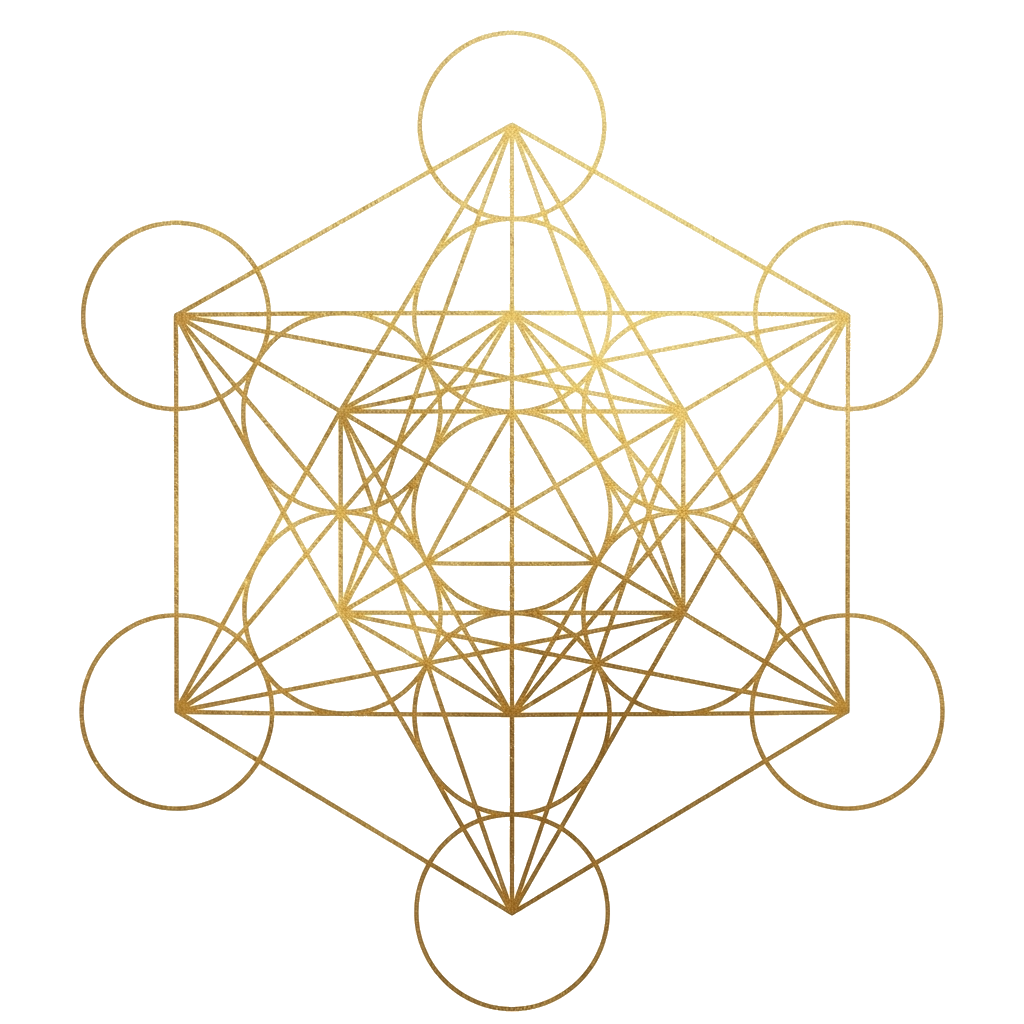
Metatron's Cube
A sacred geometric figure derived from the Fruit of Life — 13 circles connected by straight lines that contain all five Platonic solids, mapping the geometric blueprint underlying physical reality.
About Metatron's Cube
Metatron's Cube is constructed by connecting the centers of the 13 circles that compose the Fruit of Life — and within that web of 78 lines, every Platonic solid can be found. Formally, it is constructed by connecting the centers of the 13 circles that compose the Fruit of Life — itself an extension of the Flower of Life — with straight lines, producing a total of 78 lines that together encode the two-dimensional wireframe projections of all five Platonic solids: the tetrahedron, the hexahedron (cube), the octahedron, the dodecahedron, and the icosahedron.
What distinguishes Metatron's Cube from other sacred geometric figures is the completeness of what it contains. While the Seed of Life encodes the generative principle and the Flower of Life encodes the lattice of creation, Metatron's Cube is the figure in which latent geometry becomes fully explicit — where every possible regular three-dimensional form that can exist in Euclidean space is present simultaneously. In the language of Platonic cosmology, it is the complete set of building blocks from which physical reality is assembled. In the language of mathematics, it is a two-dimensional projection containing the full family of convex regular polyhedra.
The figure is named for Metatron, the archangel who appears in Kabbalistic, Talmudic, and apocryphal literature as the celestial scribe — the being who records and transmits the divine architecture of creation. The attribution is relatively modern, emerging primarily in the twentieth-century sacred geometry revival, but it draws on a deep tradition associating Metatron with the mediation between infinite divine reality and finite material form. The name is fitting: the Cube is the geometric intermediary between the undifferentiated potential of the circle (spirit) and the fully differentiated structure of the polyhedron (matter).
Metatron's Cube has become a central figure in contemporary sacred geometry education, meditation practice, and spiritual art. Its visual complexity — 13 circles, 78 lines, five embedded solids, and multiple axes of symmetry — makes it simultaneously a rigorous mathematical object and a powerful contemplative tool. It rewards extended visual study: the longer one looks, the more structures emerge from the same set of lines, enacting in real time the principle it symbolizes — that all form is implicit in a single underlying pattern.
Visual Description
Metatron's Cube begins with the Fruit of Life: 13 circles of equal radius arranged so that one circle sits at the center, six circles form a ring around it (their centers on the central circle's circumference, evenly spaced at 60-degree intervals), and six more circles extend outward, each centered on the midpoint between two adjacent inner-ring circles. The result is a compact hexagonal cluster of 13 circles — three rows of three, four, three, and three — that fits neatly within the broader Flower of Life lattice.
From this foundation, Metatron's Cube is generated by a single operation: draw a straight line from the center of every circle to the center of every other circle. With 13 centers, this produces 78 unique line segments (the number of edges in a complete graph of 13 nodes). The visual result is a strikingly intricate figure — a web of intersecting lines radiating outward from the center in multiple directions, overlaid on the soft curves of the underlying circles.
The figure possesses sixfold rotational symmetry inherited from the Fruit of Life's hexagonal arrangement. It also displays mirror symmetry along six axes. At its center, the densest cluster of intersecting lines creates a star-like radiance; at its periphery, the lines fan outward in triangular and hexagonal groupings. The contrast between the organic roundness of the circles and the geometric precision of the straight lines gives the figure its characteristic visual tension — feminine curvature and masculine linearity held in perfect equilibrium.
Within this web of 78 lines, the trained eye can identify the flat projections of all five Platonic solids. The tetrahedron (four triangular faces) appears as a triangle connecting three alternate outer circles. The cube or hexahedron (six square faces) appears as a tilted square or rhombus within the central region. The octahedron (eight triangular faces) appears as a diamond shape formed by connecting four circles in a cross pattern. The icosahedron (twenty triangular faces) and dodecahedron (twelve pentagonal faces) — the most complex of the Platonic solids — appear as more intricate overlapping structures requiring careful tracing of specific line subsets. All five shapes are present simultaneously, sharing edges and vertices within the same figure, demonstrating their geometric interdependence.
The figure is often rendered in metallic gold or white lines on a dark background, emphasizing the luminous quality of the intersecting geometry. Some contemporary versions color-code the five Platonic solids within the Cube to make them visually distinct — fire-red for the tetrahedron, earth-green for the cube, air-yellow for the octahedron, water-blue for the icosahedron, spirit-violet for the dodecahedron — though traditional renderings present all lines equally, inviting the viewer to discover the embedded forms through their own contemplation.
Esoteric Meaning
At the heart of Metatron's Cube's esoteric significance lies a single, powerful idea: that the five Platonic solids — and therefore the geometric building blocks of all physical matter — are not arbitrary shapes but are derived from a single pattern rooted in the circle, the most primordial geometric form. The Cube demonstrates, visually and mathematically, that the complexity of three-dimensional reality emerges from the simplicity of circles and straight lines. In esoteric terms, this is the mystery of manifestation: how the One becomes the Many without ever ceasing to be One.
The five Platonic solids embedded within the Cube correspond to the five classical elements in the Platonic tradition articulated in the Timaeus. The tetrahedron corresponds to Fire — the element of transformation, the simplest solid, sharp-pointed and dynamic. The hexahedron or cube corresponds to Earth — stable, square-faced, the most grounded of forms. The octahedron corresponds to Air — balanced, symmetrical, oriented along three perpendicular axes like the three dimensions of space. The icosahedron corresponds to Water — the most spherical of the solids, with twenty faces that approximate the fluidity of liquid form. The dodecahedron corresponds to Aether or Spirit — the most complex regular solid, with twelve pentagonal faces encoding the Golden Ratio in every edge, the element Plato assigned to 'the whole cosmos' itself. That all five are contained within Metatron's Cube means the figure holds the complete elemental architecture of reality in a single two-dimensional image.
In Kabbalistic tradition, the figure's namesake — the archangel Metatron — occupies a unique position in the celestial hierarchy. Metatron is described in the Talmud and in the mystical text Sefer Yetzirah as the 'scribe of God,' the being who sits nearest the divine throne and records the geometry of creation. In the Zohar and in Hekhalot literature, Metatron is identified with the transfigured Enoch — a human being who ascended to angelic status, bridging the gap between mortal and divine. The Cube that bears his name enacts the same bridging function geometrically: it translates the formless potential of circles (spirit, the infinite, the unmanifest) into the definite structure of polyhedra (matter, the finite, the manifest). It is the blueprint the scribe writes — the recording of how divine intention crystallizes into physical law.
In Hermetic philosophy, the principle 'As above, so below' finds precise geometric expression in Metatron's Cube. The two-dimensional figure (the plane of abstract geometry, the realm of ideal forms) contains within it the three-dimensional solids (the physical world of volume, mass, and substance). The higher dimension encodes the lower; the archetype contains the manifestation. For the Hermetic practitioner, meditating on the Cube is an act of perceiving this correspondence directly — seeing with geometric clarity that the world of form and the world of principle are not separate domains but two views of the same reality.
At the deepest initiatory level, Metatron's Cube teaches that structure itself is sacred. The five Platonic solids are not merely interesting mathematical curiosities; they are the only possible convex regular polyhedra in three-dimensional Euclidean space. This is a theorem — a mathematical absolute. There can be no sixth Platonic solid. The fact that all five arise from a single circle-based pattern suggests that the laws governing physical form are not accidental but are intrinsic to the geometry of space itself. For the contemplative mind, this is a profound insight: the universe is not chaotic matter awaiting the imposition of order from outside. It is ordered from within, by the same geometric principles that Metatron's Cube makes visible.
Exoteric Meaning
On a purely mathematical level, Metatron's Cube is a complete graph on 13 vertices (K13) overlaid on a specific geometric arrangement of those vertices — the Fruit of Life configuration. The 78 edges of this complete graph, when the vertices are positioned in the hexagonal pattern of the Fruit of Life, happen to contain within their subsets the edge-projections of all five Platonic solids. This is a genuine and verifiable mathematical property, not a mystical claim — anyone with a straightedge and compass can construct the figure and identify the embedded polyhedra.
The five Platonic solids themselves are objects of serious mathematical study with applications far beyond sacred geometry. In crystallography, three of the five (tetrahedron, cube, octahedron) correspond directly to crystal systems found in nature. The icosahedral structure appears in virology — many viruses, including adenoviruses, have icosahedral capsids. Fullerenes (buckminsterfullerene, C60) are truncated icosahedra. The dodecahedral structure appears in certain quasicrystals. Metatron's Cube, by containing all five, serves as a compact reference to the full family of regular polyhedra and their natural manifestations.
In mathematics education, constructing Metatron's Cube is an excellent exercise in compass-and-straightedge geometry, graph theory, and spatial reasoning. Starting from a single circle, the student progresses through the Seed of Life (7 circles), the Flower of Life (19 circles), the Fruit of Life (13 circles extracted), and finally Metatron's Cube (78 connecting lines) — experiencing firsthand how complex structures emerge from simple, iterated operations. Extracting the Platonic solids from the completed figure teaches projection, visualization of three-dimensional objects from two-dimensional representations, and the concept of geometric duality.
In art and design, the figure's high degree of symmetry and visual complexity make it a popular motif in geometric illustration, tattoo art, architectural ornamentation, and digital generative art. Its mathematical precision gives it a quality of inevitability — it does not look designed so much as discovered, which is precisely the aesthetic that sacred geometry seeks to evoke. The figure is also used in parametric design and 3D printing as a template for complex lattice structures, taking advantage of the inherent structural stability of the Platonic solid geometries it encodes.
Usage
In contemporary spiritual practice, Metatron's Cube serves multiple functions that reflect the breadth of its symbolic content. As a meditation focus, it is used to cultivate geometric awareness — the capacity to perceive the mathematical order underlying natural forms. Practitioners report that extended contemplation of the figure produces a distinctive state of calm alertness, as the visual complexity fully engages the pattern-recognition faculties of the mind while the underlying symmetry provides a stabilizing framework. Some meditation traditions use the progressive construction of the figure (circle by circle, line by line) as a visualization practice, building Metatron's Cube in the mind's eye as a way of internalizing the creation sequence it represents.
In energy healing and crystal grid work, Metatron's Cube is used as a layout template for arranging stones and crystals. Practitioners place crystals at the 13 circle centers and sometimes at key line intersections, using the figure's geometry to structure the energetic field of a healing session. The five Platonic solids embedded in the pattern are sometimes associated with the five lower chakras or with the five elements in Ayurvedic and Taoist systems, creating a bridge between geometric and somatic energy work.
In protective and clearing practices, the figure is employed as a symbol of divine order and archangelic presence. Because Metatron is traditionally associated with the highest levels of the angelic hierarchy — often described as the 'angel of the presence' or the guardian of the threshold between human and divine realms — the Cube bearing his name is used in space clearing, aura cleansing, and protective visualization. Practitioners may visualize the Cube rotating around their body or a space, its 78 lines forming a geometric shield that harmonizes discordant energies.
In education and outreach, Metatron's Cube is frequently the culminating figure in sacred geometry workshops and courses. Its construction from the Flower of Life demonstrates the progressive unfolding of geometric complexity, while the extraction of the Platonic solids provides a tangible connection between two-dimensional pattern and three-dimensional form. It is also one of the most popular sacred geometry images in jewelry, wall art, clothing, and digital media — serving as a visual shorthand for the principle that reality is geometrically ordered at its deepest level.
In Architecture
While Metatron's Cube in its complete, explicitly named form is largely a product of the modern sacred geometry revival, the geometric principles it encodes have been employed in architecture and sacred design for millennia. The five Platonic solids it contains have served as structural and ornamental elements across virtually every major building tradition.
In Islamic geometric art, the hexagonal lattice underlying Metatron's Cube — the Fruit of Life arrangement of 13 circles — served as a construction scaffold for the complex star-and-polygon tessellations adorning mosques, madrasas, and palaces from Andalusia to Central Asia. The Alhambra in Granada, the Shah Mosque in Isfahan, and the Topkapi Palace in Istanbul all feature geometric patterns whose construction begins with the same circle-packing geometry from which Metatron's Cube is derived. Islamic artisans did not name the figure as such, but their mastery of its underlying mathematics is evident in every muqarnas vault and girih tile.
In Gothic cathedral architecture, the geometric relationships encoded in Metatron's Cube appear in rose window designs, floor labyrinths, and the proportional systems governing nave dimensions. The Chartres Cathedral labyrinth, for instance, is constructed on a geometry closely related to the Flower of Life lattice. The Gothic master builders' use of compass-and-straightedge construction meant they were working with the same geometric vocabulary that generates Metatron's Cube, even if they organized it under different symbolic frameworks (the Masonic tradition of sacred proportion, the Scholastic theology of divine order manifesting through number).
In the Renaissance, Leonardo da Vinci's systematic study of the Platonic solids — documented in his illustrations for Luca Pacioli's De Divina Proportione (1509) — represents perhaps the closest historical antecedent to the modern concept of Metatron's Cube. Leonardo drew all five Platonic solids in both solid and skeletal form, exploring precisely the relationships that Metatron's Cube encodes. His work on these polyhedra directly influenced architectural proportion in Renaissance church design, particularly the centrally planned churches of Bramante and the mathematical harmonies of Palladio.
In contemporary architecture and design, the figure appears explicitly in sacred geometry-inspired buildings, meditation spaces, and wellness centers. It is also used in generative architectural design, where the Platonic solid geometries it contains serve as starting forms for parametric structures, geodesic domes (derived from the icosahedron), and space-frame constructions (derived from the octahedron and tetrahedron). Buckminster Fuller's geodesic work, while not directly referencing Metatron's Cube, operates entirely within its geometric territory.
Significance
Metatron's Cube marks the point at which the generative sequence of sacred geometry reaches completion. The Seed of Life encodes the beginning — the first seven circles, the genesis pattern. The Flower of Life encodes the middle — the full lattice of overlapping circles from which all two-dimensional geometry can be derived. Metatron's Cube encodes the end — the moment when two-dimensional pattern gives birth to three-dimensional form, when the flat blueprint becomes the volumetric architecture of physical reality. It is the final figure in the sacred geometry creation narrative before geometry itself becomes matter.
This position gives it a unique philosophical weight. If the Flower of Life asks the question 'How does pattern arise from simplicity?' then Metatron's Cube answers the question 'How does structure arise from pattern?' The five Platonic solids it contains are not merely five shapes among infinitely many; they are the only five convex regular polyhedra that can exist in three-dimensional Euclidean space. This mathematical fact — that the vocabulary of perfect three-dimensional form is finite, small, and completely contained within a single two-dimensional figure — is one of the most striking demonstrations in all of geometry that reality is fundamentally ordered rather than arbitrary.
For traditions that read geometric order as evidence of divine intelligence — Pythagorean, Platonic, Hermetic, Kabbalistic — Metatron's Cube is among the most powerful symbols available. It does not merely assert that creation is structured; it shows the structure. It does not merely claim that the material world derives from a higher-dimensional blueprint; it displays the derivation. In this sense, it functions less as a symbol (which points toward something beyond itself) and more as a proof — a visible, verifiable demonstration that the geometric laws governing physical form emerge from the simplest possible starting conditions.
The figure's growing cultural visibility — in spiritual practice, in education, in art, in design — reflects a broader recognition that the boundaries between mathematics, philosophy, and contemplative practice are more porous than modernity has typically assumed. Metatron's Cube does not require belief to be appreciated; its geometric properties are facts. But those facts carry implications that extend well beyond geometry, into questions about the nature of order, the origin of form, and the relationship between the abstract and the actual. It is a rare figure that can be simultaneously a mathematical diagram, a philosophical argument, and a devotional image — and that triple identity is precisely its significance.
Connections
Metatron's Cube is inseparable from sacred geometry as a discipline — it is, in many ways, the discipline's culminating figure, the point at which the progressive construction from circle to lattice to polyhedron reaches completion. Any serious study of sacred geometry leads eventually to this figure, and any presentation of the figure leads outward to the full scope of the tradition.
The Sefer Yetzirah — the foundational text of Kabbalistic cosmology — provides the theological framework within which Metatron's Cube finds its deepest meaning. The Sefer Yetzirah describes creation as an act of geometric and linguistic structuring: God creates the universe through combinations of the 22 Hebrew letters and the 10 Sephiroth, arranging them in spatial and numerical patterns. Metatron, as the celestial scribe who records this creative geometry, is the angelic embodiment of the principle that the Cube illustrates: that divine intention manifests as geometric law, and that geometric law manifests as physical form.
The Platonic tradition — particularly the Timaeus, where Plato assigns the five regular solids to the five elements — provides the philosophical basis for interpreting Metatron's Cube as a cosmological diagram. The Neoplatonic elaboration of this idea, running through Proclus, Iamblichus, and eventually into Renaissance Hermeticism, treats the Platonic solids not merely as convenient symbols for the elements but as the actual geometric forms through which the World Soul organizes matter. Metatron's Cube, by containing all five, becomes a map of the World Soul's complete geometric vocabulary.
In modern science, the connections are descriptive rather than causal but no less striking. The symmetry groups of the Platonic solids appear throughout physics and chemistry: in crystallography (cubic, tetrahedral, and octahedral crystal systems), in molecular geometry (methane's tetrahedral carbon, sulfur hexafluoride's octahedral structure), in virology (icosahedral viral capsids), and in theoretical physics (the role of symmetry groups in particle physics and string theory). The geometric relationships that Metatron's Cube makes visible are, quite literally, the same relationships that govern the structure of matter at scales from the subatomic to the cosmic.
Further Reading
- Sacred Geometry: Philosophy and Practice by Robert Lawlor — the foundational academic treatment of sacred geometry, including rigorous analysis of the Platonic solids and the geometric construction sequence from Seed to Flower to Fruit to Cube.
- The Ancient Secret of the Flower of Life, Volumes 1 & 2 by Drunvalo Melchizedek — the most widely read popular treatment of the Flower of Life sequence, with extensive discussion of Metatron's Cube, the Platonic solids, and their esoteric significance. Influential in contemporary sacred geometry circles.
- De Divina Proportione by Luca Pacioli, illustrated by Leonardo da Vinci (1509) — the Renaissance masterwork on mathematical proportion, featuring Leonardo's celebrated illustrations of the Platonic solids that directly relate to the geometry encoded in Metatron's Cube.
- The Elements by Euclid (c. 300 BCE), Book XIII — the original mathematical proof that exactly five convex regular polyhedra exist, providing the rigorous foundation for the claim that Metatron's Cube contains the complete set of regular solids.
- A Beginner's Guide to Constructing the Universe by Michael S. Schneider — an accessible, illustrated journey through the geometric forms underlying nature and art, situating Metatron's Cube within the broader tradition of constructive geometry.
- Sefer Yetzirah: The Book of Creation (attributed to Abraham; multiple translations) — the foundational Kabbalistic text describing creation as geometric and linguistic structuring, providing the theological context for the archangel Metatron's role as celestial scribe and the figure's spiritual significance.
Frequently Asked Questions
What does the Metatron's Cube symbolize?
At the heart of Metatron's Cube's esoteric significance lies a single, powerful idea: that the five Platonic solids — and therefore the geometric building blocks of all physical matter — are not arbitrary shapes but are derived from a single pattern rooted in the circle, the most primordial geometric form. The Cube demonstrates, visually and mathematically, that the complexity of three-dimensional reality emerges from the simplicity of circles and straight lines. In esoteric terms, this is the mystery of manifestation: how the One becomes the Many without ever ceasing to be One.
Where does the Metatron's Cube originate?
The Metatron's Cube originates from the Kabbalistic-geometric (named for the archangel Metatron; modern sacred geometry synthesis) tradition. It dates to Medieval (concept); modern (current form). It first appeared in Europe, Western esoteric tradition.
How is the Metatron's Cube used today?
In contemporary spiritual practice, Metatron's Cube serves multiple functions that reflect the breadth of its symbolic content. As a meditation focus, it is used to cultivate geometric awareness — the capacity to perceive the mathematical order underlying natural forms. Practitioners report that extended contemplation of the figure produces a distinctive state of calm alertness, as the visual complexity fully engages the pattern-recognition faculties of the mind while the underlying symmetry provides a stabilizing framework. Some meditation traditions use the progressive construction of the figure (circle by circle, line by line) as a visualization practice, building Metatron's Cube in the mind's eye as a way of internalizing the creation sequence it represents.