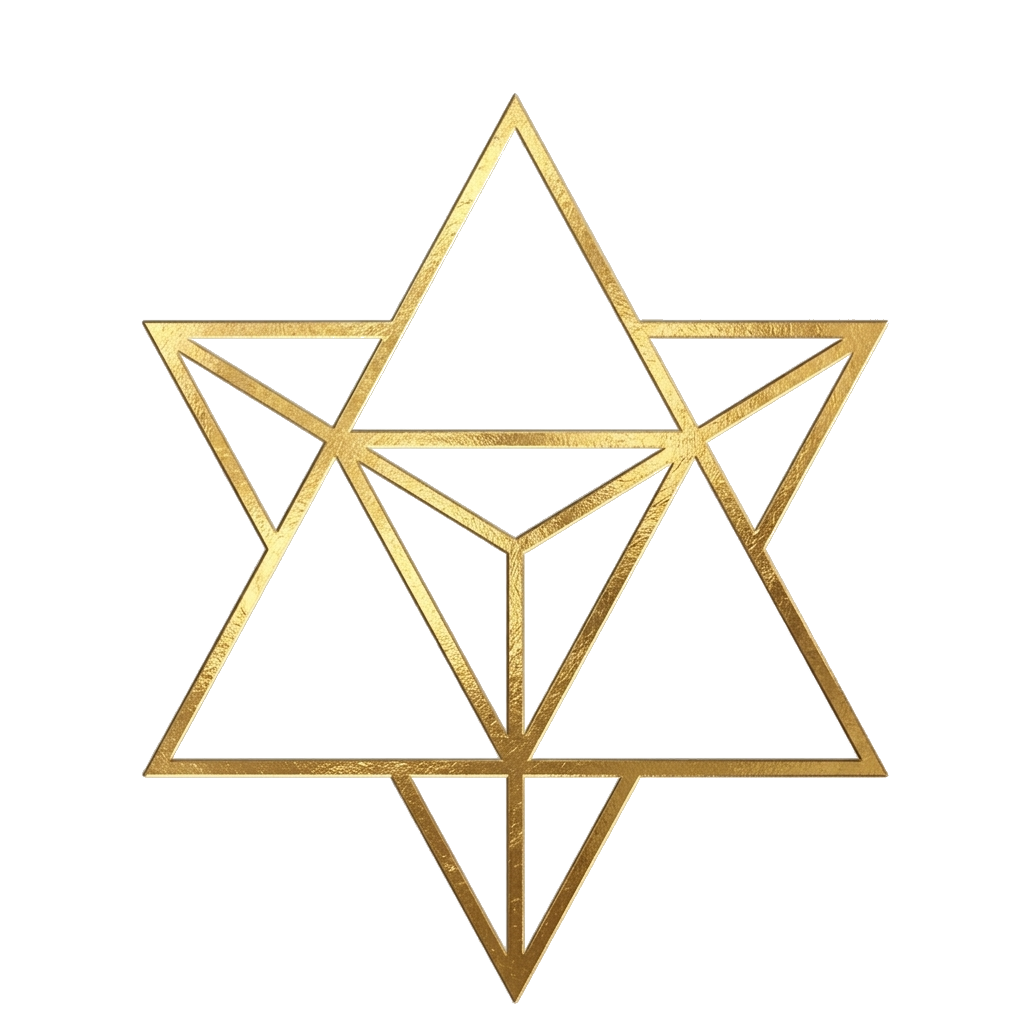
Merkaba
The chariot of light — two interlocking tetrahedra forming a three-dimensional Star of David, representing the divine light vehicle of ascension in Kabbalistic mysticism and modern sacred geometry.
About Merkaba
The Merkaba is one of the most ancient and enduring symbols in the Western mystical tradition, bridging Jewish esotericism, Hermetic philosophy, and contemporary sacred geometry into a single luminous form. At its simplest, it appears as two interlocking tetrahedra — one pointing upward, one pointing downward — creating an eight-pointed, three-dimensional star. But this geometric simplicity belies a symbol that has carried some of the deepest metaphysical claims in human spiritual history: that the human being possesses a vehicle of light, a crystalline field of counter-rotating energy, capable of bridging the material and divine worlds.
The word itself is typically parsed from ancient Egyptian and Hebrew roots. Mer refers to light, specifically a light that rotates within itself. Ka is the spirit or subtle body — the animating force that the Egyptians understood to survive physical death. Ba is the soul, the unique individuality that incarnates into form. Together, Merkaba means something like 'the spirit-soul carried in rotating light' — a chariot not of wood and horses but of consciousness and geometry. This etymology, while popularized in the 20th century and debated by scholars, points to the cross-cultural intuition that the human energy field has a specific geometric structure, and that this structure can be activated, strengthened, and ultimately used as a vehicle for spiritual ascension.
The earliest roots of Merkaba mysticism lie in the Hebrew Bible, specifically in the first chapter of Ezekiel, where the prophet describes a vision of the divine throne-chariot — the Merkavah — borne by four living creatures (chayot), surrounded by wheels within wheels (ophanim), eyes everywhere, and a firmament of terrible crystal above. This passage became the foundation of an entire school of Jewish mysticism, the Merkabah mystics of the Second Temple and Talmudic periods (roughly 1st century BCE through the 6th century CE), who developed elaborate meditative practices for ascending through the heavenly palaces (Hekhalot) to behold the divine throne. These practices were considered so dangerous and so sacred that the Mishnah restricted their teaching, and the Talmud records stories of practitioners who went mad, died, or lost their faith in the attempt.
The modern geometric symbol — two interlocking tetrahedra forming a star tetrahedron — was brought into widespread awareness primarily through the work of Drunvalo Melchizedek in the 1990s, particularly in his books The Ancient Secret of the Flower of Life (Volumes 1 and 2). Melchizedek taught that the Merkaba is the energetic structure of the human light body: a counter-rotating field of light extending roughly 55 feet around the physical body when fully activated, composed of two tetrahedra spinning in opposite directions at near-light speed. He described specific breathing meditations — sequences of 17 breaths coordinated with mudras, visualizations, and prana flow — designed to activate this dormant field and restore the practitioner to their full multidimensional nature.
Whether one takes the modern Merkaba meditation literally or metaphorically, the symbol itself encodes genuine principles found across mystical traditions: the union of polarities, the geometry inherent in creation, the possibility of conscious evolution, and the ancient claim — shared by Kabbalists, Hermeticists, Vedic seers, and Egyptian priests alike — that the human being is not merely a physical body but a being of light temporarily housed in matter, capable of remembering and reclaiming its luminous nature.
Visual Description
The Merkaba takes the form of a star tetrahedron — two equally sized tetrahedra (four-sided pyramids with equilateral triangle faces) interlocked so that one points upward and the other points downward. When viewed from above, the form creates a perfect hexagram (six-pointed star). When viewed from the side, it appears as a complex, multi-faceted three-dimensional star with eight triangular points — four extending upward and four downward.
Each tetrahedron has four vertices, but two of these vertices are shared where the forms intersect, giving the complete star tetrahedron a total of eight points. The intersecting volume at the center creates an octahedron — one of the five Platonic solids — which many sacred geometers consider the 'seed' or 'heart' of the Merkaba. The geometry is precise: every edge is equal in length, every face is an equilateral triangle, and the proportions are governed by the square root of two.
In sacred geometry diagrams, the Merkaba is often shown inscribed within a sphere, illustrating how the points of the star tetrahedron touch the surface of the surrounding field. It is sometimes depicted with one tetrahedron rendered in a warm color (gold, red, or orange) and the other in a cool color (blue, silver, or violet) to represent the masculine/feminine or solar/lunar polarities it encodes. In Drunvalo Melchizedek's teaching, three star tetrahedra are actually superimposed: one static (the physical body), one spinning clockwise (the mental/masculine field), and one spinning counterclockwise (the emotional/feminine field). The counter-rotation generates the toroidal energy field that constitutes the activated light body.
When drawn in two dimensions, the Merkaba collapses into the familiar Star of David or hexagram — the same symbol found on the flag of Israel, in Hindu yantras (as the Shatkona), and in alchemical diagrams. This two-dimensional shadow of a three-dimensional form is itself a teaching: what appears flat and symbolic on paper is, in the esoteric understanding, a living, spinning, multidimensional reality.
Esoteric Meaning
At the deepest level, the Merkaba represents the divine light vehicle of the soul — the geometric energy field that surrounds and interpenetrates the human body, serving as the interface between individual consciousness and the infinite. In Kabbalistic tradition, the Merkavah is the throne-chariot of God, and the mystic who ascends through the Hekhalot (heavenly palaces) to behold it is participating in the most direct form of divine encounter available to a human being. The chariot is not merely something God rides — it is the structure of divine emanation itself, the way the Infinite organizes itself into form.
The two interlocking tetrahedra encode the fundamental polarity at the heart of creation. The upward-pointing tetrahedron represents spirit descending into matter, the masculine principle, the solar force, the fire element, and the movement of consciousness from unity toward manifestation. The downward-pointing tetrahedron represents matter ascending toward spirit, the feminine principle, the lunar force, the water element, and the movement of form back toward its source. Their interlocking is not opposition but sacred marriage — the hieros gamos — the union of above and below that generates all of manifest reality. This is the geometric expression of the Hermetic axiom: 'As above, so below; as below, so above.'
In Ezekiel's vision, the chariot is described with extraordinary precision: four living creatures (the chayot hakodesh), each with four faces (human, lion, ox, eagle) and four wings; wheels within wheels (ophanim) covered in eyes, moving in all directions simultaneously without turning; and above them, a firmament like terrible crystal bearing a throne of sapphire upon which sits a figure of fire from the waist up and brightness from the waist down. The Merkabah mystics understood this not as mere prophecy but as a map of the inner cosmos — the chayot as the four elements or four worlds of Kabbalah, the ophanim as the cycling of consciousness through levels of reality, the eyes as omnidirectional awareness, and the throne as the seat of the higher self within the divine architecture.
The counter-rotating fields described in modern Merkaba meditation carry a specific esoteric claim: that consciousness generates reality through spin. The mental tetrahedron spinning clockwise at a ratio of 34 and the emotional tetrahedron spinning counterclockwise at a ratio of 21 create a Fibonacci relationship (34/21 approaches the golden ratio, phi). This is understood to mean that the activated Merkaba resonates with the fundamental mathematical structure of organic life and cosmic creation. The spinning fields generate a toroidal (donut-shaped) energy field that extends far beyond the physical body — the same toroidal geometry found in Earth's magnetic field, the structure of galaxies, and the electromagnetic field of the human heart.
Perhaps most significantly, the Merkaba is understood as a vehicle of ascension — not necessarily a means of leaving the body, but of expanding consciousness while remaining embodied. The Kabbalistic mystics sought to ascend through the seven Hekhalot to the throne of glory. The Egyptian references (however debated their historical accuracy) point to the Ka and Ba reuniting in luminous form. The modern teaching frames activation as remembering what the human energy field was always designed to do: bridge dimensions, access higher states of consciousness, and operate as a fully conscious, multidimensional being within a physical form.
Exoteric Meaning
In its most accessible interpretation, the Merkaba symbolizes balance, integration, and wholeness. The two interlocking tetrahedra — one reaching upward, one reaching downward — represent the harmonious union of complementary forces: heaven and earth, spirit and matter, masculine and feminine, thought and feeling, giving and receiving. For someone encountering the symbol without esoteric context, it communicates the idea that true stability comes not from one direction or one force but from the dynamic interplay of opposites held in perfect geometric balance.
As a three-dimensional Star of David, the Merkaba carries associations with protection, divine guidance, and the integration of the human and the divine. In Jewish cultural symbolism, the hexagram (Magen David, Shield of David) has long represented the protective power of God over the people of Israel. The Merkaba extends this into three dimensions, suggesting that divine protection is not a flat shield but an encompassing field — a sphere of sacred geometry surrounding the individual on all sides.
In the wellness and personal growth communities where the Merkaba is most widely recognized today, it is commonly understood as a symbol of spiritual transformation, light-body activation, and the human potential for expanded awareness. It appears on jewelry, meditation tools, yoga studio walls, and healing-space altars as a reminder of the geometric order underlying apparent chaos, and the possibility that the human being is more than meets the eye — that consciousness itself has a structure, and that structure can be cultivated.
The Merkaba also serves as a powerful teaching tool for sacred geometry more broadly. It demonstrates how the Platonic solids (tetrahedron, octahedron) nest within one another, how two-dimensional symbols (the hexagram) are shadows of three-dimensional realities, and how simple geometric relationships encode complex metaphysical principles. For students of sacred geometry, the Merkaba is often one of the first forms studied after the Flower of Life and Metatron's Cube, because it so clearly illustrates the principle that geometry is not abstract mathematics but the language in which creation speaks.
Usage
The Merkaba is used across a wide range of spiritual, meditative, and contemplative practices, from ancient Jewish mysticism to contemporary energy healing. Its applications span millennia and traditions, though the specific techniques vary considerably depending on the lineage.
In Merkaba meditation as taught by Drunvalo Melchizedek and his students, the practice involves a precise sequence of 17 breaths. The first six breaths cleanse and balance the electrical (masculine/mental) and magnetic (feminine/emotional) circuits of the body through specific mudras (thumb-to-finger combinations) coordinated with rhythmic breathing and visualization of the tetrahedra filling with light. Breath seven shifts the prana flow from the two-dimensional polarity pattern to the spherical breath of the higher self. Breaths eight through thirteen establish the connection to universal life force. Breath fourteen shifts the equilibrium of prana energy from the third dimension to the fourth. Breaths fifteen through seventeen activate the counter-rotating fields of the Merkaba itself, first at the speed of thought, then at the speed of light, then beyond — at which point the practitioner is said to be 'riding the chariot.' The entire sequence is typically practiced seated, with eyes closed, and takes 15-30 minutes.
In Kabbalistic meditation, the Merkavah practices of the Hekhalot tradition involved extensive preparation — fasting, purification, recitation of divine names, and the memorization of 'seals' (combinations of angelic names and secret words) needed to pass the guardians of each heavenly palace. The practitioner would typically sit with the head between the knees (a posture also used by Elijah on Mount Carmel) and enter progressively deeper states of trance while reciting hymns to the angelic throne-bearers. These practices were not casual — they required years of preparation and were traditionally restricted to married men over forty who had mastered Torah and Talmud.
In contemporary energy healing, practitioners may visualize the Merkaba around a client to strengthen the biofield, clear energetic blockages, or create a protected space for deep healing work. Reiki masters, pranic healers, and other energy workers sometimes incorporate Merkaba visualization as a way to establish and maintain a high-vibration field during sessions. Crystal grids arranged in star tetrahedron patterns are used for space clearing, intention amplification, and manifestation work.
The Merkaba is also widely used as a wearable talisman — pendants, rings, and earrings in the star tetrahedron shape are among the most popular sacred geometry jewelry items worldwide. Many wearers report a sense of heightened awareness, energetic protection, or spiritual connection while wearing the symbol, whether attributed to the geometry itself, the intention behind it, or the psychological anchoring effect of carrying a meaningful symbol.
In Architecture
The Merkaba as a three-dimensional geometric form does not appear frequently in historical architecture in the way that, say, the dome or the pointed arch does. However, its constituent geometries — the tetrahedron, the hexagram, and the principles of interlocking forms — permeate sacred architecture across cultures and centuries.
The hexagram, which is the Merkaba's two-dimensional projection, appears extensively in Islamic geometric patterns (girih), where the six-pointed star is one of the fundamental generating shapes used in tile work throughout mosques, madrasas, and palaces from Moorish Spain to Mughal India. The Alhambra in Granada, Spain, features numerous hexagram-based patterns in its intricate stucco and tile work. In Jewish sacred architecture, the Star of David appears in synagogue decoration from at least the medieval period, including the famous Capernaum synagogue frieze and numerous European synagogues.
In Hindu and Buddhist temple architecture, the Shatkona — the same hexagram form — appears in yantras embedded in temple floors, walls, and sanctum sanctorum. The Sri Yantra, which contains the Shatkona among its interlocking triangles, has been used as the geometric basis for temple ground plans, most notably in certain South Indian temples. The principle of interlocking upward and downward triangles as a representation of Shiva-Shakti union is fundamental to Tantric temple design.
In the modern era, the star tetrahedron has become a popular form in contemporary sacred architecture and installation art. Large-scale Merkaba sculptures serve as meditation focal points in retreat centers, healing spaces, and spiritual communities worldwide. The Burning Man festival has featured massive illuminated Merkaba structures. Architects working within the sacred geometry tradition occasionally use the star tetrahedron's proportions to generate building forms, spatial relationships, and structural systems — though these applications remain niche compared to more widely adopted sacred geometry principles like the golden ratio or the vesica piscis.
Perhaps the most architecturally significant legacy of the Merkaba is its role in cathedral geometry. The rose windows of Gothic cathedrals, particularly those with six-fold symmetry, encode the hexagram pattern that is the Merkaba's planar shadow. The master builders of Chartres, Notre-Dame, and Cologne — many of whom are believed to have been initiated into Hermetic and Kabbalistic knowledge — used these geometries not as mere decoration but as functional elements believed to shape the consciousness of anyone who entered the space. The cathedral itself, in this reading, is a Merkaba rendered in stone: a vehicle for the collective ascent of consciousness.
Significance
The Merkaba occupies a unique position in the landscape of sacred symbols: it is simultaneously one of the most ancient (rooted in biblical prophecy and Second Temple mysticism) and one of the most modern (popularized globally only in the 1990s through the New Age movement). This dual nature makes honest assessment of its significance both important and nuanced.
The ancient Merkabah tradition is historically significant beyond dispute. The Hekhalot literature — texts like 3 Enoch, the Hekhalot Rabbati, and the Ma'aseh Merkavah — represents one of the earliest systematic approaches to mystical practice in the Western tradition, predating and deeply influencing the later development of Kabbalah. The great scholar Gershom Scholem argued that Merkabah mysticism was the direct ancestor of the entire Kabbalistic tradition, making it foundational to Jewish esotericism and, by extension, to much of Western occultism. The image of Ezekiel's chariot has inspired Christian mysticism (particularly in the Eastern Orthodox tradition), Islamic angelology, and Hermetic philosophy for over two millennia.
The modern geometric Merkaba is a different matter and deserves forthright treatment. Drunvalo Melchizedek's teachings, which brought the star tetrahedron Merkaba into global awareness, draw on a mixture of channeled material, Egyptian mythology (some of it historically contested), sacred geometry principles, and personal spiritual experience. The specific claims — that the Merkaba is an 'ancient Egyptian' concept, that the counter-rotating fields spin at precise Fibonacci ratios, that activation grants interdimensional travel — are not supported by mainstream Egyptology or physics, and the etymological derivation from Egyptian (Mer-Ka-Ba) is disputed by academic scholars who note that the Hebrew Merkavah simply means 'chariot' and has no established Egyptian cognate.
This does not, however, invalidate the symbol's power or the genuine experiences reported by thousands of practitioners. The star tetrahedron is a legitimate geometric form with real mathematical properties. The principle of counter-rotating energy fields has parallels in physics (magnetic fields, angular momentum) and in contemplative traditions (the ida and pingala nadis of yoga, the contractive and expansive phases of breathing). And the Merkabah mystics of antiquity were undeniably doing something — achieving altered states of consciousness through systematic practice — that produced a literature and a lineage lasting two thousand years.
The Merkaba's greatest significance may lie in its role as a bridge symbol — connecting Jewish mysticism with Egyptian lore, sacred geometry with meditation practice, ancient wisdom with modern seekers, and the mathematical structure of the universe with the lived experience of spiritual aspiration. Whether understood as a literal energy field or a powerful contemplative tool, the Merkaba encodes a claim that resonates across every tradition represented in Satyori's Library: that the human being is a being of light, that consciousness has geometry, and that the path of awakening involves remembering — and reactivating — what we have always been.
Connections
Further Reading
Primary Sources and Classical Scholarship:
Scholem, Gershom. Major Trends in Jewish Mysticism (1941). The foundational academic work on Merkabah mysticism and its relationship to later Kabbalah. Chapters 2 and 3 cover the Merkabah period in detail.
Scholem, Gershom. Jewish Gnosticism, Merkabah Mysticism, and Talmudic Tradition (1960). A more focused examination of the Hekhalot literature and its relationship to Gnostic traditions.
Halperin, David J. The Faces of the Chariot: Early Jewish Responses to Ezekiel's Vision (1988). Comprehensive scholarly analysis of how Ezekiel's chariot vision was interpreted across different periods and communities.
Modern Merkaba Teaching:
Melchizedek, Drunvalo. The Ancient Secret of the Flower of Life, Volumes 1 and 2 (1998, 2000). The primary texts for the modern geometric Merkaba meditation. Volume 2 contains the complete 17-breath meditation technique.
Sacred Geometry Context:
Lawlor, Robert. Sacred Geometry: Philosophy and Practice (1982). Excellent introduction to the mathematical and philosophical principles underlying sacred geometry, including the Platonic solids that compose the Merkaba.
Lundy, Miranda. Sacred Geometry (Wooden Books, 2001). A concise, beautifully illustrated guide to the geometric forms, including the star tetrahedron and its relationship to other Platonic and Archimedean solids.
Frequently Asked Questions
What does the Merkaba symbolize?
At the deepest level, the Merkaba represents the divine light vehicle of the soul — the geometric energy field that surrounds and interpenetrates the human body, serving as the interface between individual consciousness and the infinite. In Kabbalistic tradition, the Merkavah is the throne-chariot of God, and the mystic who ascends through the Hekhalot (heavenly palaces) to behold it is participating in the most direct form of divine encounter available to a human being. The chariot is not merely something God rides — it is the structure of divine emanation itself, the way the Infinite organizes itself into form.
Where does the Merkaba originate?
The Merkaba originates from the Jewish mystical (Merkabah/Chariot mysticism from Ezekiel's vision); modern geometric form via Drunvalo Melchizedek tradition. It dates to c. 1st century BCE (Merkabah mysticism) — present. It first appeared in Ancient Israel, Western esoteric tradition.
How is the Merkaba used today?
The Merkaba is used across a wide range of spiritual, meditative, and contemplative practices, from ancient Jewish mysticism to contemporary energy healing. Its applications span millennia and traditions, though the specific techniques vary considerably depending on the lineage.