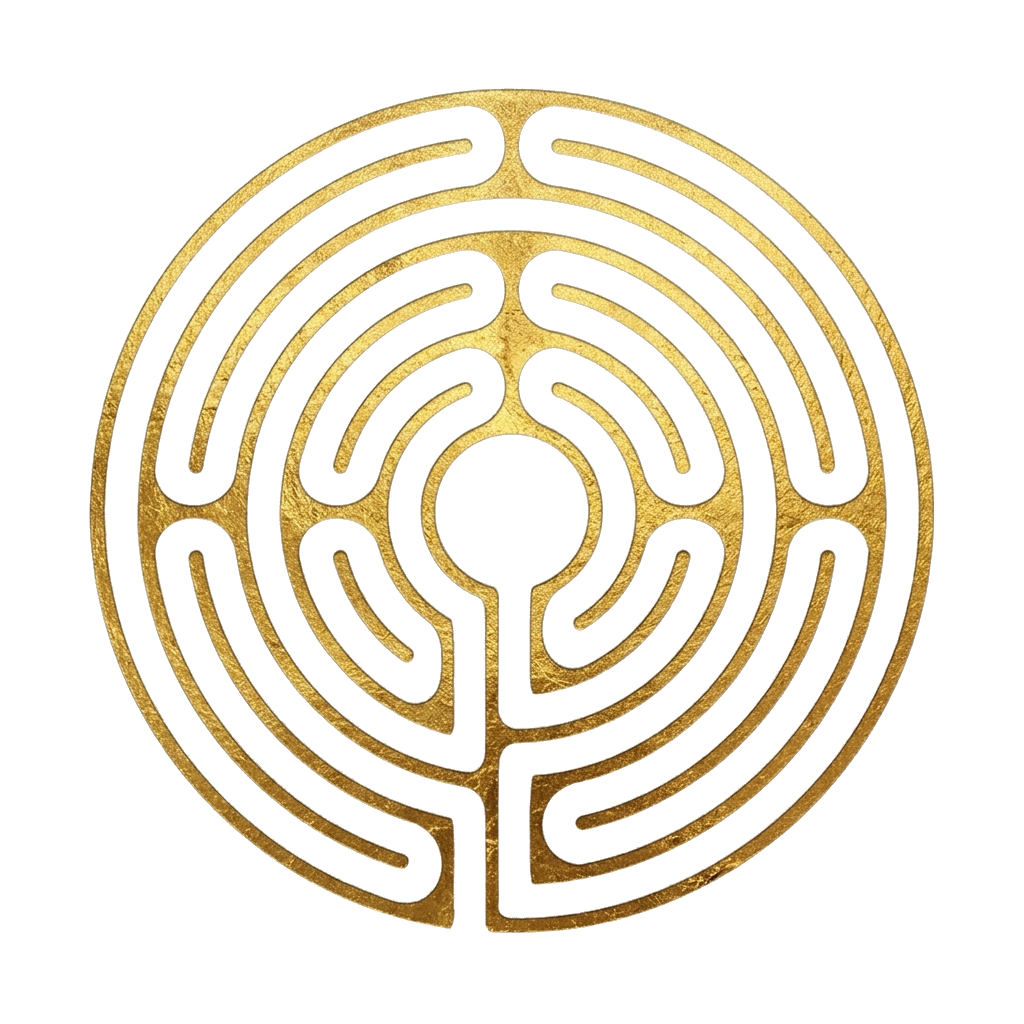
Labyrinth
The unicursal path to the center — not a maze with dead ends but a single winding route that draws the walker inward, found across civilizations as a symbol of pilgrimage, initiation, and the journey to the self.
About Labyrinth
The labyrinth is one of humanity's oldest and most universal sacred symbols — a single, unicursal path that winds inward to a center and back out again. Unlike a maze, which offers branching choices and dead ends designed to confuse, the labyrinth has only one route. There is no possibility of getting lost. The walker surrenders the need to decide and simply follows where the path leads, a deceptively simple act that strips away the restless mind's demand for control and opens a doorway into contemplative presence.
Labyrinths appear across cultures and millennia with a consistency that suggests something fundamental about the pattern's resonance with human consciousness. The seven-circuit classical labyrinth carved on a pillar at Knossos connects to the Greek myth of Theseus and the Minotaur. Stone labyrinths line the coasts of Scandinavia, where fishermen walked them before setting out to sea. The kolam tradition of southern India traces labyrinthine patterns on thresholds each morning as acts of devotion and protection. The great eleven-circuit labyrinth set into the floor of Chartres Cathedral around 1200 CE became a pilgrimage substitute — walking its 861 feet of folded path served as a symbolic journey to Jerusalem for those who could not make the physical voyage. Native American traditions, Hopi petroglyphs, and Indonesian rice-paddy designs echo the same essential form.
The labyrinth functions simultaneously as a physical walking practice and a spiritual metaphor. As a practice, the rhythmic turning and retracing of steps induces a meditative state that practitioners across traditions have used for prayer, grief processing, decision-making, and ceremonial preparation. As a metaphor, it maps the inner journey of transformation — the winding descent toward the center mirrors the soul's movement inward through layers of distraction toward its essential nature, while the return outward represents the integration of insight into daily life. The path doubles back on itself repeatedly, bringing the walker close to the center and then away again, teaching patience and trust in a process that does not move in straight lines. This mirrors the lived experience of growth itself, where progress rarely feels linear and yet every step, however circuitous, is part of the one path.
Visual Description
The labyrinth takes two primary historical forms, each with distinct geometry and spiritual significance.
The classical or Cretan labyrinth — the older of the two — is a unicursal design of seven concentric circuits arranged around a central point. It is constructed from a seed pattern: a cross, four L-shapes at the corners, and four dots between them. From this seed, the paths are drawn by connecting endpoints in sequence, producing a pattern that folds back on itself in a way that feels far more complex than its simple construction suggests. The walker enters at the mouth, traverses all seven circuits in a seemingly unpredictable order — moving close to the center, then swinging back to the outer edge, then inward again — before finally arriving at the center. The path is never branching. There are no choices to make, no dead ends. The only decision is whether to enter. This seven-circuit form appears on Cretan coins from the third century BCE, on rock carvings in Galicia and Sardinia dating to the Bronze Age, and scratched into the walls of Pompeii. The number seven carries its own weight: seven planets of the ancient world, seven chakras, seven days of creation, seven stages of alchemical transformation.
The medieval or Chartres labyrinth is an eleven-circuit design laid into the floor of Chartres Cathedral around 1205 CE. It is contained within a circle approximately 12.9 meters in diameter, divided into four quadrants by the arms of a cross — a deliberate Christianization of the form. The path winds through all four quadrants in sequence, making 28 loops, 34 turns, and covering roughly 260 meters before reaching the six-petaled rosette at the center. Unlike the classical form, the Chartres design is more mathematically complex, with the path visiting each quadrant multiple times in a pattern that creates a meditative rhythm of approach and retreat. The rosette at the center — six petals arranged around a seventh central space — has been interpreted as representing the six days of creation, the six-petaled lily of the Virgin Mary, or the flowering of the soul upon reaching its destination. Medieval pilgrims walked or crawled this path on their knees as a substitute for the pilgrimage to Jerusalem, which the Crusades had made dangerous or impossible. The labyrinth was sometimes called the chemin de Jerusalem — the road to Jerusalem.
Beyond these two dominant forms, labyrinths appear in extraordinary variety: the stone-lined trojaborgar (Troy Towns) along Scandinavian coastlines, some with as many as fifteen circuits; the kolam threshold designs of Tamil Nadu, drawn each morning in rice powder as protective labyrinthine patterns; the Tohono O'odham basket designs depicting I'itoi (Elder Brother) at the center of a circular maze; the Roman mosaic labyrinths found from Britain to North Africa, typically square rather than circular, often depicting the Minotaur at the center; and the turf labyrinths of England and Germany, cut into hillside grass and walked at seasonal festivals. What unites all these forms is the unicursal principle: one path, no choices, only commitment to the journey.
Esoteric Meaning
The labyrinth represents the soul's journey from the periphery of ordinary consciousness to the still center of divine union — and back again, transformed.
The Greek myth of Theseus and the Minotaur encodes this teaching in narrative form. The labyrinth beneath Knossos was built by Daedalus to contain the Minotaur — a creature half-human, half-bull, born of Queen Pasiphae's unnatural union with the Cretan Bull. Athens was compelled to send seven youths and seven maidens into the labyrinth every nine years as tribute, where they were devoured. Theseus volunteered to enter, received a ball of thread from Ariadne (whose name means 'most holy'), slew the Minotaur, and followed the thread back to the entrance. Read esoterically, the Minotaur is the shadow self — the beast at the center of our own psyche that feeds on the innocence we sacrifice to it. The labyrinth is the winding, disorienting path of self-knowledge that must be traversed before the shadow can be confronted. Ariadne's thread is the lifeline of awareness, the continuity of consciousness that prevents the seeker from becoming lost in the unconscious. The slaying is not destruction but integration: Theseus does not escape the labyrinth by avoiding the center but by reaching it, facing what he finds there, and returning changed.
This death-and-rebirth structure is the labyrinth's essential esoteric meaning across all traditions. To enter the labyrinth is to die to the outer world. The winding path disorients the rational mind, dissolves the walker's sense of direction and progress, strips away the usual landmarks of identity. The center is the place of encounter — with the divine, the shadow, the void, the self, the beloved. The return journey is resurrection: the same path walked in reverse, but the walker is not the same person who entered.
In Christian mysticism, the labyrinth became a symbol of the via purgativa, the purgative way. The eleven circuits of Chartres were sometimes mapped to the stations of the cross, each turn a stage in Christ's passion. Walking the labyrinth on one's knees was an act of penitential devotion — but also, for those with eyes to see, a reenactment of the soul's descent into matter, its suffering at the center, and its triumphant return to God. The labyrinth at Chartres is positioned at the exact same distance from the entrance as the rose window is from the floor — if the west wall were folded flat, the rose window would land directly on the labyrinth's center. This architectural alignment encodes the teaching: the labyrinth below (the earthly journey) mirrors the rose above (divine wholeness). The path leads to the place where they meet.
In Hindu and tantric traditions, the labyrinth maps onto the path of kundalini — the serpent energy coiled at the base of the spine that must wind through the seven chakras before reaching the crown. The seven circuits of the classical labyrinth correspond to the seven energy centers. The path's characteristic back-and-forth movement — approaching the center, retreating, approaching again — mirrors the actual experience of spiritual awakening, which is never linear but always spiraling, recursive, and often disorienting.
As a walking meditation, the labyrinth engages the body as a vehicle for contemplation in ways that seated meditation cannot. The rhythmic movement of the feet, the gentle turns, the narrowing and widening of the path — all of these produce a physical experience of surrender. The walker cannot get lost (there are no wrong turns) but also cannot rush ahead (the path will not be shortened). This enforced patience, this stripping away of the illusion of control, is itself the teaching. The labyrinth says: you do not need to know the way. You only need to keep walking.
Exoteric Meaning
On the surface, the labyrinth is a symbol of journey, pilgrimage, and the experience of navigating complexity to reach a goal.
In its most accessible reading, the labyrinth represents life's path — full of unexpected turns, apparent reversals, and moments where the destination seems to recede even as progress is being made. Unlike a maze, which tests the intellect with branching choices and dead ends, the labyrinth tests something deeper: the willingness to trust a path whose logic cannot be seen from inside it. This makes it a powerful metaphor for any sustained undertaking — a career, a relationship, a creative project, a healing process — where the way forward is not straight and the endpoint cannot be seen from the starting position.
Historically, labyrinths served practical and communal purposes alongside their symbolic ones. Scandinavian fishermen walked stone labyrinths (trojaborgar) before setting out to sea, believing the winding path would trap malevolent trolls and winds inside its circuits, ensuring safe passage. English turf labyrinths were walked at spring festivals, likely connected to fertility rites — the passage into the earth-cut path and out again enacting the seed's journey into the soil and the plant's emergence. Roman mosaic labyrinths at villa entrances served as protective thresholds, a visual ward against evil entering the home. In each case, the labyrinth marked a boundary between one state and another — the safe and the dangerous, the profane and the sacred, the old self and the new.
In the contemporary world, labyrinth walking has experienced a significant revival. The Reverend Lauren Artress, Canon for Special Ministries at Grace Cathedral in San Francisco, traveled to Chartres in 1991 and brought the practice back to the United States, installing a canvas Chartres-style labyrinth at Grace Cathedral that has since been walked by over a million people. The Labyrinth Society, founded in 1998, now tracks over 6,000 labyrinths worldwide in hospitals, prisons, parks, retreat centers, schools, and churches. Medical studies have documented measurable reductions in stress, blood pressure, and anxiety among labyrinth walkers, and the practice is increasingly used in palliative care, addiction recovery, grief counseling, and trauma therapy. What was once a tool of medieval pilgrimage has become a modern therapeutic practice — the form ancient, the application adapted to contemporary need.
Usage
The labyrinth has been used across millennia in remarkably diverse contexts, each drawing on its core properties of containment, transformation, and guided passage.
Pilgrimage and devotion. Medieval Christians walked cathedral labyrinths as a substitute for the pilgrimage to Jerusalem. The practice was especially common during the Crusades, when travel to the Holy Land was dangerous or impossible. At Chartres, pilgrims walked the labyrinth on their knees on Good Friday, taking up to an hour to reach the center. Some cathedrals — Amiens, Reims, Saint-Quentin — had labyrinths destroyed in the 18th century by clergy who objected to children playing on them during services, but the practice itself survived in folk tradition and has been revived since the 1990s.
Initiation and ritual transition. In many traditions, the labyrinth marks the passage between states of being. Hopi traditions describe the labyrinth as the symbol of emergence — the path through which the people passed from one world to the next. Tohono O'odham baskets depict the figure of I'itoi at the center of a labyrinthine design, representing the journey of life and the passage to the spirit world. Scandinavian stone labyrinths were walked by fishermen before voyages and by young people at courtship festivals, marking the transition from one life stage to another.
Walking meditation and contemplative practice. The labyrinth is increasingly used as a tool for embodied meditation. The three-stage practice — releasing (walking in), receiving (dwelling at the center), and returning (walking out) — provides a simple structure for contemplative experience. Unlike seated meditation, labyrinth walking engages the body, making it accessible to people who struggle with stillness. The practice has been adopted by Christian, Buddhist, Jewish, Sufi, secular, and interfaith communities alike.
Healing and therapeutic application. Since the mid-1990s, labyrinths have been installed in over 300 hospitals and healthcare facilities in North America alone. Johns Hopkins, Walter Reed, and numerous hospice centers use labyrinth walking as a complementary therapy. Research published in the Journal of Holistic Nursing and elsewhere has documented reductions in cortisol levels, heart rate, and self-reported anxiety following labyrinth walks. The practice is used in addiction recovery programs, bereavement support, PTSD treatment, and end-of-life care.
Protective and apotropaic use. Roman mosaic labyrinths at building entrances were designed to trap evil spirits, who were believed to be able to travel only in straight lines. Scandinavian trojaborgar served a similar function — trolls, winds, and malevolent entities were drawn into the winding path and could not find their way out. The labyrinth at the entrance to the Lucca Cathedral in Italy bears an inscription: 'This is the labyrinth which the Cretan Daedalus built, out of which nobody could get who was inside.' Even as ornamentation, the labyrinth retained its power as a threshold guardian.
Architectural and civic design. Turf labyrinths were cut into village greens across England and Northern Europe, maintained communally and walked at seasonal festivals — particularly at Easter and Midsummer. These civic labyrinths served as gathering points, ritual spaces, and expressions of local identity. Names like 'Julian's Bower,' 'Troy Town,' and 'Walls of Troy' connected them to classical mythology while rooting them in local tradition.
In Architecture
Chartres Cathedral, France (c. 1205 CE). The most famous labyrinth in the world. An eleven-circuit design laid in blue and white limestone into the floor of the nave, 12.9 meters in diameter. The path covers 260 meters. Positioned precisely so that if the west wall were folded down, the great rose window would land exactly on the labyrinth — encoding the relationship between the earthly journey (below) and divine illumination (above). Partially obscured by chairs for centuries, it was restored to full access in 2000. Walked by an estimated 300,000 visitors annually.
Knossos, Crete (c. 1700 BCE). The Palace of Knossos — excavated by Sir Arthur Evans beginning in 1900 — is the legendary site of the Minotaur's labyrinth. While no actual labyrinth structure has been found within the palace, the building's complex multi-level plan (over 1,300 rooms) may itself have inspired the myth. Cretan coins from the 3rd century BCE depict both square and circular labyrinth designs, confirming the deep association between Knossos and the labyrinth symbol. Some scholars, including geologist Nicholas Howarth, have proposed the Gortyn cave system near Knossos as the physical source of the labyrinth myth — a network of quarried tunnels extending over 2.5 kilometers.
Scandinavian stone labyrinths (c. 1200 CE — present). Over 600 stone labyrinths survive along the coastlines of Sweden, Finland, Norway, and the Baltic states — the highest concentration of labyrinths anywhere in the world. Built from locally gathered stones arranged on flat ground, most follow the classical seven-circuit or eleven-circuit pattern, ranging from 5 to 20 meters in diameter. Known as trojaborgar (Troy Towns) or jungfrudanser (Maiden Dances), they are concentrated near fishing communities and coastal areas. The largest cluster — over 30 labyrinths — is on the Bolshoi Zayatsky Island in Russia's Solovetsky archipelago, dated to approximately 3000 BCE, making them among the oldest stone labyrinths known.
Lucca Cathedral, Italy (12th-13th century). A finger-tracing labyrinth carved into a pillar of the cathedral's portico. Only 50 centimeters in diameter, it is a classical seven-circuit design accompanied by a Latin inscription referencing Daedalus and the Cretan labyrinth. This miniature form — designed to be traced with the finger rather than walked — represents a distinct tradition of labyrinth engagement, meditative and intimate rather than processional.
Grace Cathedral, San Francisco (1991). Two Chartres-replica labyrinths installed by the Reverend Lauren Artress — one woven into a tapestry inside the cathedral, one cast in terrazzo on the outdoor terrace. These installations launched the modern labyrinth revival movement. Over one million people have walked the Grace Cathedral labyrinths since their installation, and the model has been replicated in thousands of locations worldwide.
Hollywood Stone, Ireland (c. 550 CE). A pillar stone in County Wicklow inscribed with a classical seven-circuit labyrinth alongside a cross — one of the earliest known examples of the labyrinth in a Christian context in the British Isles, predating the great cathedral labyrinths by several centuries.
Hopi Mesa, Arizona. The Tapu'at (Mother and Child) symbol — a square labyrinth design — appears in rock carvings, pottery, and basketry across the Hopi mesas. It represents the process of emergence from one world to the next and the path of life from birth through death. The design is distinct from European labyrinth forms but shares the unicursal, centripetal principle.
Significance
The labyrinth is both universal and specific — appearing independently across cultures separated by oceans and millennia, yet carrying remarkably consistent meaning wherever it surfaces.
Its significance operates on multiple levels simultaneously. Geometrically, it is a solution to the problem of containing maximum path length within minimum space — a fact that gives it inherent mathematical elegance and practical utility. Psychologically, it externalizes the structure of introspection itself: the winding, recursive, disorienting process by which consciousness moves toward self-knowledge. Spiritually, it maps the perennial teaching found in every tradition Satyori documents: that the journey to the center of the self is the journey to the divine, and that this journey requires surrender of the illusion of control.
The labyrinth's resurgence in the contemporary world — from hospitals to corporate retreats, from prison yards to public parks — testifies to a deep cultural hunger for embodied contemplative practice. In an age of constant distraction and apparent optionality, the labyrinth offers something radical: a path with no choices, no wrong turns, no way to fail. It asks only that you begin walking and trust that the path knows where it is going.
For the student of cross-traditional wisdom, the labyrinth is a master symbol: it connects Greek mystery religion to Christian mysticism, Hindu kundalini yoga to Native American emergence stories, Scandinavian folk magic to modern neuroscience. It demonstrates, in stone and soil and tile, one of Satyori's core premises — that the deepest human truths arise independently wherever human beings turn their attention inward.
The labyrinth does not argue. It does not explain. It invites you to walk.
Connections
Meditation — The labyrinth is one of the oldest forms of walking meditation, predating the Buddhist tradition of kinhin and the Christian practice of lectio divina on foot. Both seated meditation and labyrinth walking use sustained, rhythmic activity to quiet the discursive mind and open access to deeper states of awareness. The labyrinth externalizes the meditative process: the winding path is the wandering mind, the center is stillness, the return is integration.
Mystery Schools — The labyrinth's connection to initiation is ancient and direct. The Eleusinian Mysteries — the most prestigious initiatory rite in the ancient world — involved a descent into darkness, an encounter with the divine, and a return to the light: the same three-stage structure the labyrinth embodies. The labyrinth at Knossos, whether literal or mythological, was the site of Theseus's archetypal initiation — entry into the unknown, confrontation with the shadow, emergence transformed. Many scholars believe that labyrinthine processions were part of the ritual choreography at Eleusis and other mystery sites, with the winding path serving to disorient initiates and dissolve their ordinary sense of identity before the central revelation.
Spiral — The spiral and the labyrinth are the two fundamental expressions of curved, centripetal movement in sacred geometry. The spiral moves inward (or outward) without return — it is the path of growth, expansion, and evolution. The labyrinth moves inward and returns — it is the path of pilgrimage, reflection, and integration. Together they express the full rhythm of the soul's movement: expansion into experience (spiral) and return to center (labyrinth).
Yoga — The seven circuits of the classical labyrinth correspond to the seven chakras of the yogic subtle body. Walking the labyrinth can be understood as a physical enactment of the kundalini's ascent — the energy moving not in a straight line but in the winding, back-and-forth pattern that characterizes actual spiritual development. The labyrinth's demand for surrender and trust mirrors yoga's central teaching of ishvara pranidhana (surrender to the divine).
Qigong — Like labyrinth walking, qigong is a practice of slow, intentional, embodied movement designed to cultivate awareness and shift the practitioner's state of consciousness. The labyrinth's unicursal path shares structural similarities with certain qigong walking patterns, and both practices work with the principle that the body in gentle motion can access states of consciousness that the body at rest cannot.
Further Reading
- Hermann Kern, Through the Labyrinth: Designs and Meanings Over 5,000 Years (Prestel, 2000) — the definitive scholarly survey, with over 500 illustrations covering labyrinths from every era and culture.
- Lauren Artress, Walking a Sacred Path: Rediscovering the Labyrinth as a Spiritual Practice (Riverhead Books, 1995) — the book that launched the modern labyrinth revival, by the woman who brought the Chartres labyrinth practice to Grace Cathedral.
- Jeff Saward, Labyrinths and Mazes: A Complete Guide to Magical Paths of the World (Lark Books, 2003) — comprehensive field guide by the editor of Caerdroia, the journal of mazes and labyrinths.
- Penelope Reed Doob, The Idea of the Labyrinth from Classical Antiquity through the Middle Ages (Cornell University Press, 1990) — scholarly study of the labyrinth in literature, philosophy, and theology from Homer through Dante.
- W.H. Matthews, Mazes and Labyrinths: Their History and Development (Dover, 1970; originally 1922) — the classic early survey, still valuable for its breadth and its documentation of now-lost turf labyrinths.
- Helen Curry, The Way of the Labyrinth: A Powerful Meditation for Everyday Life (Penguin Compass, 2000) — practical guide to labyrinth walking as contemplative practice, with exercises for personal and group use.
- Sig Lonegren, Labyrinths: Ancient Myths and Modern Uses (Gothic Image, 2001) — covers dowsing, sacred geometry, and earth energy dimensions of labyrinth practice.
- Jill Kimberly Hartwell Geoffrion, Praying the Chartres Labyrinth (Pilgrim Press, 2006) — focused study of the Chartres labyrinth in its Christian contemplative context.
Frequently Asked Questions
What does the Labyrinth symbolize?
The labyrinth represents the soul's journey from the periphery of ordinary consciousness to the still center of divine union — and back again, transformed.
Where does the Labyrinth originate?
The Labyrinth originates from the Uncertain; Cretan labyrinth (Knossos) is most famous but pattern appears independently across cultures tradition. It dates to c. 2500 BCE — present. It first appeared in Crete, Scandinavia, India, Europe, Americas — worldwide.
How is the Labyrinth used today?
The labyrinth has been used across millennia in remarkably diverse contexts, each drawing on its core properties of containment, transformation, and guided passage.