Hamsa / Hand of Fatima
The protective open hand -- found across Judaism, Islam, and pre-Abrahamic Middle Eastern traditions. The Hamsa deflects the evil eye and channels divine protection through a symbol that predates every religion that claims it.
About Hamsa / Hand of Fatima
The Hamsa is a palm-shaped amulet depicting an open right hand, used across the Middle East, North Africa, and beyond as a symbol of divine protection, blessing, and the power to deflect malevolent forces. The word 'hamsa' comes from the Arabic for 'five,' referring to the five fingers of the hand, and the symbol predates all three Abrahamic religions by millennia. Archaeological evidence places it in ancient Mesopotamia and Carthage, where it was associated with the goddess Tanit (the Phoenician equivalent of Astarte/Ishtar). The hand was already old when Judaism, Christianity, and Islam adopted it.
What makes the Hamsa remarkable is its antiquity but its stubborn persistence across religious boundaries. In Judaism and the Hand of Miriam, associated with the sister of Moses who watched over his basket in the Nile and danced after the crossing of the Red Sea. In Islam, it is the Hand of Fatima, honoring the Prophet Muhammad's daughter. In Christianity, it appears as the Hand of Mary. In each case, the symbol is linked to a powerful feminine figure within the tradition -- a protectress, a mother, a guardian. This consistent feminine association across otherwise competing religions suggests that the Hamsa taps into something pre-religious, something rooted in the primal human experience of the mother's hand as the first source of safety.
The five fingers carry multiple layers of meaning. In Islam, they represent the Five Pillars. In Judaism, the five books of the Torah. In broader folk tradition, the number five itself was considered protective -- holding up an open palm with five spread fingers was a universal gesture of warding off danger, and the Hamsa crystallizes that gesture into permanent form. The eye often depicted in the center of the palm is not decoration but function: it is the counter-gaze that watches back at whatever malevolent force is watching you. The evil eye cannot operate if it is seen. The Hamsa sees it.
The symbol's cross-traditional survival is a case study in how deep symbols outlast the religions that adopt them. Empires rise and fall. Theological systems compete and supplant each other. But the open hand, palm forward, eye at center, keeps appearing on doorways, necklaces, keychains, and nursery walls because the human need for protection -- the need to feel that something stands between you and the forces that mean you harm -- does not change with the theology of the century. The Hamsa is older than any living religion and will likely outlast all of them.
Visual Description
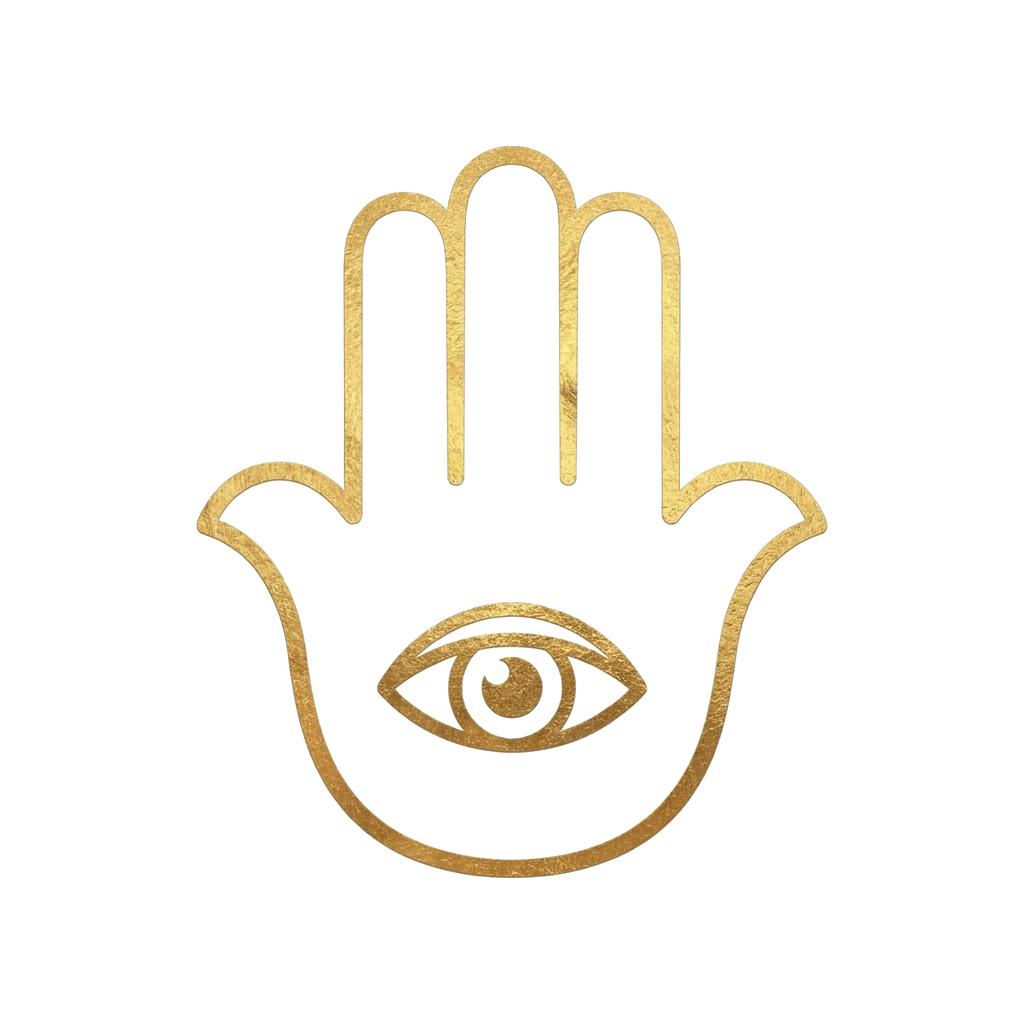
The Hamsa is a symmetrical open hand, typically with two thumbs (one on each side) rather than the anatomical arrangement of a natural hand. This bilateral symmetry is intentional -- the Hamsa is not a depiction of a hand but a symbol in the shape of a hand, and the symmetry gives it a formal, iconic quality distinct from a traced palm.
The hand may point upward (fingers reaching toward heaven, representing prayer, blessing, and the channeling of divine energy downward) or downward (fingers pointing toward the earth, representing protection, the warding off of evil, and the deflection of malevolent attention). Both orientations are common and carry slightly different emphasis, though the protective function is primary in both.
At the center of the palm, an eye is frequently depicted -- open, watching, alert. This is the counter-gaze, the eye that watches back at the evil eye. In Jewish Hamsas, the eye may be replaced by a Star of David, Hebrew letters (particularly the letter Shin, standing for Shaddai, a divine name), or a fish (symbol of fertility and protection from the evil eye in Jewish folk tradition). In Islamic Hamsas, the center may contain calligraphy, geometric patterns, or floral motifs consistent with the tradition's aniconism.
The five fingers may be decorated with intricate patterns -- filigree, scrollwork, floral designs, geometric tessellations -- reflecting the artistic traditions of whichever culture produced the particular Hamsa. Moroccan Hamsas tend toward dense, complex patterning. Israeli Hamsas range from traditional to modern minimalist. Turkish Hamsas often incorporate blue glass or enamel, connecting to the nazar (evil eye bead) tradition.
Materials range from precious metals (gold and silver, especially in jewelry and high-end decorative pieces) to painted ceramics, carved wood, blown glass, embroidered fabric, and mass-produced zinc alloy. The Hamsa appears on walls above doorways, on necklaces and bracelets, on keychains, embedded in floor tiles, painted on the hulls of fishing boats, and tattooed on skin. The diversity of materials and contexts reflects the symbol's unusual property of being simultaneously sacred and everyday -- a spiritual object that lives comfortably in the kitchen, the car, and the marketplace.
Esoteric Meaning
The esoteric dimensions of the Hamsa unfold across the traditions that have adopted it, each adding a layer of meaning to the symbol's already ancient core.
In Kabbalah, the Hamsa's five fingers map to the five levels of the soul: nefesh (vital soul), ruach (spirit), neshamah (breath of God), chayah (living essence), and yechidah (unique oneness with the divine). The hand thus represents the complete soul in its fullness, from its most material expression to its most transcendent. Displaying the Hamsa is a statement of wholeness -- a declaration that all five levels of the soul are present and active, forming a complete circuit of protection.
The eye at the Hamsa's center has deeper implications than simple counter-surveillance. In Sufi tradition, the eye of the heart (ayn al-qalb) is the organ of spiritual perception -- the faculty that sees through appearances to the reality beneath. The Hamsa's eye is this inner eye externalized, a reminder that genuine protection comes not from shutting out the world but from seeing it clearly. You cannot be deceived by what you can perceive fully. The evil eye operates through unconscious envy, unacknowledged resentment, covert ill-will. The Hamsa's eye makes the unconscious conscious. It names what is unnamed. It sees what hides.
In Hindu and Buddhist traditions, the open palm appears as the Abhaya Mudra (gesture of fearlessness), displayed by the Buddha and by Hindu deities to communicate: 'Fear not. No harm will come to you in my presence.' The Hamsa carries this same gestural meaning, compressed into an amulet. It is a permanent Abhaya Mudra -- an always-open hand saying perpetually: 'Be not afraid.'
The number five, fundamental to the Hamsa, carries esoteric weight across traditions. Five elements in Vedic and Chinese cosmology. Five pillars of Islam. Five wounds of Christ. Five Platonic solids. The human body's fivefold symmetry (head, two arms, two legs). The Hamsa crystallizes the fivefold principle into a single protective image, suggesting that the human form itself -- the body with its five extensions -- is sacred and protected when properly aligned.
Exoteric Meaning
On the most accessible level, the Hamsa is an object of protection. You hang it on your wall, wear it around your neck, clip it to your baby's stroller, mount it above your door, or display it in your shop. Its function is to keep bad things away -- jealousy, illness, misfortune, the ill-will of others, the unspecified malevolence that the Mediterranean and Middle Eastern world calls the evil eye.
This is not a minor function. In cultures where the evil eye belief is taken seriously -- and this includes hundreds of millions of people across the Middle East, North Africa, South Asia, and Southern Europe -- protection against it is a daily practical concern. A new baby, a beautiful child, a successful business, a new car, a good harvest -- anything that might provoke envy is vulnerable, and the Hamsa is a primary countermeasures. The logic is straightforward: display the symbol, invoke its protection, and the envious gaze is deflected or returned.
Beyond the evil eye specifically, the Hamsa functions as a general blessing. It represents divine favor, maternal protection, the presence of God's hand in daily life. Giving a Hamsa as a gift communicates: 'I want good things for you and protection from bad things.' Receiving one communicates: 'You are under the care of something larger than yourself.' In a world that can feel threatening and uncertain, this is not a small comfort.
The Hamsa has also become a significant cultural and identity symbol. For many Jewish communities, particularly Mizrahi and Sephardic Jews whose families came from the Middle East and North Africa, the Hamsa is a marker of cultural identity -- a connection to ancestral traditions that predates and transcends the European-centered narrative of Jewish history. For many Arab and Berber communities, it carries similar weight as a cultural anchor.
Usage
The Hamsa is used in four primary contexts:
Architectural protection. Hamsas are mounted above doorways, embedded in walls, and placed at the entrances of homes, shops, and public buildings throughout the Middle East and North Africa. The placement is specific: facing outward, toward whatever approaches from outside. In Morocco, hamsas are commonly found on the doors of the old medinas, painted or carved into the wood. In Israel, ceramic and metal hamsas are mounted at entrances ranging from apartments to synagogues. The purpose in all cases is threshold protection -- sanctifying the boundary between inside and outside, safe and unsafe, mine and the world's.
Personal jewelry and amulets. Hamsa pendants, rings, bracelets, and earrings are worn throughout the region and, increasingly, worldwide. The jewelry may be simple (a small silver hand on a chain) or elaborate (gold filigree with gemstones and enamel). Wearing the Hamsa on the body extends its protective function to the individual wherever they go. It is a highly common pieces of jewelry in Jewish and Muslim communities and has become widely popular in Western fashion, though this popularization sometimes strips it of its protective intention.
Baby and child protection. In many Middle Eastern and North African cultures, Hamsa amulets are placed on or near newborn babies and young children, who are considered particularly vulnerable to the evil eye because they are most likely to attract admiration and thus envy. Blue-eyed Hamsas (combining the Hamsa with the nazar/evil eye bead) are especially common for children.
Ritual and devotional use. In some Jewish communities, the Hamsa is incorporated into ritual objects -- embroidered on Torah covers, engraved on kiddush cups, included in marriage contracts (ketubot). In Islamic folk practice, Hamsas bearing Quranic verses are used as protective amulets (taweez). In both cases, the symbol functions as a meeting point between folk tradition and formal religion, carrying the weight of both.
In Architecture
Doors of Moroccan Medinas. The old cities of Fez, Marrakech, and Essaouira are dense with Hamsa imagery. Carved wooden doors, wrought iron knockers in Hamsa form, and painted hands above lintels mark the entrances to homes, riads, and mosques. The Hamsa here serves both as protection and as architectural ornament, its repetition across the cityscape creating a collective shield.
Synagogues of the Maghreb and Middle East. Synagogues in Morocco, Tunisia, Turkey, and Iraq historically featured Hamsas in prominent positions -- on ark curtains (parochet), carved into Torah cases (tik), and mounted above entrances. The El Ghriba Synagogue in Djerba, Tunisia, one of the oldest synagogues in the world, incorporates Hamsa imagery throughout its interior decoration.
Modern Israeli Architecture and Public Art. The Hamsa appears throughout Israeli public spaces, from bus stations to parks to government buildings. The Knesset (Israeli parliament) building in Jerusalem incorporates Hamsa motifs in its interior decoration. Street art and murals in Tel Aviv, Jaffa, and Haifa frequently feature Hamsas, often combined with contemporary design elements.
Ottoman and Islamic Architecture. While formal Islamic architecture tends toward geometric and calligraphic decoration rather than figural symbols, the Hamsa appears in folk architectural contexts throughout the Ottoman sphere -- painted on the walls of homes in Anatolia, carved into the facades of houses in the Balkans, and incorporated into the decorative tile work of North African hammams.
Significance
The Hamsa's significance runs in two directions simultaneously. On one level, it is a highly practical and widely used protective symbols in the world. Millions of people -- from Orthodox Jewish grandmothers in Brooklyn to Moroccan shopkeepers to secular millennials buying jewelry online -- display the Hamsa with genuine belief in its protective function. This is not naive superstition. It is participation in a symbolic practice whose consistency across time and culture suggests it connects to something real about how consciousness interacts with intention and attention.
On a deeper level, the Hamsa demonstrates one of Satyori's core premises: that the deepest spiritual truths are not the property of any single tradition. The protective hand predates Judaism, Christianity, and Islam. It passed through all of them without being captured by any of them. It functions for people who can articulate its theology and for people who cannot. This kind of persistence is a marker of a genuinely archetypal symbol -- one rooted not in doctrine but in the structure of human consciousness itself.
The Hamsa also is a quiet bridge between traditions that are often positioned as adversaries. A Jewish Israeli and a Palestinian Muslim may disagree about everything political and theological, but both may have a Hamsa on their wall. The symbol does not resolve the conflict, but it reveals a shared layer of experience beneath it -- a common recognition of vulnerability, a common impulse to invoke protection, a common trust that the divine responds to that invocation. In a world that emphasizes religious division, the Hamsa is a stubborn reminder of what was shared before the divisions formed.
Connections
Evil Eye / Nazar -- The Hamsa and the evil eye are complementary opposites. The evil eye is the threat; the Hamsa is the defense. They form a paired system found throughout the Mediterranean and Middle Eastern world.
Kabbalah -- In Jewish mystical tradition, the five fingers of the Hamsa correspond to the five levels of the soul (nefesh, ruach, neshamah, chayah, yechidah) and the five books of the Torah.
Cross -- Both the Hamsa and the cross function as protective symbols worn on the body and placed at thresholds. The gesture of blessing in Christian tradition (the open hand raised) mirrors the Hamsa's form.
Yoga -- The open palm in yoga mudras (particularly Abhaya Mudra, the gesture of fearlessness) carries the same meaning as the Hamsa: the hand raised to say 'do not fear, you are protected.'
Sacred Geometry -- The fivefold symmetry of the Hamsa connects to the broader significance of the pentad in sacred geometry, including the golden ratio and the human body's fivefold symmetry.
Further Reading
- Lucienne Thys-Senocak, The Hand of Fatima: Women and Protection in Islam and Judaism
- Naama Vilozny, Hamsa: The Hand in Jewish Art (Ben Zvi Institute)
- Frederick Thomas Elworthy, The Evil Eye: The Classic Account of an Ancient Superstition (Dover, 2004; originally 1895)
- Rivka Ulmer, The Evil Eye in the Bible and in Rabbinic Literature (KTAV)
- Edward William Lane, An Account of the Manners and Customs of the Modern Egyptians -- Chapter on amulets and protective symbols
Frequently Asked Questions
What does the Hamsa / Hand of Fatima symbolize?
The esoteric dimensions of the Hamsa unfold across the traditions that have adopted it, each adding a layer of meaning to the symbol's already ancient core.
Where does the Hamsa / Hand of Fatima originate?
The Hamsa / Hand of Fatima originates from the Pre-Abrahamic Mesopotamian/Phoenician; adopted independently by Judaism, Islam, and Christianity tradition. It dates to c. 1800 BCE (Mesopotamian origins) through the present day. It first appeared in Middle East, North Africa, Mediterranean. Primary use areas include Morocco, Tunisia, Algeria, Egypt, Israel/Palestine, Turkey, Iraq, and Iran. Now global through diaspora communities and popular culture..
How is the Hamsa / Hand of Fatima used today?
Architectural protection. Hamsas are mounted above doorways, embedded in walls, and placed at the entrances of homes, shops, and public buildings throughout the Middle East and North Africa. The placement is specific: facing outward, toward whatever approaches from outside. In Morocco, hamsas are commonly found on the doors of the old medinas, painted or carved into the wood. In Israel, ceramic and metal hamsas are mounted at entrances ranging from apartments to synagogues. The purpose in all cases is threshold protection -- sanctifying the boundary between inside and outside, safe and unsafe, mine and the world's.