Flower of Life
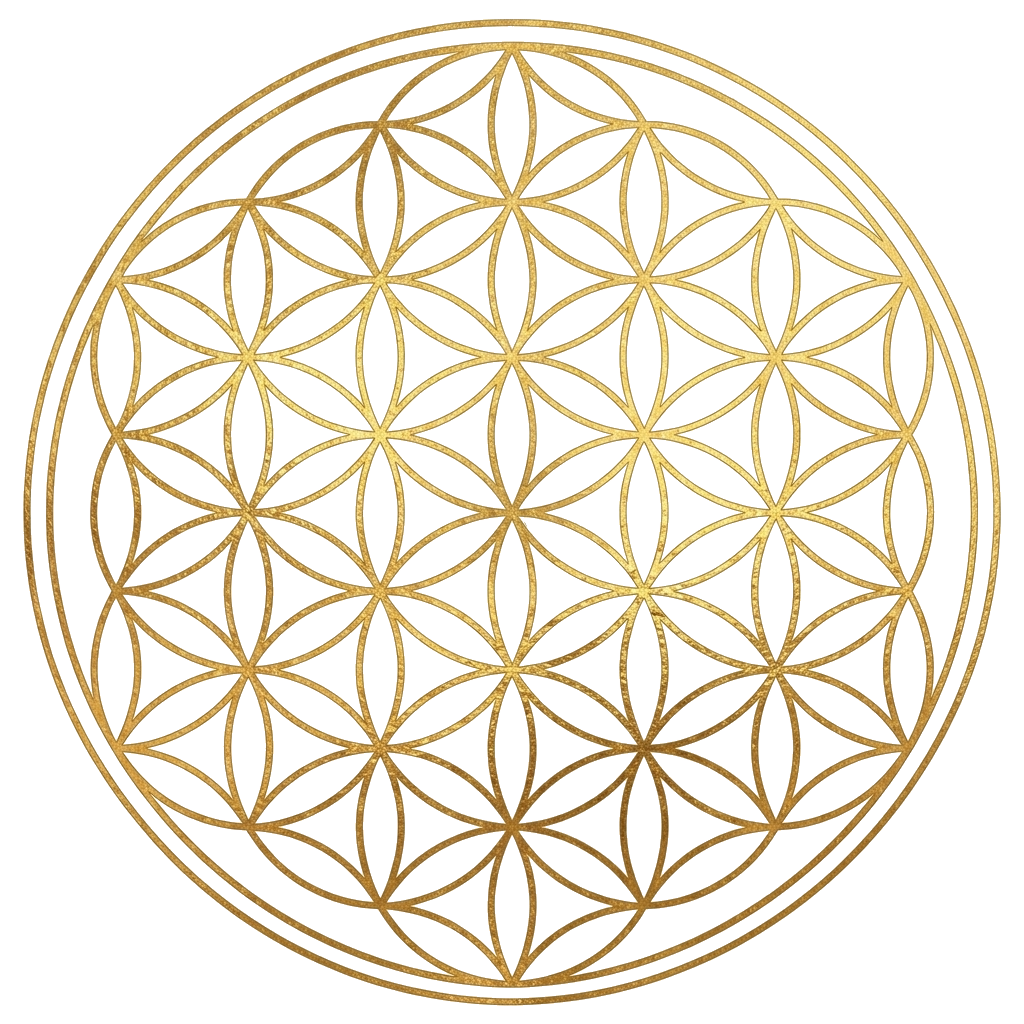
A geometric pattern of 19 overlapping circles arranged in sixfold symmetry — found in temples from Egypt to China, encoding the mathematical blueprint from which all sacred geometry unfolds.
About Flower of Life
The Flower of Life consists of 19 equally-spaced, overlapping circles arranged in a hexagonal pattern — a figure found carved into temple walls from Egypt to China, from Assyria to medieval Europe. The whole figure enclosed within a larger circle. Each circle's center sits on the circumference of six surrounding circles, producing an intricate lattice of petal-shaped vesicae piscis — the almond-shaped intersections that have carried sacred meaning since antiquity.
The figure's real significance lies not in its visual beauty but in its generative power. Within this single pattern lie the templates for every regular polygon, the five Platonic solids, the Fibonacci sequence's geometric expression, and the proportions of the Golden Ratio. It is, in a very real mathematical sense, the mother pattern — the figure from which the entire vocabulary of sacred geometry can be derived.
The symbol appears across virtually every major civilization, often in sacred or royal contexts: carved into granite at the Temple of Osiris in Abydos, painted on palace thresholds in Assyria, woven into Chinese temple ornamentation, sketched in Leonardo da Vinci's private notebooks. Its cross-cultural presence has made it one of the most studied and debated figures in both academic geometry and esoteric philosophy. Whether one reads it as evidence of a shared primordial knowledge, as a natural consequence of compass-and-straightedge construction, or as a universal archetype arising from the mathematics of close-packing, the Flower of Life remains a uniquely powerful intersection of art, science, and spiritual inquiry.
Visual Description
The pattern begins with a single circle. A second circle of identical radius is drawn with its center on the circumference of the first, creating a vesica piscis at their intersection — the fundamental lens shape from which all subsequent geometry emerges. Four more circles are placed at equal intervals around the first, their centers also on its circumference, completing the first ring of six circles around one. This inner figure of seven circles is known as the Seed of Life.
A second ring of twelve circles is then added, each centered on an intersection point of the first ring, extending the pattern outward while maintaining the same radius throughout. The result is 19 circles total (1 central + 6 inner ring + 12 outer ring), all interlocking in sixfold rotational symmetry. The entire figure is bounded by a single encompassing circle.
The visual effect is a field of overlapping petals — 90 individual petal shapes formed by the vesicae piscis intersections. At the center of every group of three adjacent circles, a curved equilateral triangle appears; at the center of every six, a perfect regular hexagon emerges. The eye naturally reads rosettes, stars, and lattice structures within the overall pattern, depending on which set of lines one follows.
If the pattern is extended further — adding a third ring of circles to create 37 total — it generates what is called the Fruit of Life: 13 circles whose centers, when connected by straight lines, produce Metatron's Cube, the figure that contains the two-dimensional projections of all five Platonic solids. The Flower of Life is thus the intermediary stage between the simple Seed and the fully articulated Cube — the point at which latent geometry becomes visible structure.
Esoteric Meaning
In virtually every esoteric tradition that engages with it, the Flower of Life is read as a map of creation itself — the process by which undifferentiated unity becomes the manifest world of form, number, and relationship. The single first circle represents the Void, the Ain Soph, the primordial consciousness before differentiation. The act of drawing a second circle from the edge of the first is the first act of creation: awareness turning to regard itself, producing duality and the vesica piscis — the womb space from which all form will emerge.
Each successive circle recapitulates another 'day' of creation, another emanation outward from source. The Kabbalistic reading maps the seven circles of the Seed of Life onto the seven days of Genesis, and onto the seven lower Sephiroth of the Tree of Life. The Hermetic reading sees the same progression as the descent of spirit into matter through successive geometric densifications — from point to line to plane to solid. In both cases, the Flower of Life is not a static symbol but a narrative: it encodes the sequence of creation as a geometric story.
The derivation of the Platonic solids is central to its esoteric significance. From the Flower's two-dimensional lattice, one can extract the Fruit of Life (13 circles), and from the Fruit, Metatron's Cube. Within Metatron's Cube lie the wireframe projections of the tetrahedron (fire), cube (earth), octahedron (air), dodecahedron (spirit/aether), and icosahedron (water) — the five regular polyhedra that Plato, in the Timaeus, assigned to the five elements composing reality. The Flower of Life therefore contains, in compressed geometric form, the entire elemental architecture of the cosmos as understood by the ancient world.
At the deepest level, initiatory traditions treat the Flower of Life as a meditation object: by contemplating the progressive unfolding from one circle to nineteen, the practitioner re-enacts the creation sequence within their own awareness, moving from unity through complexity and back to the recognition that the complexity was always implicit in the original circle. It is a geometric koan — the answer is in the starting point, but you must complete the journey to see it.
Exoteric Meaning
On a purely geometric level, the Flower of Life is a study in circle packing — the mathematical problem of how to arrange circles of equal size to fill a plane most efficiently. The hexagonal packing it represents is provably the densest possible arrangement of circles in two dimensions, a fact that was conjectured by Kepler in 1611 and finally proven by Thomas Hales in 1998. The pattern therefore appears naturally wherever spheres or circles are packed together: in honeycombs, in the cross-section of soap bubbles, in the arrangement of cells during embryonic development, and in the crystal lattice structures of many minerals.
In mathematics education, the Flower of Life serves as an elegant demonstration of how complex geometric relationships emerge from simple, repeated operations. Using nothing but a compass set to a single fixed radius, a student can construct the entire pattern and then extract from it equilateral triangles, squares, hexagons, and the beginnings of the Platonic solids. It is a masterclass in emergent complexity — proof that richness of form does not require richness of method.
In design and decorative arts, the pattern has been used for millennia as a foundational grid. Islamic geometric art, in particular, uses the Flower of Life lattice as a starting scaffold from which to derive the complex star-and-polygon tessellations that adorn mosques and palaces across the Islamic world. Gothic rose windows, Celtic knotwork, and Art Nouveau organic patterning all draw on the same underlying hexagonal geometry. The pattern's appeal to designers across cultures and centuries reflects its unique combination of mathematical rigor and visual harmony.
Usage
In contemporary spiritual practice, the Flower of Life is one of the most widely used sacred geometry symbols. It appears on meditation tools, altar cloths, crystal grids, jewelry, and body art. Practitioners use it as a focus for meditation, believing that contemplating its progressive geometry quiets the analytical mind and opens intuitive perception. Crystal healing practitioners arrange stones on Flower of Life grids, using the pattern's geometry to direct and amplify energetic intentions.
In architecture and interior design, the pattern is incorporated into floor tiles, window designs, wall panels, and ceiling rosettes — both for its visual beauty and for its purported effect on the energetic quality of a space. Some practitioners of feng shui and vastu shastra recommend placing Flower of Life images in specific areas of a home to harmonize energy flow.
In education, the Flower of Life is used as a teaching tool for geometry, introducing students to concepts of symmetry, tessellation, ratio, and the relationship between two-dimensional and three-dimensional forms. Montessori and Waldorf pedagogies, both of which emphasize geometric construction as a path to mathematical understanding, frequently incorporate the pattern.
The symbol has also become a significant presence in digital culture, generative art, and data visualization. Programmers and digital artists use its mathematical properties as the basis for algorithmic art, fractal explorations, and interactive educational tools. Its clean mathematical definition makes it particularly well-suited to parametric design and 3D printing.
In Architecture
The most famous architectural instance of the Flower of Life is at the Temple of Osiris in Abydos, Egypt, where the pattern is inscribed on massive granite pillars in the Osireion — a subterranean structure dating to the reign of Seti I (c. 1280 BCE) or possibly earlier. The Abydos Flower of Life has been the subject of extensive debate: the pattern was not carved but appears to have been drawn or burned onto the stone surface with ochre, and its dating remains contested. Some researchers argue it is contemporaneous with the temple; others suggest it was added centuries later, possibly by Greek or Roman visitors familiar with Pythagorean geometry. Regardless of its precise date, it remains the most celebrated example of the symbol in an ancient sacred context.
At the Assyrian palace of Ashurbanipal at Nineveh (c. 645 BCE), Flower of Life patterns appear on threshold stones — the earliest securely dated instances of the complete figure. Their placement at doorways suggests an apotropaic or protective function, guarding the transition between spaces.
Leonardo da Vinci devoted extensive study to the Flower of Life in his private notebooks (Codex Atlanticus, c. 1478-1519), meticulously constructing the pattern and exploring its geometric derivatives. He derived the Platonic solids from it, studied the proportional relationships it encodes, and used its lattice as an organizational framework for understanding natural forms. His engagement with the pattern bridges medieval sacred geometry and Renaissance scientific inquiry.
In the Forbidden City in Beijing, spherical Flower of Life patterns appear beneath the paws of guardian lion statues (shishi) flanking important gates. The spheres, carved from stone or cast in bronze, display the characteristic overlapping-circle lattice across their curved surface — a remarkable feat of three-dimensional geometric carving. Their presence at the imperial palace connects the symbol to Chinese cosmological concepts of universal order and the harmony of heaven and earth.
Examples also appear in the Golden Temple (Harmandir Sahib) in Amritsar, in medieval Italian churches, in Romanesque and Gothic architectural ornamentation across Europe, and in Japanese temple art — confirming the pattern's truly global distribution across sacred architecture.
Significance
The Flower of Life operates simultaneously on multiple registers — mathematical, aesthetic, philosophical, and spiritual — without any of these registers contradicting the others. A pure mathematician can verify its geometric properties; a designer can confirm its visual harmony; a philosopher can explore its implications for the relationship between simplicity and complexity; a contemplative practitioner can use it as a meditation focus. Few symbols in human history manage to be rigorously true, visually beautiful, and spiritually evocative at the same time.
Its cross-cultural distribution raises profound questions about the transmission of knowledge in the ancient world. The pattern's presence in Mesopotamia, Egypt, India, China, and Europe — in contexts spanning thousands of years — has been interpreted as evidence of a shared body of geometric knowledge predating the historical record, as parallel independent discovery arising from the universality of compass-and-circle construction, or as a combination of both. The debate remains unresolved and continues to generate serious scholarship alongside more speculative theories.
In the contemporary world, the Flower of Life has become perhaps the single most recognizable emblem of the sacred geometry movement. Its image serves as a bridge between ancient wisdom traditions and modern scientific understanding, between mathematical precision and spiritual intuition. For many people, encountering the Flower of Life is their first introduction to the idea that geometry itself can carry meaning — that the shapes underlying reality are not arbitrary but encode deep truths about the nature of existence.
The symbol's resurgence in popular culture, wellness, and design reflects a broader cultural hunger for frameworks that reconnect the material and the meaningful. In a world that has largely separated science from spirit, the Flower of Life stands as a reminder that these domains were once unified — and that the geometry of nature remains, as it always has been, available to anyone with a compass and an open mind.
Connections
The Flower of Life is the foundational figure of sacred geometry — the discipline that studies the mathematical relationships underlying natural forms and sacred architecture. Its geometric derivatives include the Golden Ratio (phi, approximately 1.618), which emerges from the proportional relationships within the pattern's vesicae piscis; the Fibonacci sequence, whose spiral approximation can be constructed from the pattern's lattice; and the five Platonic solids, which unfold from Metatron's Cube, itself derived from the Flower's extension.
In Kabbalistic tradition, the Tree of Life — the central diagram of the Sephiroth — can be mapped onto the Flower of Life pattern, with each of the ten Sephiroth corresponding to a node in the geometric lattice. This mapping is one of the most widely cited connections between sacred geometry and Western esoteric tradition, suggesting that the Kabbalistic map of divine emanation and the geometric map of spatial unfolding describe the same underlying reality in different symbolic languages.
In Platonic and Neoplatonic philosophy, the Flower of Life relates directly to the cosmology of the Timaeus, where the five regular polyhedra (derivable from the pattern) are assigned to the five classical elements. The Flower of Life can therefore be read as a two-dimensional encoding of the Platonic elemental system — the blueprint from which the three-dimensional building blocks of reality emerge.
Modern physics has found unexpected resonances with the pattern. The hexagonal close-packing geometry it represents appears in crystallography, molecular biology (the arrangement of atoms in graphene), and cosmology (the proposed toroidal structure of certain theoretical models of the universe). While these connections are descriptive rather than causal, they underscore the pattern's status as a genuinely fundamental geometric configuration — not merely a decorative motif but a structure that nature itself employs.
Further Reading
- Sacred Geometry: Philosophy and Practice by Robert Lawlor — the standard introduction to the mathematical and philosophical foundations of sacred geometry, including extensive analysis of the Flower of Life and its derivatives.
- The Ancient Secret of the Flower of Life, Volumes 1 & 2 by Drunvalo Melchizedek — the most widely read esoteric treatment of the symbol, exploring its connections to consciousness, meditation, and multidimensional geometry. Influential in popular sacred geometry circles, though academically contested.
- A Beginner's Guide to Constructing the Universe by Michael S. Schneider — an accessible and beautifully illustrated exploration of how numbers and geometric forms manifest in nature, with the Flower of Life as a recurring reference point.
- The Elements of Dynamic Symmetry by Jay Hambidge — a foundational text on proportional geometry in art and nature, providing the mathematical framework for understanding the ratios encoded in the Flower of Life.
- Quadrivium: The Four Classical Liberal Arts of Number, Geometry, Music, & Cosmology (Wooden Books) — a compact visual guide to the mathematical arts, situating the Flower of Life within the broader tradition of geometric education from antiquity through the Renaissance.
Frequently Asked Questions
What does the Flower of Life symbolize?
In virtually every esoteric tradition that engages with it, the Flower of Life is read as a map of creation itself — the process by which undifferentiated unity becomes the manifest world of form, number, and relationship. The single first circle represents the Void, the Ain Soph, the primordial consciousness before differentiation. The act of drawing a second circle from the edge of the first is the first act of creation: awareness turning to regard itself, producing duality and the vesica piscis — the womb space from which all form will emerge.
Where does the Flower of Life originate?
The Flower of Life originates from the Disputed; found across multiple civilizations with no clear single origin. Earliest securely dated: Assyrian palace at Nineveh tradition. It dates to c. 645 BCE (earliest dated example at Ashurbanipal's palace) — present. It first appeared in Mesopotamia, Egypt, India, China, Europe — worldwide.
How is the Flower of Life used today?
In contemporary spiritual practice, the Flower of Life is one of the most widely used sacred geometry symbols. It appears on meditation tools, altar cloths, crystal grids, jewelry, and body art. Practitioners use it as a focus for meditation, believing that contemplating its progressive geometry quiets the analytical mind and opens intuitive perception. Crystal healing practitioners arrange stones on Flower of Life grids, using the pattern's geometry to direct and amplify energetic intentions.