Eye of Horus
The Wadjet eye — ancient Egypt's most powerful protective symbol, encoding a mathematical system, a medical diagram, and a mythic narrative of loss, healing, and restored wholeness in a single image.
About Eye of Horus
The Eye of Horus, known in ancient Egyptian as Wedjat or Wadjet (meaning 'the whole one' or 'the sound one'), has survived from the earliest dynasties of the Nile Valley to the present day, functioning simultaneously as mythological emblem, mathematical notation, medical prescription, and protective amulet. Originating in the earliest dynasties of Egyptian civilization and persisting in continuous use for over three millennia, it served simultaneously as a religious icon, a protective amulet, a mathematical notation, and a medical reference — a convergence of functions that speaks to the Egyptian genius for embedding multiple layers of meaning within a single visual form. The symbol depicts the left eye of the falcon-headed sky god Horus, lost during his epic battle with his uncle Set and subsequently restored by the god Thoth, making it the preeminent Egyptian emblem of healing, restoration, and the triumph of order over chaos.
The mythological foundation of the Eye of Horus is inseparable from the Osirian cycle — the central narrative of Egyptian religion. When Set murdered his brother Osiris and dismembered his body, Horus, the son of Osiris and Isis, waged a prolonged war to avenge his father and reclaim the throne of Egypt. During this conflict, Set tore out Horus's left eye and shattered it into six pieces. Thoth, the ibis-headed god of wisdom, mathematics, and magic, gathered the fragments and reassembled them, restoring the eye to wholeness — or, in some versions of the myth, supplied the missing fraction himself, since the six mathematical parts of the eye sum to only 63/64, with the final 1/64 representing the divine magic needed to make anything truly complete. This restored eye, the Wedjat, was then offered by Horus to his dead father Osiris, and its power revived Osiris sufficiently to rule as king of the underworld. The eye thus became the quintessential offering — the gift that restores life.
Archaeologically, the Eye of Horus appears in Egyptian material culture from the Old Kingdom onward and reaches extraordinary ubiquity by the New Kingdom and Late Period. It is found on temple walls, coffins, papyri, jewelry, vessels, headrests, and thousands of small faience amulets placed on mummified bodies. The Book of the Dead contains multiple spells referencing the Wedjat eye, and funerary texts regularly describe the offering of the eye as the central act that sustains the deceased in the afterlife. Sailors painted it on the prows of boats for protection, physicians used its component parts as a fractional measurement system for compounding medicines, and scribes employed it as a mathematical tool for measuring grain. This range of simultaneous functions across so many domains of life and death is without parallel in Egyptian symbolism.
Visual Description
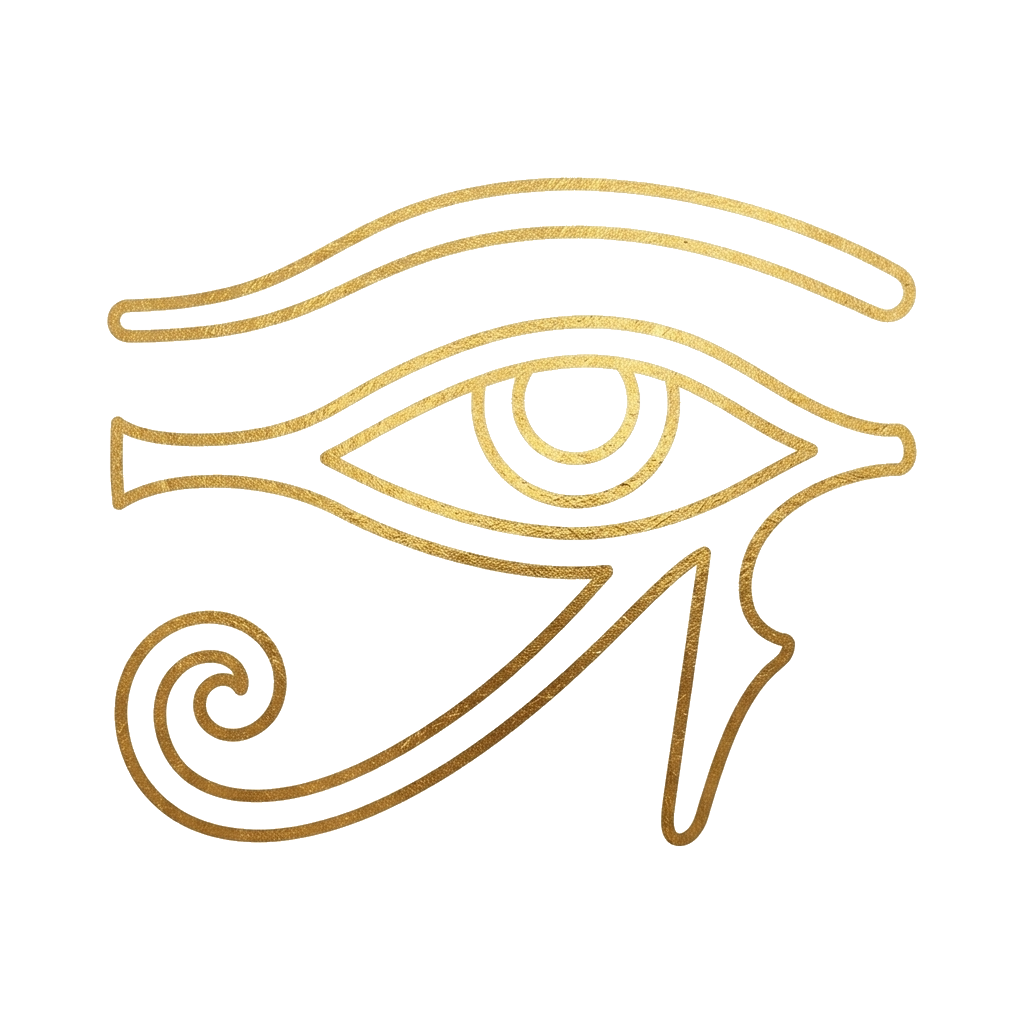
The Eye of Horus is a stylized human eye rendered in a distinctive form that incorporates elements of both a human and a falcon's facial markings. The central element is an almond-shaped eye with a clearly defined pupil — a dark circle or dot at the center. Above the eye runs a thick, curved eyebrow line. Below and behind the eye extend two markings characteristic of the peregrine falcon sacred to Horus: a long, curving teardrop line dropping vertically beneath the eye (sometimes called the cosmetic line), and a spiraling or hooked extension curling backward and downward from the outer corner, resembling the cheek marking of the falcon. The overall effect is of a human eye fused with avian features — watchful, alert, and unmistakably non-naturalistic.
What elevates the Eye of Horus from artistic convention to intellectual monument is its mathematical structure. The six distinct components of the eye — the eyebrow, the pupil, the right side of the eye nearest the nose, the left side of the eye nearest the ear, the curving teardrop below, and the spiral extension — each correspond to a specific fraction of the heqat, the standard Egyptian unit of grain measurement (approximately 4.8 liters). The right side nearest the nose represents 1/2; the pupil represents 1/4; the eyebrow represents 1/8; the left side nearest the ear represents 1/16; the curving teardrop represents 1/32; and the spiral extension represents 1/64. Together, these six fractions sum to 63/64 — one sixty-fourth short of a complete whole. This missing fraction was attributed to the magic of Thoth, the god who reassembled the eye, and it encodes a profound philosophical observation: that material wholeness always requires something beyond the merely measurable, something divine.
Beyond its mathematical encoding, the Eye of Horus was also read as a medical and anatomical diagram. Egyptian physicians and later interpreters mapped the six parts of the eye onto the six senses (sight, hearing, smell, taste, touch, and thought) and, in some traditions, onto structures within the brain. The teardrop line beneath the eye has been compared to the optic tract connecting the eye to the thalamus; the eyebrow to the frontal cortex; the pupil to the primary visual cortex; and the spiral to the olfactory or auditory pathways. While these neuroanatomical correspondences remain debated among Egyptologists, the broader principle is clear: the Egyptians understood the eye as a gateway between the external world and the interior world of consciousness, and they encoded this understanding in the very form of the symbol.
Esoteric Meaning
The Eye of Horus encodes the central mystery of Egyptian spiritual technology: the restoration of wholeness after dismemberment. This is not a story about physical injury and physical healing — it is a map of consciousness shattered by trauma, illusion, and the fragmenting forces of incarnate existence, and then painstakingly reassembled through wisdom, magic, and divine intervention. The six pieces of the eye represent the six faculties of perception (sight, hearing, smell, taste, touch, and thought), each of which, in the Egyptian understanding, can be disrupted or distorted. When the eye is whole, perception is whole — reality is seen clearly, as it is. When the eye is shattered, perception fractures into partial views, each mistaking itself for the whole. The restoration of the Wedjat is therefore the restoration of unified consciousness, the capacity to perceive the total field of reality without distortion. This is why the eye was the supreme offering to Osiris: it represents the gift of clear seeing, which is the gift of life itself.
The missing 1/64 — the piece that cannot be accounted for by the six measurable fractions — carries immense esoteric weight. It represents the irreducible role of the divine, the sacred, the immeasurable in any act of true healing or true knowing. No purely mechanical process can restore wholeness; something beyond calculation must intervene. In Egyptian theology, this role belonged to Thoth, the neter of wisdom, writing, and magic, whose very name is associated with the operations of cosmic intelligence. The missing fraction is Thoth's fraction — a reminder that the universe is not entirely rational, that healing requires grace, and that the most important things cannot be measured. This teaching resonates across traditions: the Kabbalistic concept of the reshimu (the trace of divine light that remains after the tzimtzum), the Buddhist understanding that sunyata is not nothingness but the ground of all appearance, and the Sufi recognition that the final station of the path is not reached by effort but by divine gift.
The eye's association with the left side of the body connects it to the lunar, receptive, feminine polarity in Egyptian sacred anatomy. Horus's right eye was the sun; his left eye was the moon. The loss and restoration of the left eye therefore tracks the lunar cycle — the monthly waning and waxing of the moon became, for the Egyptians, a recurring cosmic enactment of the Osirian mystery. The Wedjat eye is in this sense a lunar symbol: it embodies the principle that wholeness includes darkness, that the path to completion passes through fragmentation, and that light is most meaningful after it has been lost and recovered. This lunar dimension connects the Eye of Horus to the broader family of third-eye symbols across traditions — the ajna chakra in Yogic tradition, the yin tang point in Traditional Chinese Medicine, the pine cone atop the papal staff, and the single eye at the apex of the Masonic pyramid. All of these reference the same inner faculty: the capacity for unified, non-dual perception that transcends the ordinary duality of subject and object.
Exoteric Meaning
In everyday Egyptian life, the Eye of Horus was first and foremost a symbol of protection, health, and royal power. Worn as an amulet — typically fashioned from faience, carnelian, lapis lazuli, or gold — it was believed to ward off evil, illness, and misfortune. The logic was straightforward: the eye that had been broken and made whole again carried within it the power of healing, and to wear or display it was to invoke that power. Mothers placed it on children, physicians painted it on medicinal vessels, and embalmers positioned it over the incision on the mummy's abdomen through which the internal organs had been removed, symbolically sealing and healing the wound. It was among the most common of all Egyptian amulets, found in burials across every social class from pharaohs to commoners.
The eye also served as a hieroglyphic and mathematical tool with practical applications. As a unit of measurement, the six fractions of the eye were used by scribes and merchants to calculate portions of grain — a function of direct economic importance in a civilization built on agricultural surplus and centralized grain distribution. A prescription in the Ebers Papyrus, one of the oldest surviving medical texts, might specify ingredients measured in fractions of a heqat, using the components of the Eye of Horus as shorthand. This dual function — sacred symbol and practical instrument — is characteristic of Egyptian thought, which did not recognize the modern separation between the spiritual and the material. To measure grain using the Eye of Horus was not a secularization of a sacred symbol; it was an acknowledgment that mathematics, agriculture, and the divine order of the cosmos were all expressions of the same underlying reality, which the Egyptians called Ma'at.
In the political sphere, the Eye of Horus reinforced the divine legitimacy of the pharaoh. Since Horus was the patron god of kingship — every living pharaoh was considered a manifestation of Horus, just as every dead pharaoh became one with Osiris — the Wedjat eye signified the pharaoh's capacity to see and govern with divine clarity. The 'Horus name' was the first and oldest of the five royal names carried by every king of Egypt. Temples displayed the eye prominently, and the ritual offering of the Wedjat eye to the gods was among the most important acts performed in the daily temple liturgy. To offer the eye was to offer wholeness itself — to restore the cosmos to its proper state by the ritualized repetition of the myth.
Usage
The Eye of Horus was deployed across virtually every domain of Egyptian civilization. In funerary practice, it was the most important protective amulet placed on or near the mummified body. Chapter 167 of the Book of the Dead specifically addresses the restoration of the Wedjat eye, and multiple spells invoke its power to protect the deceased during the perilous journey through the Duat (the underworld). Amulets of the eye were placed over the chest, throat, and abdomen of mummies, and the eye was painted or inlaid on coffins and sarcophagi. The 'opening of the mouth' ceremony — the critical ritual that reanimated the mummy's senses — drew explicitly on the mythology of the restored eye.
In medicine, the eye's six fractional components provided a measurement system for compounding pharmaceutical preparations. The Ebers Papyrus and the Edwin Smith Papyrus — among the oldest medical texts in the world — reference the heqat fractions. Beyond measurement, the eye itself was understood as a healing symbol: its image was painted on vessels containing medicines, and physicians were understood to be performing a kind of Thoth-work when they restored a patient to health. The Egyptian word for physician, swnw, carried connotations of magical as well as practical knowledge, and the Eye of Horus bridged both functions.
In mathematics and commerce, the heqat fractions derived from the eye were standard units of grain measurement used throughout the bureaucratic apparatus of the Egyptian state. Scribes trained in the temple schools learned these fractions as part of their mathematical education. The system is documented in the Rhind Mathematical Papyrus (c. 1550 BCE), which contains problems using heqat fractions.
In modern usage, the Eye of Horus has experienced a remarkable afterlife. It appears in Freemasonic imagery (often conflated with the All-Seeing Eye of Providence), in pharmaceutical branding (the Rx symbol has been speculatively linked to the eye, though this etymology is debated), in fashion and jewelry, in tattoo culture, and as a general emblem of spiritual protection in contemporary esoteric and New Age contexts. The symbol has been adopted by practitioners of Kemeticism (reconstructed Egyptian religion) and appears frequently in African diasporic spiritual traditions that draw on Egyptian iconography as a source of ancestral pride and spiritual authority.
In Architecture
The Eye of Horus is one of the most frequently occurring symbols in Egyptian monumental architecture. It appears carved in relief on temple walls throughout the Nile Valley, from the Old Kingdom mortuary temples at Saqqara to the great Ptolemaic temples at Edfu, Dendera, and Philae. At the Temple of Horus at Edfu — the best-preserved temple in Egypt, built between 237 and 57 BCE — the Wedjat eye appears hundreds of times: on column capitals, door lintels, sanctuary walls, and in the elaborate reliefs depicting the ritual offering of the eye to Horus himself. The symmetry is deliberate: the god receives back the symbol of his own restored wholeness.
In funerary architecture, the eye appears on the eastern face of Middle Kingdom coffins, positioned at the level where the mummy's head would rest, enabling the deceased to 'see out' into the world of the living and toward the rising sun. This architectural convention — the eye as a window between worlds — persisted for centuries. The false doors in Old Kingdom mastaba tombs often feature the Wedjat eye as a liminal marker between the realm of the living and the realm of the dead.
Beyond Egypt, the Eye of Horus influenced architectural decoration in Phoenician, Greek, and Roman contexts through trade and cultural transmission. The eye motif on Mediterranean ship prows — still visible in traditional Greek and Turkish fishing boats — may descend from the Egyptian practice of painting the Wedjat eye on vessels for protection during voyages. In modern architecture, the eye appears in Masonic lodge decoration, on the reverse of the United States Great Seal (though that eye is formally the Eye of Providence, not the Eye of Horus), and in the decorative programs of esoteric and occult buildings worldwide.
Significance
The Eye of Horus is exceptional among ancient symbols because a single image simultaneously encodes a mythological narrative (the conflict between Horus and Set), a theological principle (wholeness restored through divine intervention), a mathematical system (the six heqat fractions), a medical diagram (the six senses and their neural pathways), a political ideology (the divine authority of the pharaoh), and a practical tool (grain measurement and pharmaceutical compounding). This extraordinary density of meaning reflects the integrated character of Egyptian civilization itself — a culture that did not compartmentalize knowledge into separate secular and sacred domains but understood all aspects of reality as expressions of a single divine order.
The symbol's endurance is equally remarkable. From its earliest appearances in the Predynastic and Early Dynastic periods (c. 3100 BCE) through its continued use in Ptolemaic and Roman Egypt (ending c. 400 CE), the Eye of Horus maintained its central position in Egyptian religious life for over three thousand years — a span of continuous use that exceeds the entire history of Christianity. Its subsequent adoption into Western esotericism, Freemasonry, and contemporary spiritual culture extends its influence into the present day, making it one of the longest-lived symbols in human history.
Perhaps most profoundly, the Eye of Horus encodes a teaching about the nature of wholeness that remains philosophically potent. The missing 1/64 — the fraction that cannot be derived from the six measurable parts, the piece that only Thoth's magic can supply — is a statement about the limits of reductionism and the irreducible role of the immeasurable in any complete understanding. In an era dominated by quantification and data, the Wedjat eye quietly insists that the most important things cannot be counted, that healing requires something beyond technique, and that the whole is always more than the sum of its parts.
Connections
Horus — The Eye of Horus is, in the most literal sense, an attribute of Horus — his left eye, torn out in combat and restored by Thoth. The mythology of the eye cannot be separated from the mythology of Horus himself: his birth from Isis and Osiris, his war with Set, his vindication before the divine tribunal, and his assumption of the throne of Egypt. Every appearance of the Wedjat eye in Egyptian art and text references this narrative and invokes the power of Horus as the rightful king, the avenger of his father, and the embodiment of Ma'at (cosmic order) triumphing over isfet (chaos).
Egyptian Book of the Dead — The Wedjat eye is one of the most frequently referenced symbols in the Book of the Dead (more properly, the Pert em Heru — 'Coming Forth by Day'). Multiple spells invoke the eye's protective power, and the offering of the Wedjat eye to Osiris is among the central ritual acts described in the text. Chapter 167 is specifically devoted to the restoration of the eye, and the eye appears in the vignettes (illustrations) accompanying numerous spells.
Third Eye and Ajna Chakra — The Eye of Horus has been extensively compared to the concept of the third eye across traditions. In Yogic tradition, the ajna chakra (the sixth chakra, located between the eyebrows) is the seat of intuitive vision, non-dual awareness, and the capacity to perceive reality beyond the five physical senses. The parallels are structural, not merely superficial: both the Wedjat eye and the ajna chakra represent an organ of perception that transcends ordinary sensory duality, both are associated with inner light and divine vision, and both traditions teach that this faculty must be 'opened' or 'restored' through disciplined practice and, ultimately, through grace. The pineal gland — located deep within the brain and sometimes called the 'third eye' in Western esoteric anatomy — has been compared to both the ajna chakra and to the pupil of the Eye of Horus, suggesting a cross-cultural intuition about the neurological substrate of non-ordinary perception.
The Eye of Horus also resonates with the Taoist concept of the 'golden flower' or inner light described in the Secret of the Golden Flower, with the Sufi concept of the 'eye of the heart' (ayn al-qalb) through which the mystic perceives divine reality, and with the Christian mystical tradition of the 'single eye' referenced in Matthew 6:22 ('If thine eye be single, thy whole body shall be full of light'). Across these traditions, the consistent teaching is that there exists a faculty of perception deeper than the five senses, that this faculty can be obscured or damaged, and that its restoration constitutes the central work of the spiritual path.
Further Reading
- Pinch, Geraldine — Egyptian Mythology: A Guide to the Gods, Goddesses, and Traditions of Ancient Egypt (Oxford University Press, 2004). Accessible scholarly overview with detailed treatment of the Horus-Set conflict and the Wedjat eye.
- Wilkinson, Richard H. — Reading Egyptian Art: A Hieroglyphic Guide to Ancient Egyptian Painting and Sculpture (Thames & Hudson, 1994). Essential reference for understanding the visual language of Egyptian symbols including the Eye of Horus.
- Ritter, Robert K. — The Mechanics of Ancient Egyptian Magical Practice (Studies in Ancient Oriental Civilization 54, 1993). Scholarly treatment of the heka (magic) system within which the Wedjat eye functioned as a ritual instrument.
- Allen, James P. — The Ancient Egyptian Pyramid Texts (SBL Press, 2015). The earliest references to the Wedjat eye in their full textual context.
- Faulkner, R.O. — The Ancient Egyptian Book of the Dead (University of Texas Press, 1990). Complete translation of the spells that reference the Eye of Horus.
- Gardiner, Sir Alan — Egyptian Grammar (Griffith Institute, 3rd ed., 1957). Standard reference for the hieroglyphic forms of the Wedjat eye and the heqat fraction system.
- Hornung, Erik — The Secret Lore of Egypt: Its Impact on the West (Cornell University Press, 2001). Traces the transmission of Egyptian symbols including the Eye of Horus into Western esotericism.
Frequently Asked Questions
What does the Eye of Horus symbolize?
The Eye of Horus encodes the central mystery of Egyptian spiritual technology: the restoration of wholeness after dismemberment. This is not a story about physical injury and physical healing — it is a map of consciousness shattered by trauma, illusion, and the fragmenting forces of incarnate existence, and then painstakingly reassembled through wisdom, magic, and divine intervention. The six pieces of the eye represent the six faculties of perception (sight, hearing, smell, taste, touch, and thought), each of which, in the Egyptian understanding, can be disrupted or distorted. When the eye is whole, perception is whole — reality is seen clearly, as it is. When the eye is shattered, perception fractures into partial views, each mistaking itself for the whole. The restoration of the Wedjat is therefore the restoration of unified consciousness, the capacity to perceive the total field of reality without distortion. This is why the eye was the supreme offering to Osiris: it represents the gift of clear seeing, which is the gift of life itself.
Where does the Eye of Horus originate?
The Eye of Horus originates from the Ancient Egyptian (associated with the sky god Horus and the goddess Wadjet) tradition. It dates to c. 3000 BCE — present. It first appeared in Ancient Egypt.
How is the Eye of Horus used today?
The Eye of Horus was deployed across virtually every domain of Egyptian civilization. In funerary practice, it was the most important protective amulet placed on or near the mummified body. Chapter 167 of the Book of the Dead specifically addresses the restoration of the Wedjat eye, and multiple spells invoke its power to protect the deceased during the perilous journey through the Duat (the underworld). Amulets of the eye were placed over the chest, throat, and abdomen of mummies, and the eye was painted or inlaid on coffins and sarcophagi. The 'opening of the mouth' ceremony — the critical ritual that reanimated the mummy's senses — drew explicitly on the mythology of the restored eye.