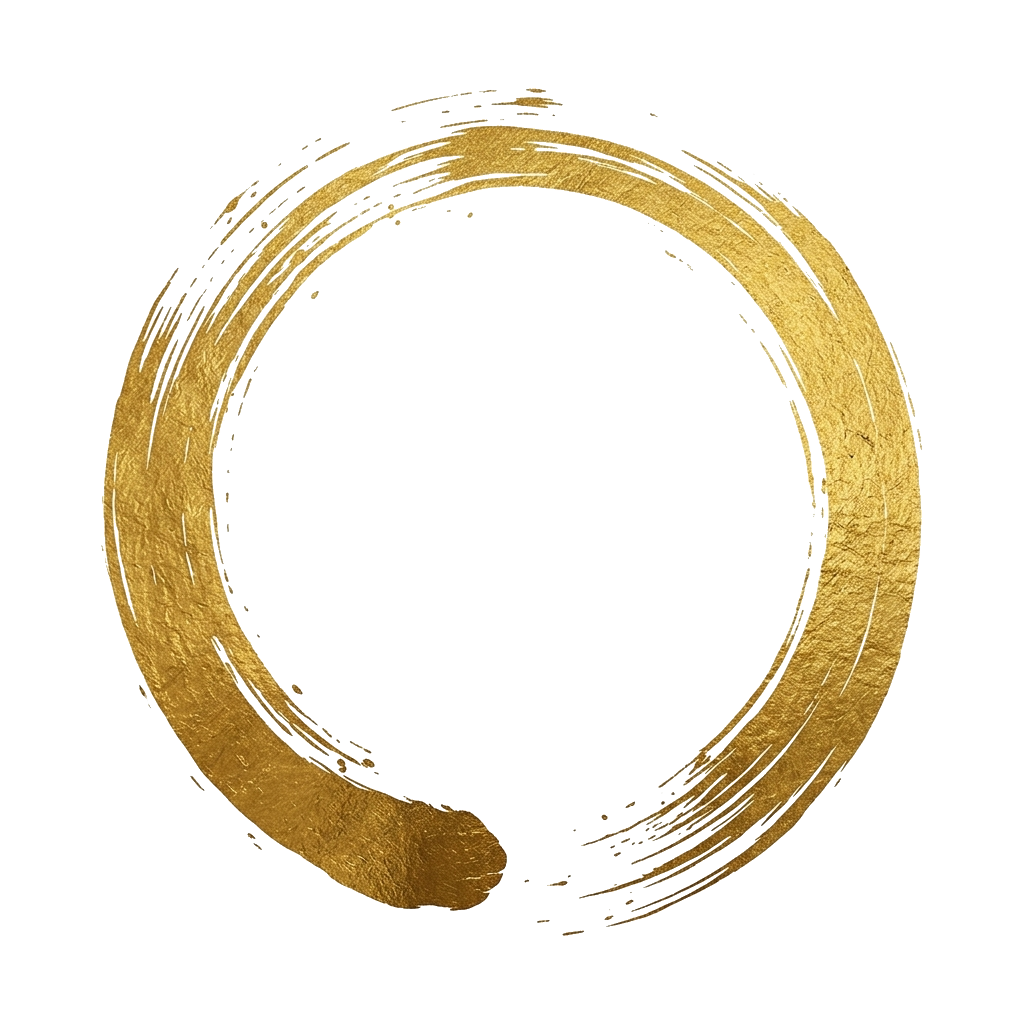
Enso
The Zen circle — a single brushstroke capturing the totality of enlightenment, emptiness, and the universe in one gesture that cannot be corrected or improved.
About Enso
A single brushstroke. One breath. The circle either closes or it does not — and both outcomes carry the full weight of Zen teaching. The Enso embodies the entirety of the Dharma in one fluid gesture. It is not a symbol in the ordinary sense, not a sign pointing beyond itself, but a direct expression of the practitioner's state of mind at the moment the brush touches paper. No revision is permitted. No second pass. The circle stands as it was made, complete in its imperfection, a record of one breath and one movement of the arm.
Originating in the Japanese Zen tradition but deeply rooted in the Chinese Chan calligraphic lineage that preceded it, the Enso has been practiced by monks, abbots, and lay practitioners for at least eight centuries. It belongs to the broader tradition of bokuseki — Zen ink traces — in which calligraphy is understood not as decorative art but as a direct transmission of awakened consciousness. The great masters Torei Enji, Hakuin Ekaku, and Sengai Gibon each left behind celebrated Enso that are studied not for their aesthetic merit alone but for what they reveal about the painter's realization.
The Enso functions simultaneously as a meditation practice, a teaching device, and a spiritual test. When a Zen master paints an Enso, the result is understood to express the depth of their awakening — the steadiness of the hand, the fluidity of the stroke, the ratio of ink to empty space all communicate something that words cannot. It is sometimes accompanied by a brief inscription or poem, but often it stands alone, needing nothing.
In the broader cultural context of Japan, the Enso has transcended its monastic origins to become a recognized symbol of simplicity, elegance, and the beauty of impermanence. It appears in temple art, on scrolls hung in tea rooms, on the walls of meditation halls, and in contemporary design. Yet its power lies in the fact that it can never be mass-produced or mechanically reproduced in any meaningful way — each Enso is unique, unrepeatable, and tied to the particular moment of its creation.
Visual Description
The Enso is rendered as a roughly circular form painted with a single continuous brushstroke using black sumi ink on white rice paper or silk. The brush is typically loaded heavily with ink at the start, producing a thick, saturated beginning that gradually thins as the ink depletes and the arm completes its arc. This creates a characteristic gradation — dense black tapering into grey, then into dry-brush texture where individual bristle marks become visible, a quality the Japanese call kasure (the fading trace).
The circle may be open or closed. An open Enso — where the two ends of the stroke do not meet — is the more common form and is generally interpreted as representing incompleteness, the unfinished nature of all things, and the space through which energy flows in and out. A closed Enso, where the stroke overlaps itself, suggests wholeness, completion, and the self-contained perfection of reality as it is. Some masters have painted both forms at different periods of their lives, and scholars have debated whether one represents a deeper realization than the other.
The shape is never a geometrically perfect circle. It wobbles, thickens unevenly, and may lean to one side. This irregularity is not a flaw but the point — it reflects the living, breathing moment of creation rather than an abstract ideal. The background is typically left entirely bare, with no decoration or embellishment, allowing the stark contrast between black ink and white paper to carry the full weight of the image. Some Enso are accompanied by a brief calligraphic inscription (san) in smaller characters to one side, but many stand completely alone.
The size varies enormously — from small studies no wider than a palm to monumental works several feet across painted with a broom-sized brush. The speed of execution ranges from a single explosive flick of the wrist to a slow, deliberate arc completed over the duration of one full exhalation. Each approach produces a radically different visual character while remaining unmistakably an Enso.
Esoteric Meaning
The Enso is a visual expression of sunyata — the emptiness that is not absence but the pregnant ground of all phenomena. The circle encloses nothing and everything simultaneously. It is mu (nothingness) made visible, the same mu that Joshu offered as his answer to the question of whether a dog has Buddha-nature. To paint an Enso is to embody mu in action — to create from the place before thought, before intention, before the separation between self and world.
The Enso also expresses shoshin, beginner's mind — the state of openness and lack of preconception that Shunryu Suzuki described as the expert's most difficult attainment. Because the Enso cannot be corrected, practiced, or perfected through repetition in the ordinary sense, each attempt requires the practitioner to face the paper with fresh eyes. There is no accumulated skill that can guarantee a good Enso. A master who has painted ten thousand circles may produce a lifeless one, while a novice in a moment of genuine presence may create something luminous. This radical equality before the blank page mirrors the Zen teaching that enlightenment is not a progressive attainment but an instantaneous recognition.
The moment of painting — the split second when brush meets paper and the arm begins its arc — is understood as a direct expression of mushin (no-mind), the state in which the practitioner acts without deliberation, without the interference of the calculating ego. In this sense, the Enso is a record of samadhi in motion, a footprint left by a mind that has dissolved the boundary between observer and observed. The great Rinzai master Hakuin Ekaku painted thousands of Enso during his lifetime, and his students studied them the way other traditions study scripture — as transmissions of realized consciousness.
The Enso also carries the spirit of wabi-sabi — the aesthetic of impermanence, imperfection, and incompleteness that pervades Japanese Zen culture. The dry-brush fade, the asymmetric shape, the deliberate refusal to correct or improve all embody the understanding that beauty arises not from perfection but from the honest expression of transience. The Enso teaches that what is most real is also most fleeting — that the brushstroke, like a life, happens once and cannot be undone.
In esoteric terms, the open Enso represents the dynamic interplay between form and emptiness described in the Heart Sutra: form is emptiness, emptiness is form. The gap in the circle is not a deficiency but a gateway — the place where the absolute and the relative interpenetrate, where nirvana and samsara are recognized as one. Some Zen commentators have compared the open Enso to the mouth that speaks the unspeakable, or to the gate that Bodhidharma passed through when he brought Chan from India to China.
Exoteric Meaning
In its most accessible interpretation, the Enso represents the cycle of existence — birth, growth, decay, and renewal — rendered in the simplest possible form. A circle has no beginning and no end, and so it naturally evokes ideas of continuity, wholeness, and the interconnectedness of all living things. For many people encountering Zen art for the first time, the Enso communicates a sense of calm, balance, and elegant simplicity that requires no specialized knowledge to appreciate.
The Enso is also widely understood as a symbol of strength and elegance achieved through disciplined practice. The ability to produce a fluid, balanced circle in a single stroke requires years of training — not in the mechanics of brushwork alone, but in the cultivation of inner stillness that allows the body to move without hesitation. In this sense, the Enso belongs to the same family of Japanese arts that use physical mastery as a vehicle for spiritual development: the way of the sword (kendo), the way of the bow (kyudo), the way of tea (chado), and the way of the brush (shodo).
In contemporary culture, the Enso has become one of the most recognizable symbols of mindfulness and meditation worldwide. It appears on book covers, meditation app logos, yoga studio walls, and corporate branding for wellness companies. While this popularization sometimes strips the symbol of its deeper meaning, it also speaks to the Enso's genuine power to communicate a universal human aspiration — the desire for presence, simplicity, and freedom from the tyranny of perfectionism. The message that imperfection is beautiful, that a single moment of full attention is more valuable than a lifetime of distracted effort, resonates across cultures and traditions.
Usage
The primary traditional use of the Enso is as a contemplative practice within Zen monastic life. Monks and nuns paint Enso as part of their daily discipline, approaching the act with the same seriousness as seated meditation (zazen). The practitioner prepares the ink by grinding an ink stick against a wet stone — itself a meditative act requiring patience and steady rhythm — then loads the brush, takes a breath, and paints the circle in one continuous motion. The result is not evaluated aesthetically but received as a mirror of the practitioner's inner state.
In the teacher-student relationship, the Enso has historically served as a form of spiritual examination. A master might ask a student to paint an Enso as a way of assessing their progress — not through the visual quality of the circle but through the energy, hesitation, or freedom visible in the stroke. Some koan traditions use the Enso as a non-verbal response to questions that cannot be answered in words. When asked 'What is the meaning of Bodhidharma coming from the West?', a student might simply paint a circle.
Enso are traditionally displayed as hanging scrolls (kakemono) in tea rooms, meditation halls, and temple reception areas. They are rotated seasonally and selected to complement the mood of a particular gathering or ceremony. In the Japanese tea ceremony, the scroll in the alcove (tokonoma) sets the tone for the entire event, and an Enso scroll communicates an invitation to enter a state of open, non-judgmental awareness.
In temple art and architecture, the Enso sometimes appears carved in stone, painted on wooden panels, or rendered in garden design as a circular stepping stone or moon gate. These architectural applications extend the symbol's meaning into three-dimensional space, creating physical thresholds that practitioners pass through as a reminder of the transition from ordinary consciousness to meditative awareness.
Contemporary practitioners worldwide have adopted the Enso as a daily mindfulness practice. The accessibility of the form — requiring only ink, paper, and a brush — makes it one of the most democratic contemplative arts. No special talent is required, no elaborate setup, no expensive materials. The practice distills the entire teaching of Zen into a single gesture that can be completed in three seconds and contemplated for a lifetime.
In Architecture
The Enso appears in Japanese temple architecture in several distinctive forms. Moon gates (tsukimon) — circular openings in garden walls — translate the Enso into a three-dimensional threshold that frames the garden beyond as a living painting. At Tofuku-ji in Kyoto, the circular window in the Abbot's quarters frames the garden in an Enso-like aperture that shifts with the seasons, teaching impermanence through the changing view.
Circular stepping stones in Zen gardens echo the Enso form, creating a path that requires the walker to pause and step deliberately onto each round surface — a walking meditation encoded in landscape design. The famous stone garden at Ryoan-ji, while rectangular in plan, contains circular moss-covered mounds around its rock groupings that suggest the Enso's influence on spatial composition.
In modern architecture, the Enso has inspired circular skylights, round windows in meditation centers, and ring-shaped floor plans for contemplative spaces. Tadao Ando's Church of the Light in Ibaraki, while using a cross rather than a circle, applies the same Zen principle of reducing form to its essence — a single gesture of light cutting through darkness. Contemporary Zen centers in North America and Europe frequently incorporate Enso motifs into their entrance gates, meditation hall screens, and garden features as a visual anchor connecting the space to its Japanese lineage.
The tradition of carving Enso into stone lanterns, temple gates, and memorial markers extends the symbol's presence beyond the impermanent medium of ink on paper, creating permanent reminders of impermanence — a paradox entirely consistent with Zen's embrace of contradiction.
Significance
The Enso is perhaps the only major sacred symbol that is simultaneously a complete spiritual practice. Unlike a cross, a Star of David, or an Om sign — which are symbols to be contemplated, worn, or displayed — the Enso is inseparable from the act of its creation. Its meaning lives not in the finished image but in the moment of painting. This makes it unique among the world's great symbols: it is both noun and verb, both object and action, both teaching and test.
Within Zen Buddhism specifically, the Enso occupies the highest position in the hierarchy of calligraphic forms. While sutras, poems, and characters all carry teaching, the Enso is considered the most direct expression because it bypasses language entirely. It communicates the inexpressible — the taste of water, the sound of one hand clapping, the face you had before your parents were born — not through metaphor or analogy but through the pure act of creation. This directness aligns with the fundamental Zen principle of transmission beyond words and scriptures.
The Enso's influence extends far beyond Buddhism into the global conversation about consciousness, creativity, and the nature of mastery. It has become a touchstone for discussions about flow states, effortless action, and the relationship between training and spontaneity in any discipline. Musicians, athletes, surgeons, and writers have all drawn on the Enso as a model for the kind of performance that emerges when years of practice dissolve into a single moment of unselfconscious action.
Historically, the Enso served as a bridge between Chinese Chan Buddhism and the distinctive Japanese Zen aesthetic that would eventually influence everything from garden design to martial arts to the tea ceremony. The minimalism of the Enso — its insistence that one stroke is enough, that nothing needs to be added or taken away — established a philosophical foundation for the entire wabi-sabi sensibility that defines Japanese aesthetic culture. In this sense, the Enso is not merely a symbol within Japanese culture but one of the seeds from which that culture grew.
Connections
The Enso connects most directly to the Buddhist concept of sunyata (emptiness), which receives its most celebrated expression in the Heart Sutra's declaration that form is emptiness and emptiness is form. The Enso is, in many ways, the visual equivalent of this teaching — a form that contains nothing, an emptiness that takes the shape of everything. Practitioners who study the Heart Sutra often use the Enso as a contemplative companion, painting a circle before or after chanting the sutra as a way of embodying its meaning beyond intellectual understanding.
The practice of Enso painting is intimately connected to meditation (zazen), and many Zen teachers describe the two as expressions of the same state. Seated meditation cultivates the stillness and presence that the Enso captures in motion — the circle becomes a record of the quality of mind that zazen develops. In some monasteries, students alternate between periods of sitting meditation and periods of calligraphy practice, treating them as complementary approaches to the same realization.
Beyond Buddhism, the Enso resonates with circular symbols across the world's wisdom traditions. The Ouroboros of Hellenistic alchemy, the Celtic knot, the Taoist taijitu (yin-yang symbol), the medicine wheel of Native American traditions, and the mandala traditions of Hinduism and Tibetan Buddhism all employ the circle to express wholeness, cyclical time, and the unity of opposites. The Enso is distinguished from these by its radical simplicity — where other traditions elaborate the circle with internal divisions, colors, and figures, the Enso strips it to a single gesture, trusting that the circle itself, unadorned, is sufficient.
The Enso also connects to the broader tradition of sacred calligraphy found in Islamic art, Hebrew mysticism, and Chinese Taoist writing. In each of these traditions, the act of writing is understood as a spiritual practice — the letters themselves carry power, and the calligrapher becomes a channel for something greater than personal expression. The Enso takes this principle to its logical extreme by reducing the entire act of sacred writing to one stroke and one shape.
Further Reading
- Audrey Yoshiko Seo and Stephen Addiss, The Art of Twentieth-Century Zen: Paintings and Calligraphy by Japanese Masters (Shambhala, 1998) — a comprehensive survey of modern Zen calligraphy including many celebrated Enso by masters such as Nantembo, Shibayama, and Hisamatsu.
- John Stevens, Sacred Calligraphy of the East (Shambhala, 1995) — places the Enso within the broader context of Asian contemplative calligraphy, including Chinese, Korean, and Tibetan traditions.
- Kazuaki Tanahashi, Brush Mind (Parallax Press, 1990) — a practical guide to Zen calligraphy by a contemporary master, with extensive discussion of the Enso as both practice and philosophy.
- Shunryu Suzuki, Zen Mind, Beginner's Mind (Weatherhill, 1970) — while not specifically about the Enso, this classic text illuminates the concept of shoshin (beginner's mind) that the Enso embodies. Essential reading for understanding why the Enso's imperfection is its perfection.
- D.T. Suzuki, Zen and Japanese Culture (Princeton University Press, 1959) — a foundational text exploring how Zen principles shaped Japanese aesthetics, including the calligraphic arts from which the Enso tradition emerged.
Frequently Asked Questions
What does the Enso symbolize?
The Enso is a visual expression of sunyata — the emptiness that is not absence but the pregnant ground of all phenomena. The circle encloses nothing and everything simultaneously. It is mu (nothingness) made visible, the same mu that Joshu offered as his answer to the question of whether a dog has Buddha-nature. To paint an Enso is to embody mu in action — to create from the place before thought, before intention, before the separation between self and world.
Where does the Enso originate?
The Enso originates from the Japanese Zen Buddhism (influenced by Chinese Chan calligraphic tradition) tradition. It dates to c. 12th century CE — present. It first appeared in Japan, China, Korea.
How is the Enso used today?
The primary traditional use of the Enso is as a contemplative practice within Zen monastic life. Monks and nuns paint Enso as part of their daily discipline, approaching the act with the same seriousness as seated meditation (zazen). The practitioner prepares the ink by grinding an ink stick against a wet stone — itself a meditative act requiring patience and steady rhythm — then loads the brush, takes a breath, and paints the circle in one continuous motion. The result is not evaluated aesthetically but received as a mirror of the practitioner's inner state.