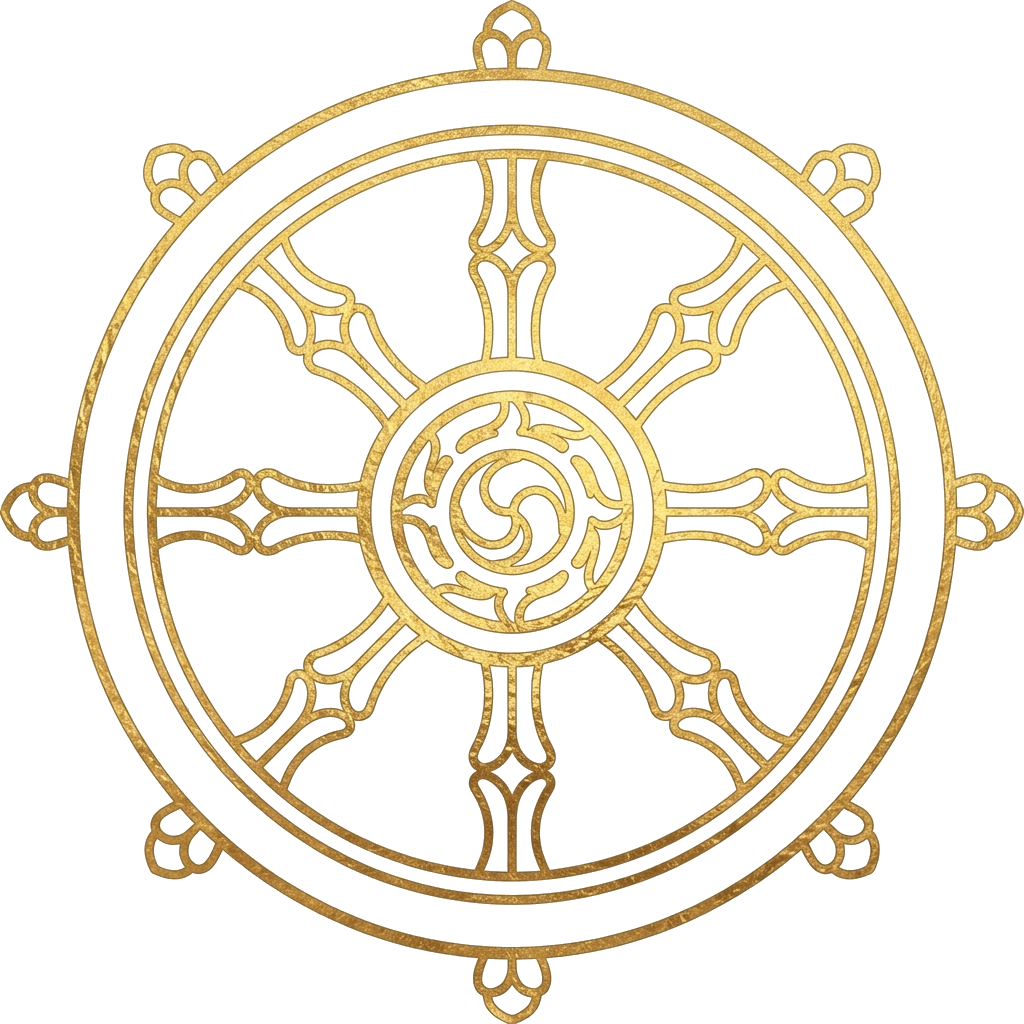
Dharma Wheel
The Dharmachakra — the wheel of the Buddha's teaching, with eight spokes representing the Noble Eightfold Path, set in motion at the First Sermon at Sarnath and turning still.
About Dharma Wheel
The Dharma Wheel, or Dharmachakra, dates its origin to a specific historical moment: the Buddha's first sermon at the Deer Park in Sarnath, an event known as the 'first turning of the wheel.' Its origins lie in the moment when Siddhartha Gautama, having attained awakening beneath the Bodhi tree at Bodh Gaya, walked to the Deer Park at Isipatana (modern Sarnath) and delivered his first discourse — the Dhammacakkappavattana Sutta, the "Setting in Motion of the Wheel of the Dharma." That single act gave the world both a teaching and its emblem. The wheel the Buddha set turning was not a physical object but a metaphor drawn from the imagery of the universal monarch, the Cakravartin, whose chariot wheel rolls unimpeded across the earth. By appropriating this royal image, early Buddhists declared that the Buddha's truth possessed a sovereignty deeper than any king's — a sovereignty over suffering itself.
For the first several centuries of Buddhist art, the Buddha was never depicted in human form. The Dharmachakra stood in his place — carved atop pillars, pressed into coins, sculpted at the center of narrative reliefs — signifying his presence through the teaching rather than the teacher. Emperor Ashoka raised polished sandstone pillars across his empire in the 3rd century BCE, and the four-lion capital at Sarnath, with its prominent wheel, became the emblem of modern India. The wheel's capacity to represent the whole of the Buddhist path in a single image — discipline, meditation, and wisdom held in dynamic balance — accounts for its survival across two and a half millennia and its adoption by every major Buddhist lineage from Sri Lanka to Japan.
Beyond Buddhism, the wheel symbol appears in Hinduism as the Sudarshana Chakra, the spinning discus of Vishnu that destroys ignorance and restores cosmic order, and in Jainism where the wheel represents the cycle of birth and death as well as the Tirthankara's universal teaching. The convergence of these meanings across three distinct traditions points to something fundamental in the wheel's geometry — an image of motion that never leaves its center, of change governed by an axis that does not change.
Visual Description
The classical Dharmachakra is rendered as a spoked wheel with three distinct structural elements: a central hub, eight evenly spaced spokes radiating outward, and an enclosing rim. The hub is typically a small circle or lotus rosette at the center, sometimes containing a yin-yang-like swirl or a secondary set of petals. The eight spokes extend from the hub to the rim in straight, slightly tapering lines, often flaring into decorative tips where they meet the outer circle. The rim itself is a continuous band, sometimes plain, sometimes ornamented with a beaded or flame-like border.
Variations across traditions and periods are significant. In early Indian art — the Sarnath capital, the Sanchi gateways — the wheel tends toward architectural solidity: thick spokes, a broad rim, an overall sense of weight and permanence befitting a monument. Tibetan renderings introduce flame borders around the rim, deer flanking the base (recalling the Deer Park sermon), and gem-like ornaments at the hub and spoke tips. The flame border signifies the burning away of ignorance. East Asian versions, particularly in Chinese and Japanese Buddhist art, often streamline the design: thinner spokes, a more geometric regularity, sometimes gold against lacquer or painted in mineral pigments on silk.
The wheel also appears in miniature on the palms and soles of Buddha statues, counted among the thirty-two major marks of a great being. In Thai and Burmese iconography, the Dharmachakra may be carried in the Buddha's hand or depicted on a pedestal as an object of veneration in its own right. Some Tibetan versions include a second, smaller wheel nested inside the first — a wheel within a wheel — symbolizing the multiple turnings of the Dharma. Color conventions vary: gold predominates, symbolizing the preciousness of the teaching, but blue, white, and polychrome versions appear in different lineages. The eight spokes are always evenly distributed at 45-degree intervals, producing a visual harmony that reinforces the balance inherent in the Eightfold Path itself.
Esoteric Meaning
The Dharmachakra's three structural components — hub, spokes, and rim — encode the entire architecture of the path to liberation. The hub represents sila — ethical discipline — the stable center around which all practice revolves. Without moral grounding, the spokes have nothing to radiate from and the wheel cannot turn. The rim represents prajna — transcendent wisdom — the encompassing insight that holds the whole structure together and gives it coherent shape. The eight spokes represent samadhi — meditative concentration — the active practices of the Noble Eightfold Path: right view, right intention, right speech, right action, right livelihood, right effort, right mindfulness, and right concentration. Together, hub, spokes, and rim form the three trainings (trisiksha) that constitute the complete Buddhist path.
The doctrine of the Three Turnings of the Wheel of Dharma (Dharmacakrapravartana) adds a temporal and philosophical dimension. The First Turning occurred at Sarnath, where the Buddha taught the Four Noble Truths and the Eightfold Path — the foundational teachings of what would become the Theravada tradition. The Second Turning, associated with Vulture Peak and the Prajnaparamita literature — including the Heart Sutra and the Diamond Sutra — introduced the doctrine of emptiness (sunyata), the radical insight that all phenomena, including the self and the path itself, lack inherent existence. The Third Turning, associated with the Samdhinirmocana Sutra and the Yogacara school, taught Buddha-nature (tathagatagarbha) — the luminous awareness present in all beings as the ground of awakening. Each turning does not negate the previous one but deepens it, like concentric wheels turning at different speeds around the same axis.
In Vajrayana Buddhism, the Dharmachakra takes on additional tantric significance. The wheel maps onto the mandala — the sacred diagram of enlightened reality — with the hub as the central deity, the spokes as the directional buddhas and bodhisattvas, and the rim as the protective circle that separates sacred from profane space. The spinning motion of the wheel corresponds to the circulation of prana (subtle energy) through the central channel, and the eight spokes align with the eight-petaled lotus of the heart chakra where, according to completion-stage practices, the subtlest mind resides. The wheel is simultaneously samsara and nirvana: seen from the perspective of ignorance, it is the endless cycle of birth and death; seen from the perspective of awakening, it is the spontaneous display of wisdom and compassion that never ceases.
Exoteric Meaning
In its most accessible meaning, the Dharma Wheel represents the Buddha's teaching and its continuous transmission across generations. When Buddhists see the Dharmachakra on a temple roof, a monastery gate, or a meditation hall wall, they understand it as a sign that the Dharma is alive in that place — that the wheel the Buddha set in motion at Sarnath has not stopped turning. The eight spokes serve as a practical mnemonic for the Noble Eightfold Path, reminding practitioners of the eight dimensions of ethical, mental, and wisdom training that together constitute the Middle Way between indulgence and asceticism.
As a national and cultural symbol, the Dharmachakra appears at the center of the Indian national flag — the Ashoka Chakra, a 24-spoke navy-blue wheel on a white background — representing the rule of dharma (righteous law) over the nation. Thailand, a predominantly Buddhist country, incorporates the wheel into royal insignia and temple decoration as a marker of the kingdom's spiritual identity. In these civic contexts, the wheel signifies justice, order, and the aspiration toward a society governed by ethical principles rather than force alone.
For lay Buddhists across Asia, the Dharma Wheel also functions as a protective emblem. Carried as an amulet, printed on prayer flags, or stamped onto votive tablets, it is believed to ward off negative influences and attract merit. The wheel's circular motion suggests completeness and self-sufficiency — a teaching that contains everything needed for liberation, requiring nothing outside itself. This sense of sufficiency makes the Dharmachakra a natural focal point for devotion, meditation, and aspiration in daily Buddhist practice.
Usage
The Dharma Wheel serves as the primary emblem of Buddhism worldwide, appearing in virtually every context where the tradition is represented. On temple rooftops across Tibet, Nepal, Mongolia, and the Himalayan region, a golden Dharmachakra flanked by two deer is mounted at the highest point, visible from a distance, marking the building as a place where the Buddha's teaching is preserved and practiced. This rooftop triad — wheel and deer — directly references the First Sermon at the Deer Park and is considered one of the Eight Auspicious Symbols (Ashtamangala) of Tibetan Buddhism.
In meditation practice, the Dharma Wheel appears as a visualization object in both Theravada and Vajrayana contexts. Practitioners may visualize a golden wheel spinning at the heart center, its rotation representing the continuous arising of wisdom and compassion. In Tibetan Buddhist sadhana (liturgical practice), the wheel appears in mandala offerings, torma decorations, and thangka paintings as a standard iconographic element. Prayer wheels — cylindrical devices filled with mantras and spun by hand, water, wind, or fire — extend the wheel metaphor into a physical devotional practice found throughout the Tibetan Buddhist world.
Beyond liturgical and architectural use, the Dharmachakra appears on Buddhist organizational logos, book covers, ordination certificates, and as a Unicode character (U+2638). It is tattooed, worn as jewelry, and incorporated into contemporary Buddhist art. The wheel is the standard symbol used on maps and signage to indicate a Buddhist temple or site, parallel to the cross for churches or the crescent for mosques. Its recognition factor across cultures and continents makes it the single most universal symbol of the Buddhist tradition.
In Architecture
The Dharma Wheel's architectural presence begins at Sarnath, where the Ashokan lion capital — four lions seated back to back atop an abacus carved with a wheel, a bull, a horse, and an elephant separated by smaller wheels — was erected around 250 BCE to mark the site of the First Sermon. The capital's wheel, though now broken, established the iconographic template that would be replicated across the Buddhist world for the next two millennia. At Sanchi, the great stupa's four elaborately carved gateways (toranas), dating to the 1st century BCE, feature Dharmachakras prominently on their architraves — in these early reliefs, the wheel serves as an aniconic representation of the Buddha himself, appearing where later art would place a human figure.
Borobudur, the 9th-century Mahayana monument in Central Java, incorporates the wheel motif into its vast mandala-shaped structure. The entire temple is, in a sense, a three-dimensional Dharmachakra: the square terraces represent the world of form, the circular upper terraces represent formlessness, and the central stupa at the summit represents the ultimate reality beyond both. Relief panels at the lower levels depict wheels in narrative contexts — the First Sermon, Cakravartin legends, cosmological diagrams — while the architecture itself embodies the wheel's philosophical meaning.
In Tibetan Buddhist architecture, the golden wheel-and-deer ornament crowning every monastery and temple is perhaps the most iconic use. The Jokhang Temple in Lhasa, Hemis Monastery in Ladakh, and Boudhanath Stupa in Kathmandu all feature this motif prominently. In Southeast Asia — at Angkor Wat, Bagan, Sukhothai — the wheel appears carved on boundary stones (sima), on Buddha pedestals, and on the tympana of temple doorways. Japanese and Chinese Buddhist temples translate the wheel into architectural ornament on roof tiles, door fittings, and lattice screens, sometimes abstracted into geometric patterns that retain the essential eight-fold symmetry while blending with local decorative traditions.
Significance
Emperor Ashoka carved the Dharma Wheel atop his pillars in the third century BCE, and it has never fallen from use. From that Mauryan imperial program to the flag of modern India, the Dharmachakra has maintained unbroken prominence across twenty-three centuries. Its persistence owes something to its geometric elegance — the wheel is instantly recognizable, simple enough to carve in stone or draw in sand, yet complex enough to sustain layers of philosophical interpretation. But its deeper staying power lies in what it communicates about the nature of the teaching itself.
The wheel is a symbol of motion. Unlike the cross, the crescent, or the Star of David — static emblems that mark identity — the Dharmachakra implies ongoing activity. The Dharma is not a fixed doctrine delivered once and preserved unchanged; it is a living process that the Buddha set in motion and that each practitioner must set in motion again within their own experience. The Three Turnings doctrine reinforces this: the teaching deepens, expands, and reveals new dimensions across centuries without contradicting its original impulse. The wheel turns, but it does not leave its center.
This paradox — movement without displacement, change without loss of essence — is the philosophical heart of the symbol. The hub that does not move while the rim revolves mirrors the Buddhist understanding of nirvana within samsara, the unconditioned within the conditioned, the still point within the turning world. For traditions that recognize Buddha-nature, the wheel suggests that awakening is not something gained from outside but something already present, already turning, waiting only to be recognized. The Dharma Wheel, in this reading, is not merely a symbol of the Buddha's teaching. It is a symbol of the mind's own nature — luminous, dynamic, and complete.
Connections
The Dharma Wheel connects to the full breadth of Buddhist literature and practice. The Heart Sutra, the most widely chanted text in Mahayana Buddhism, belongs to the Second Turning of the Wheel and distills the Prajnaparamita teaching into a single page: form is emptiness, emptiness is form. The Diamond Sutra, also a Second Turning text, takes the logic further — even the concept of a wheel turning, even the idea of a teaching being given, must be released if one is to realize what the teaching points toward.
In practice, the Dharma Wheel connects directly to meditation traditions across all Buddhist lineages. The Eightfold Path encoded in the eight spokes culminates in Right Concentration — the meditative absorption (jhana/dhyana) that the Buddha himself practiced and that remains the core training method in both Theravada vipassana and Zen. Tibetan Buddhism maps the wheel onto the subtle body, connecting it to the heart chakra and the innermost practices of Dzogchen and Mahamudra.
The Lotus frequently appears alongside the Dharma Wheel in Buddhist iconography — the wheel resting on a lotus pedestal, or the Buddha seated on a lotus throne with a wheel at his heart. Where the lotus symbolizes purity arising from muddy water, the wheel symbolizes the teaching that makes that arising possible. The Enso, the Zen circle brushed in a single stroke, can be read as the wheel stripped to its essence — all spokes, hub, and ornamentation dissolved into the bare circle of awakeness itself.
Further Reading
- The Wheel of the Dharma: The Symbolism of the Dharmachakra in Buddhist Art — Anna Maria Quagliotti
- Buddhist Symbols in Tibetan Culture — Dagyab Rinpoche, translated by Maurice Walshe
- The Foundations of Buddhism — Rupert Gethin (Oxford University Press)
- In the Buddha's Words: An Anthology of Discourses from the Pali Canon — Bhikkhu Bodhi
- Indian Buddhist Iconography — Benoytosh Bhattacharyya
- The Art of Buddhism: An Introduction to Its History and Meaning — Denise Patry Leidy
Frequently Asked Questions
What does the Dharma Wheel symbolize?
The Dharmachakra's three structural components — hub, spokes, and rim — encode the entire architecture of the path to liberation. The hub represents sila — ethical discipline — the stable center around which all practice revolves. Without moral grounding, the spokes have nothing to radiate from and the wheel cannot turn. The rim represents prajna — transcendent wisdom — the encompassing insight that holds the whole structure together and gives it coherent shape. The eight spokes represent samadhi — meditative concentration — the active practices of the Noble Eightfold Path: right view, right intention, right speech, right action, right livelihood, right effort, right mindfulness, and right concentration. Together, hub, spokes, and rim form the three trainings (trisiksha) that constitute the complete Buddhist path.
Where does the Dharma Wheel originate?
The Dharma Wheel originates from the Buddhist (first turning of the wheel at the Deer Park in Sarnath, c. 528 BCE) tradition. It dates to c. 3rd century BCE (Ashokan pillars) — present. It first appeared in India, East and Southeast Asia.
How is the Dharma Wheel used today?
The Dharma Wheel serves as the primary emblem of Buddhism worldwide, appearing in virtually every context where the tradition is represented. On temple rooftops across Tibet, Nepal, Mongolia, and the Himalayan region, a golden Dharmachakra flanked by two deer is mounted at the highest point, visible from a distance, marking the building as a place where the Buddha's teaching is preserved and practiced. This rooftop triad — wheel and deer — directly references the First Sermon at the Deer Park and is considered one of the Eight Auspicious Symbols (Ashtamangala) of Tibetan Buddhism.