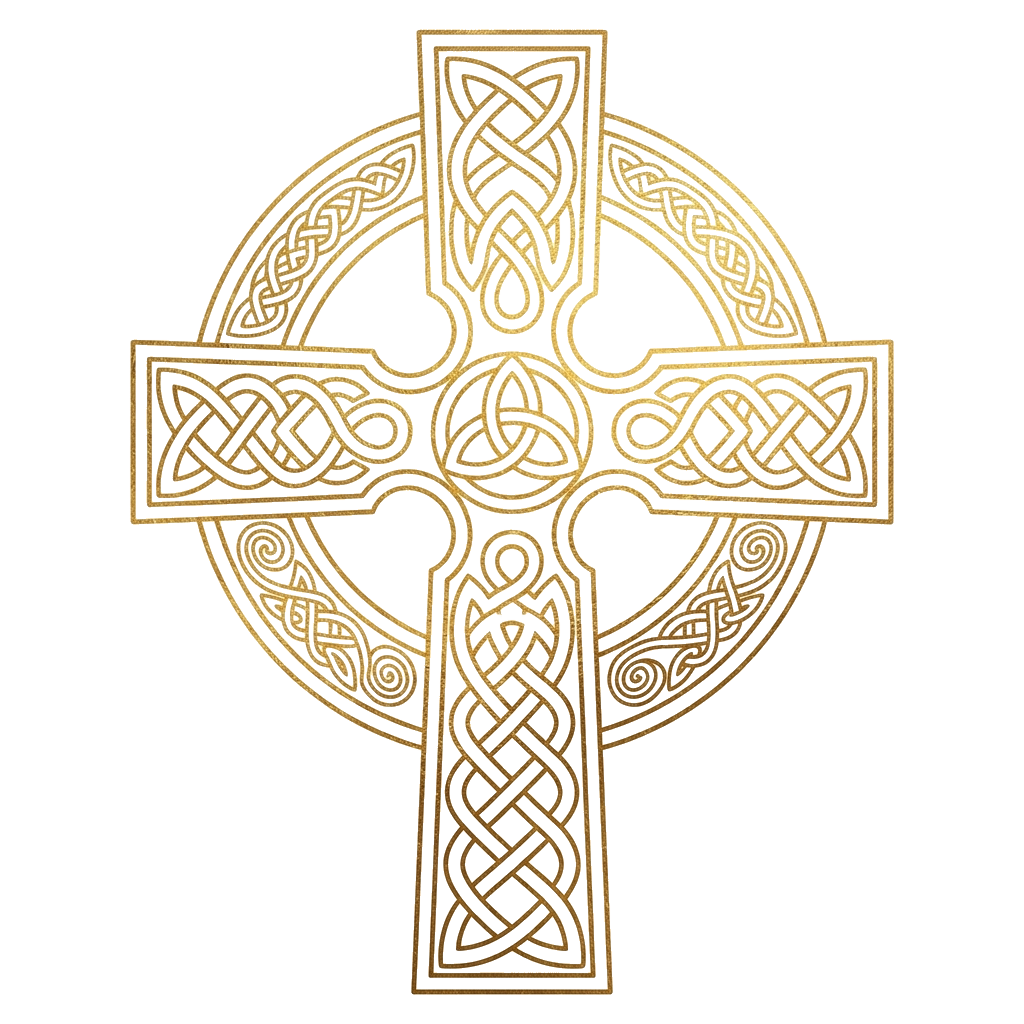
Celtic Cross
A ringed cross merging the Christian cross with the pre-Christian sun wheel — Ireland and Scotland's defining monument, bridging pagan solar worship and Christian salvation in a single form.
About Celtic Cross
The Celtic Cross — a Latin cross ringed at the intersection of its arms — first appeared in stone during the early medieval period in Ireland and Britain — a Latin cross surrounded by or merged with a ring at the intersection of its arms. This distinctive form, sometimes called the ringed cross, the wheel cross, or the Irish cross, has stood in the landscapes of Ireland, Scotland, Wales, and Brittany for more than a thousand years, its stone monuments weathering centuries of rain, invasion, reformation, and revival while the symbol itself only grew in resonance and reach.
The Celtic Cross is extraordinary not for its longevity alone but for its layered origin. It is not a purely Christian symbol, nor is it purely pagan. It is a synthesis — one of the most successful acts of religious syncretism in European history. The cross, the universal emblem of Christian faith since the early centuries of the Common Era, is here married to the circle, an older and more universal sign: the sun, the wheel of the year, the cycle of seasons, the unbroken continuity of life. The resulting form speaks to both traditions simultaneously without betraying either. For the Christian, the ring frames the cross in glory, suggesting the eternal radiance of Christ's sacrifice. For the inheritor of pre-Christian Celtic spirituality, the cross sits within the wheel of nature, acknowledging the solar and seasonal rhythms that governed life long before missionaries arrived.
The earliest surviving Celtic high crosses date to the seventh and eighth centuries CE, emerging in monastic settlements across Ireland and Scotland during the period when Celtic Christianity was at its most distinctive and creative. These were not modest markers but monumental works of art — some standing over five meters tall, carved from single blocks of sandstone or granite, covered on every face with interlocking panels of scripture, zoomorphic interlace, geometric knotwork, and figural scenes from the Bible and the lives of the saints. The great high crosses at Monasterboice, Clonmacnoise, Ahenny, and Iona represent one of the supreme achievements of early medieval European sculpture, rivaling the finest Romanesque and Byzantine work in their ambition and execution.
The Celtic Cross never disappeared. When the great monastic centers declined under Viking raids and Norman conquest, the form persisted in smaller wayside crosses, grave markers, and boundary stones. When the Protestant Reformation swept much of Britain and suppressed Catholic imagery, the Celtic Cross endured in the landscapes of Ireland and the Scottish Highlands, too embedded in the land to be removed. When the Celtic Revival of the nineteenth century sought to recover a distinctly Irish and Scottish cultural identity, the Celtic Cross became its foremost emblem — carved on gravestones, printed on book covers, woven into jewelry, and erected as war memorials. Today it marks graves from Arlington to Anzac, adorns churches from Dublin to São Paulo, and serves as both a sacred symbol and a cultural identifier for the Irish, Scottish, Welsh, and Breton diasporas worldwide.
Visual Description
The Celtic Cross consists of a Latin cross — a vertical shaft intersected by a shorter horizontal bar positioned above the midpoint — with a ring or nimbus encircling the intersection of the two arms. The ring connects all four arms of the cross, creating a unified form in which the cruciform and circular elements are structurally interdependent. In the earliest stone high crosses, the ring is not merely drawn around the cross but carved as an integral part of the same monolithic block, the spaces between the arms and the ring either left open (creating four arched windows) or filled with carved panels of ornament.
The proportions of the Celtic Cross vary considerably across periods and regions, but certain features remain consistent. The vertical shaft typically extends well below the crossbar, sometimes widening at the base into a trapezoidal pedestal or plinth. The upper arm above the crossbar is shorter than the lower shaft, giving the form its characteristic upward emphasis. The ring itself is usually a true circle centered on the intersection, though in some early examples it is slightly flattened or elliptical. The overall effect is of a figure at once grounded and aspiring — rooted in the earth through its base, reaching toward the sky through its upper arm, and embraced by the eternal circuit of the ring.
The surfaces of the great Irish high crosses are among the most densely decorated stone surfaces in early medieval art. Panels of figurative carving depict scenes from the Old and New Testaments — the Fall of Adam, the sacrifice of Isaac, Daniel in the lion's den, the Crucifixion, the Last Judgment — alongside images of monks, abbots, chariots, hunts, and abstract ornament. The spaces between and around these panels are filled with interlace patterns of astonishing complexity: bands of knotwork that weave over and under themselves without beginning or end, zoomorphic forms in which serpents, birds, and quadrupeds dissolve into and emerge from geometric lattices, and spirals that recall the prehistoric carved stones of Newgrange and Knowth, linking the Christian high crosses to a decorative tradition stretching back three thousand years before their creation.
In the simplified modern form, the Celtic Cross appears as a clean outline — the cross and ring rendered in even-width lines, sometimes with a simple knotwork panel at the center where the arms intersect. This pared-down version, widely used in jewelry, tattoo art, heraldry, and gravestone design, retains the essential formal power of the original while making it reproducible at any scale. Whether carved at monumental scale from Clonmacnoise sandstone or cast in silver for a pendant, the form communicates the same fundamental statement: the cross is ringed, the mortal is enclosed by the eternal, the Christian sacrifice is framed by the turning wheel of cosmic time.
Esoteric Meaning
The Celtic Cross encodes the fundamental principle that the linear and the cyclical, the historical and the eternal, are not opposed but interwoven. The cross is the sign of intersection — the point where the vertical axis of spirit meets the horizontal axis of matter, where the transcendent descends into the immanent. The circle is the sign of wholeness — the line that returns to itself, encompassing all directions, all seasons, all states of being. When the circle embraces the cross, it declares that the moment of intersection is not a single event in linear time but an eternal pattern, perpetually enacted at the center of existence.
For the Celtic Christian monks who created the great high crosses, this was a statement about the nature of Christ's sacrifice. The Crucifixion was not merely a historical event that occurred at a specific place and date — it was the irruption of the eternal into the temporal, a point at which the whole circling cosmos was gathered into a single act of divine self-giving. The ring around the cross says: this happened once, and it happens always. The center holds. The sacrifice that redeems the world is also the axis around which the world turns.
But the ring carries older meanings that the Christian monks did not erase so much as baptize. In pre-Christian Celtic cosmology, the circle was the sun — the great wheel that rises and sets, that waxes and wanes through the solstices and equinoxes, that governs the agricultural year upon which all life depends. The four arms of the cross, reaching to the four quarters of the ring, correspond to the four cardinal directions, the four seasons, and the four great fire festivals of the Celtic year: Imbolc, Beltane, Lughnasadh, and Samhain. The cross within the wheel is a map of sacred time and sacred space — a cosmogram that orients the viewer within the turning order of the natural world.
This double reading — Christian theology and Celtic cosmology, the cross of salvation and the wheel of the year — is not a contradiction but a creative tension that gives the Celtic Cross its peculiar spiritual power. The monks of Iona, Clonmacnoise, and Kells were not confused about what they believed. They were sophisticated theologians who understood that the God who redeems through the cross is the same God who turns the seasons and raises the sun. By placing the cross within the wheel, they were not compromising their faith but completing it — declaring that nature and grace, creation and redemption, the cosmic and the particular, are aspects of a single divine reality.
The interlace patterns that cover the surfaces of the high crosses carry their own esoteric significance. The endless knot — a band that weaves over and under itself without termination — is a visual koan: it has no beginning and no end, yet it is structured, orderly, and beautiful. It represents eternity not as static emptiness but as dynamic, self-sustaining pattern. The zoomorphic interlace, in which animal forms dissolve into and re-emerge from geometric lattices, speaks to the Celtic understanding of metamorphosis — the fluid boundary between human, animal, and spirit that pervades the mythology preserved in the Irish and Welsh cycles. The spirals recall the triple spirals of Newgrange, linking the Christian monuments to the neolithic sacred sites of three thousand years earlier and suggesting an unbroken thread of spiritual intuition running through the entire history of the Celtic-speaking peoples.
In the tradition of Western esotericism, the Celtic Cross has been interpreted as a variant of the universal mandala — the sacred circle divided by a cross that appears in virtually every human culture as a symbol of the ordered cosmos. The medicine wheel of the Indigenous American traditions, the Hindu and Buddhist mandala, the Chinese compass rose, the astrological chart — all share the same fundamental geometry of a circle quartered by a cross. The Celtic Cross is the specifically Celtic and Christian expression of this archetype, locating the redemptive act of the Crucifixion at the center of the cosmic wheel and thereby declaring that the deepest truth of the cosmos is not impersonal order but sacrificial love.
Exoteric Meaning
In its most straightforward public meaning, the Celtic Cross is a Christian symbol — a marker of faith, a monument to the Gospel, and an emblem of the Celtic churches of Ireland, Scotland, and the broader Insular world. The great high crosses were erected at monastic sites to proclaim the Christian message in visual form, making the stories and teachings of the Bible accessible to a largely non-literate population through carved figural panels. A visitor to Monasterboice in the ninth century could 'read' the Cross of Muiredach panel by panel, moving from the Fall of Adam through the prophets and patriarchs to the Crucifixion and Last Judgment — a complete salvation history rendered in stone.
For the monastic communities that created them, the high crosses also served practical liturgical functions. They marked the boundaries of sacred precincts, the stations of outdoor processional routes, and the gathering points for open-air preaching and worship. In a landscape without large church buildings — the earliest Irish monasteries were clusters of small stone cells and oratories — the high cross was often the most prominent vertical element, the focal point around which the religious life of the community was organized. It was pulpit, catechism, and sanctuary combined.
As a funerary marker, the Celtic Cross has been in continuous use for over a thousand years and remains the most common gravestone form in Ireland and much of Scotland. The ring around the cross, in this context, carries the straightforward meaning of eternal life — the soul's passage from the linear time of mortal existence into the unending circle of divine eternity. Grieving families chose the Celtic Cross not because they were making an esoteric statement about solar symbolism but because the form expressed, simply and powerfully, the Christian hope that death is not the end.
In the nineteenth century, the Celtic Revival transformed the Celtic Cross from a regional religious symbol into a national and cultural emblem. Antiquarians, poets, and political activists — from George Petrie and Samuel Ferguson to W.B. Yeats and Patrick Pearse — looked to the high crosses as evidence of a distinctly Irish artistic and spiritual genius, a heritage that predated and transcended British colonial rule. The Celtic Cross became a symbol of Irish identity itself, reproduced on everything from gravestones and war memorials to sports jerseys and pub signs. The same process occurred in Scotland, where the Celtic Cross adorns war memorials, clan badges, and the iconography of Scottish national identity.
Today, the Celtic Cross functions simultaneously as a religious symbol, a cultural identifier, a decorative motif, and a marker of ancestry. It appears on churches and cathedrals, on military cemeteries from Flanders to Gallipoli, on jewelry worn by people of Irish and Scottish descent worldwide, and in tattoo art where it often signifies heritage, faith, or both. For millions of people in the global Celtic diaspora — from Boston to Buenos Aires, from Sydney to Cape Town — the Celtic Cross is the single most powerful visual sign of where they come from and what they believe.
Usage
The original and primary use of the Celtic Cross was as a monumental stone sculpture erected at early medieval monastic sites throughout Ireland, Scotland, and the broader Insular world. These high crosses served multiple functions simultaneously: they were objects of devotion, teaching tools, processional markers, and assertions of the monastery's spiritual authority in the surrounding landscape. Monks and pilgrims circumambulated them in prayer. Abbots preached beside them. The carved panels served as visual catechisms, telling the stories of salvation to communities where literacy in Latin — or any language — was limited to the clerical elite.
In funerary practice, the Celtic Cross has been the predominant gravestone form in Ireland for centuries and remains so today. Every churchyard in Ireland, from the grandest urban cemeteries to the smallest rural burial grounds, is populated with Celtic Cross headstones of every size and quality, from rough-cut local stone to polished granite imported from quarries in India and China. The form is so ubiquitous in Irish funerary culture that it functions as a default — the assumed shape of a headstone unless another form is specifically chosen.
The Celtic Cross also plays a significant role in civic and military commemorative use. War memorials in the Celtic Cross form were erected across Ireland, Britain, Australia, New Zealand, Canada, and the United States following the First and Second World Wars, often in communities with strong Irish or Scottish populations. The Celtic Cross at the Australian War Memorial in Canberra, the Irish National War Memorial Gardens at Islandbridge in Dublin, and numerous Commonwealth War Graves Commission cemeteries in France and Belgium all employ the Celtic Cross form to honor the dead while asserting the specific cultural identity of those who served.
In contemporary spiritual practice, the Celtic Cross is used by Celtic Christians, neo-pagans, and practitioners of Celtic reconstructionist traditions as a focal point for meditation, prayer, and ritual. For Celtic Christians — those who emphasize the distinctive spirituality of the early Irish and British churches, with its love of nature, its ascetic rigor, and its integration of contemplative practice into daily life — the Celtic Cross is the primary sacred symbol, preferred over the plain Latin cross for its embodiment of the Celtic spiritual genius. For neo-pagans and reconstructionists, the ring of the Celtic Cross represents the wheel of the year, and the cross within it maps the solstices, equinoxes, and cross-quarter days that structure the ritual calendar.
In divination, the Celtic Cross is also the name of the most widely used Tarot spread — a ten-card layout in the shape of a cross with a vertical staff beside it. While this usage derives from the Hermetic Order of the Golden Dawn's adaptation of Tarot in the late nineteenth century rather than from ancient Celtic practice, the association has further cemented the Celtic Cross as a symbol with spiritual and divinatory connotations in the broader Western esoteric tradition.
In decorative and commercial contexts, the Celtic Cross appears on jewelry, clothing, album art, book covers, pub signs, sports insignia, and countless other surfaces. Celtic knotwork designs based on the patterns found on the high crosses constitute an entire genre of decorative art, reproduced by jewelers, tattoo artists, graphic designers, and crafters worldwide. The Claddagh ring may be Ireland's most famous piece of jewelry, but the Celtic Cross pendant is almost certainly its most widely worn sacred ornament.
In Architecture
The Celtic Cross achieves its most monumental expression in the Irish high crosses of the eighth through twelfth centuries — freestanding stone monuments that rank among the supreme achievements of early medieval European sculpture. The most celebrated of these is the Cross of Muiredach at Monasterboice, County Louth, erected in the early tenth century. Standing over five meters tall on its pyramidal base, the Cross of Muiredach is covered on every face with intricately carved panels depicting biblical scenes — the arrest of Christ, the Crucifixion, the Last Judgment, Moses striking the rock, the adoration of the Magi — interspersed with panels of dense interlace ornament and flanked by figural compositions of monks, warriors, and animals. The ring of the cross is pierced, creating four arched openings between the arms, and the capstone takes the form of a miniature shrine or church roof, suggesting that the cross itself is a kind of sacred building.
The Cross of the Scriptures at Clonmacnoise, County Offaly, is equally important — erected around 900 CE, probably by King Flann Sinna and Abbot Colman, its panels focus on the Crucifixion and the founding of the monastery, with an inscription requesting a prayer for the king and the craftsman who made it. This is one of the rare cases where the high cross speaks directly about its own creation, giving us a glimpse of the collaborative relationship between secular and ecclesiastical power that produced these monuments.
The South Cross at Ahenny, County Tipperary, represents an earlier phase of high cross design — probably eighth century — in which geometric ornament dominates and figural scenes are confined to the base. The Ahenny crosses are covered with spiral, interlace, and boss patterns of extraordinary refinement, executed with a precision that suggests they were modeled on metalwork prototypes — the stone carver translating into sandstone the techniques of the goldsmith and the bronze-caster. The bosses that stud the surface of the Ahenny crosses recall the great Irish metalwork reliquaries and processional crosses, suggesting that the high crosses and the metalwork tradition were two expressions of a single artistic vision.
On the Scottish island of Iona — the monastery founded by St. Columba in 563 CE, the spiritual heart of Celtic Christianity — the high crosses of St. Martin and St. John stand as testimony to the art of the Columban monks. St. Martin's Cross, dating to the eighth century, is one of the finest surviving examples of Insular sculpture, its west face dominated by a magnificent Virgin and Child flanked by angels, its east face covered with serpent-and-boss ornament of hypnotic complexity.
Beyond the great monastic high crosses, the Celtic Cross form pervades the architecture of churches, cathedrals, and chapels throughout Ireland, Scotland, and Wales. Gothic and Romanesque church windows in the Celtic lands frequently incorporate the ringed cross into their tracery. The great medieval cathedrals at Cashel, Clonfert, and Cong incorporate Celtic Cross motifs into their carved stonework. In the nineteenth and twentieth centuries, the Celtic Revival led to a flourishing of Celtic Cross forms in church architecture — stained glass windows, altar crosses, baptismal fonts, and exterior monuments designed to assert continuity with the early Christian heritage.
The Celtic Cross has also left its mark on secular civic architecture and landscape design. The O'Connell Monument in Dublin's Glasnevin Cemetery, the memorial crosses at Gettysburg, and numerous town crosses and market crosses throughout Ireland and Scotland all employ the Celtic Cross form. In the contemporary landscape, new Celtic Cross monuments continue to be erected — at the Irish Hunger Memorial in New York City, at memorial sites in Australia and Canada, and in churchyards worldwide — ensuring that this ancient form continues to shape the built environment of the twenty-first century.
Significance
Between the seventh and twelfth centuries, the high crosses of Ireland and Scotland achieved something unprecedented: a fusion of Christian theology with pre-Christian cosmology cast in stone and meant to last. It is, together with the Book of Kells and the Ardagh Chalice, one of the three crowning achievements of Insular art — the distinctive artistic tradition that flourished in Ireland, Scotland, and Northern England during the early medieval period, roughly the sixth through twelfth centuries. This tradition represents one of the most original and accomplished artistic movements in European history, and the high crosses are its most public, most monumental, and most enduring expression.
The significance of the Celtic Cross lies not only in its artistic quality but in what it represents about the nature of the civilization that produced it. The great high crosses were created during a period when Ireland and Scotland were among the most intellectually and spiritually vibrant regions in Europe — the 'island of saints and scholars' that preserved classical learning, developed new forms of manuscript illumination and metalwork, and sent missionaries across the continent to establish monasteries from Lindisfarne to Bobbio, from St. Gall to Wurzburg. The high crosses are the outdoor, public-facing expression of the same cultural energy that produced the Book of Kells in the scriptorium and the Tara Brooch in the workshop. They declare, in stone, that this civilization had something to say to the world.
As a symbol of religious syncretism, the Celtic Cross is historically significant as evidence of how Christianity was received and transformed in the Celtic world. The early Irish church did not simply adopt Roman Christianity wholesale — it adapted the faith to Celtic patterns of thought, social organization, and artistic expression, producing a distinctive form of Christianity characterized by monasticism rather than diocesan structure, by a love of nature as the theatre of divine revelation, by extreme ascetic discipline, and by an artistic tradition that drew freely on pre-Christian Celtic decorative vocabulary. The Celtic Cross is the most visible artifact of this process: the Gospel came to Ireland, and Ireland gave the Gospel a ring.
In terms of cultural identity, the Celtic Cross has become the preeminent symbol of Irishness and, to a lesser but significant degree, of Scottish, Welsh, and Breton identity. Its role in the Celtic Revival of the nineteenth and early twentieth centuries — which was inseparable from the broader movements for Irish cultural autonomy and political independence — gave it a political dimension that it retains today. The Celtic Cross on a gravestone, a war memorial, or a lapel pin is not merely a religious statement but a cultural one: it says, I belong to a tradition that predates the modern nation-state, that has its own artistic genius, its own spiritual character, and its own way of understanding the relationship between God, nature, and humanity.
For practitioners of various spiritual traditions today, the Celtic Cross remains a living symbol — not a museum piece but an active focal point for prayer, meditation, and contemplation. Its power derives from the same source that has sustained it for thirteen centuries: the formal elegance of circle and cross, the tension between the eternal return of the ring and the singular event of the crucifixion, and the accumulated resonance of a thousand years of devotion, artistry, and cultural memory concentrated in a single form.
Connections
The Celtic Cross connects to the broader family of sacred symbols that combine the cross and the circle — a formal archetype that appears across virtually every human culture. The sun cross or wheel cross, consisting of a circle divided by two perpendicular lines, is one of the oldest and most widespread symbols in human history, appearing in neolithic rock carvings, Bronze Age artifacts, and the iconography of cultures from Scandinavia to Mesoamerica. The Celtic Cross is the specifically Celtic and Christian elaboration of this universal form, developed to a level of artistic sophistication unmatched by any other cultural tradition.
Within the Celtic artistic tradition, the high crosses are closely related to the great illuminated manuscripts — the Book of Kells, the Lindisfarne Gospels, the Book of Durrow — which share the same decorative vocabulary of interlace, spirals, zoomorphic forms, and geometric patterns. The carpet pages of the Book of Kells, with their dizzying complexity of interlocking ornament organized around a central cross motif, are essentially two-dimensional versions of the same artistic program that the high crosses execute in three dimensions. To understand one is to understand the other; they are products of the same workshops, the same monastic schools, and the same theological imagination.
The Celtic Cross also connects to the tradition of monastic sculpture across the early medieval world. The Pictish cross-slabs of eastern Scotland, the Anglo-Saxon crosses of Northumbria (the Ruthwell Cross, the Bewcastle Cross), and the Viking-age crosses of the Isle of Man and Northern England all participate in the same broad tradition of monumental stone carving, though each regional tradition has its own distinctive character. The Ruthwell Cross, with its runic inscriptions and its sophisticated figural style, represents the Northumbrian contribution; the Pictish slabs, with their enigmatic Pictish symbols alongside Christian imagery, represent the northeastern Scottish tradition; and the Manx crosses, with their blend of Norse and Celtic ornament, represent the hybrid culture of the Viking Age Irish Sea world.
The connection between the Celtic Cross and the Triquetra is intimate and longstanding. The Triquetra appears on dozens of Irish and Scottish high crosses, carved into panels alongside interlace and figural scenes. Both symbols are products of the same Celtic Christian culture, and both encode the same theological conviction — that the divine manifests in patterns of three-in-one unity, whether understood as the Christian Trinity or as the older Celtic pattern of triple aspects.
The Celtic Cross's relationship to the Ankh deserves consideration as well. Both symbols combine a loop or ring with a cruciform base. Both served as the defining sacred symbol of their respective civilizations. Both carry the double meaning of a specific religious doctrine (resurrection/eternal life) and a broader cosmological principle (the union of opposites, the conjunction of the eternal and the temporal). The Coptic crux ansata — the Ankh adopted as a Christian cross — represents a historical point of contact between the Egyptian and the Celtic forms, both of which were circulating in the early Christian world during the formative centuries of Insular art.
The Celtic Cross's modern connections extend into the world of Tarot through the Celtic Cross spread, the most widely used Tarot layout in the Western esoteric tradition. Developed by the Hermetic Order of the Golden Dawn in the late nineteenth century and popularized by Arthur Edward Waite, the Celtic Cross spread arranges ten cards in a pattern that maps past, present, future, and the querent's inner and outer circumstances. While this divinatory usage has no direct historical connection to the medieval high crosses, it has become one of the primary associations of the Celtic Cross in contemporary spiritual culture, linking the ancient symbol to an ongoing tradition of self-knowledge and spiritual inquiry.
Further Reading
- Triquetra — The three-pointed knot that appears alongside the Celtic Cross on Irish high crosses, representing trinitarian theology in Celtic visual language
- Ankh — The Egyptian key of life, which shares the Celtic Cross's fundamental geometry of a ring or loop combined with a cruciform base
- Tree of Life — The cosmic axis that connects the three worlds, resonating with the vertical shaft of the Celtic Cross as a symbol of the axis mundi
- Ouroboros — The eternal serpent whose circular form shares the Celtic Cross ring's meaning of cyclical completeness and return
- Flower of Life — The geometric pattern of sacred geometry that underlies the Celtic Cross's combination of circle and straight line
- Eye of Horus — A comparison point from Egyptian tradition, showing how different cultures encode protection and divine sight in compact symbolic forms
Frequently Asked Questions
What does the Celtic Cross symbolize?
The Celtic Cross encodes the fundamental principle that the linear and the cyclical, the historical and the eternal, are not opposed but interwoven. The cross is the sign of intersection — the point where the vertical axis of spirit meets the horizontal axis of matter, where the transcendent descends into the immanent. The circle is the sign of wholeness — the line that returns to itself, encompassing all directions, all seasons, all states of being. When the circle embraces the cross, it declares that the moment of intersection is not a single event in linear time but an eternal pattern, perpetually enacted at the center of existence.
Where does the Celtic Cross originate?
The Celtic Cross originates from the Celtic Christian (synthesis of Christian cross and pre-Christian solar symbolism) tradition. It dates to c. 7th century CE — present (as ringed cross); pre-Christian ring/wheel symbolism much older. It first appeared in Ireland, Scotland, Wales, Brittany, Northern England.
How is the Celtic Cross used today?
The original and primary use of the Celtic Cross was as a monumental stone sculpture erected at early medieval monastic sites throughout Ireland, Scotland, and the broader Insular world. These high crosses served multiple functions simultaneously: they were objects of devotion, teaching tools, processional markers, and assertions of the monastery's spiritual authority in the surrounding landscape. Monks and pilgrims circumambulated them in prayer. Abbots preached beside them. The carved panels served as visual catechisms, telling the stories of salvation to communities where literacy in Latin — or any language — was limited to the clerical elite.