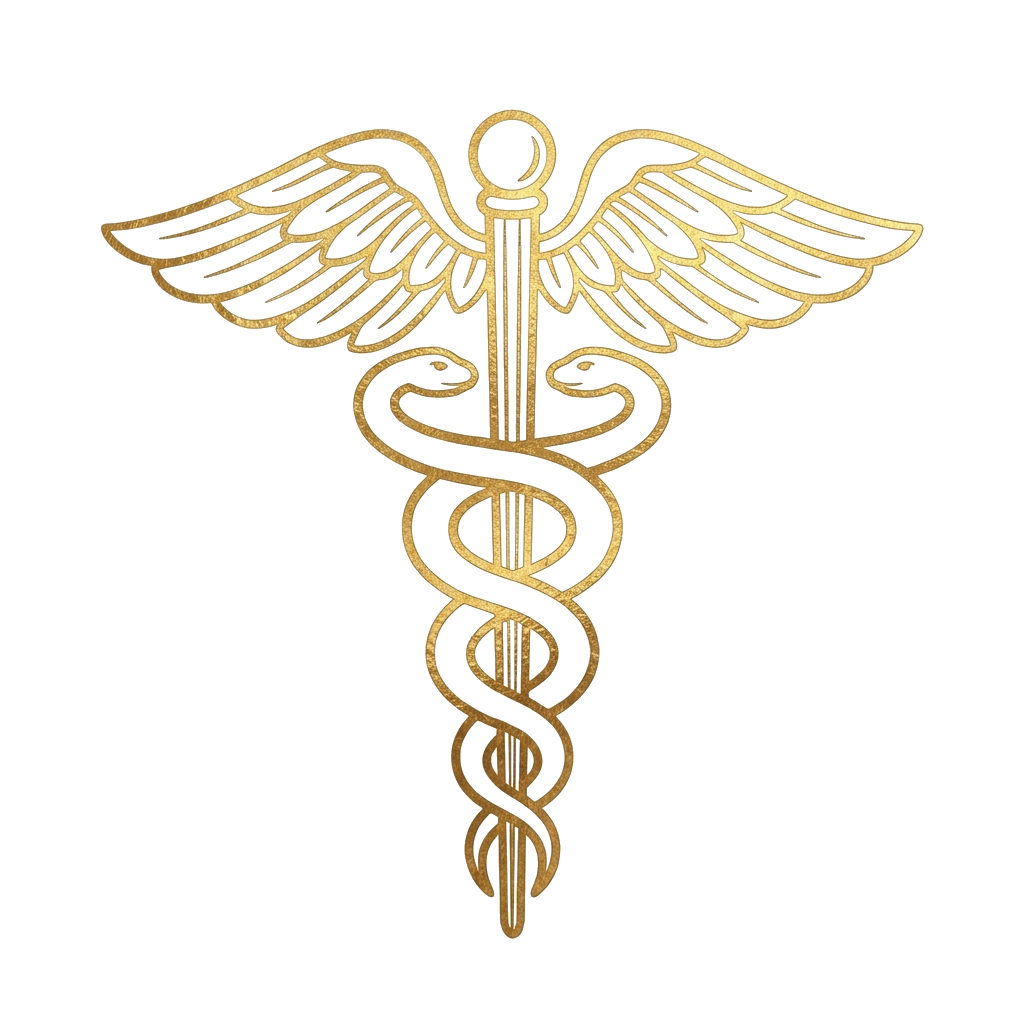
Caduceus
The twin-serpent staff of Hermes — an ancient symbol of mediation between opposites, cosmic balance, and the transformative power of communication, often confused with the Rod of Asclepius.
About Caduceus
The Caduceus is a winged staff entwined by two serpents, carried by Hermes (Roman Mercury) as the herald's rod of the gods. Its earliest antecedents reach back to Mesopotamia around 2600 BCE, where the intertwined serpents appear on the libation vase of Gudea of Lagash as an attribute of Ningishzida, a chthonic deity of the underworld who served as a mediator between humans and the divine. The symbol was adopted into Greek culture no later than the seventh century BCE, where it became inseparable from Hermes — god of boundaries, transitions, communication, trade, thieves, travelers, and the escort of souls to the underworld. The Greek word kerykeion (from keryx, "herald") gave rise to the Latin caduceus, cementing the staff's identity as the instrument of one who moves between worlds, carrying messages that cannot be refused and establishing truces that cannot be broken.
What distinguishes the Caduceus from superficially similar serpent-staff symbols is its precise geometry: two serpents, not one, winding in opposite directions around a central axis, their heads facing each other at the top, with wings spreading above the point of their meeting. This is not ornamentation — it is a diagram of cosmic mechanics. The two serpents represent polar forces held in dynamic equilibrium by the central staff of consciousness, and the wings represent the transcendence that becomes possible when those forces are balanced rather than at war. Every tradition that has worked seriously with this symbol has recognized it as a map of the process by which divided, conflicting energies can be harmonized into a unified field of creative power. It is, in essence, a blueprint for transformation through reconciliation rather than through the triumph of one force over another.
The Caduceus must be carefully distinguished from the Rod of Asclepius — a single serpent wound around an unwinged staff — which is the true symbol of medicine and healing in the Greek tradition. Asclepius was the god of medicine; Hermes was not. The widespread confusion between the two symbols, particularly in American medical contexts, dates to the early twentieth century and represents one of the most consequential iconographic errors in modern institutional history. The United States Army Medical Corps adopted the Caduceus as its insignia in 1902 through a decision by a single officer, Captain Frederick P. Reynolds, who apparently preferred its visual complexity to the simpler Rod of Asclepius. This error propagated through American healthcare culture despite protests from classicists and medical historians, and today the two-serpent Caduceus appears on hospitals, ambulances, and pharmaceutical companies across the United States, while much of the rest of the world correctly uses the single-serpent rod. The irony is rich: the symbol of the trickster god, patron of thieves, has been mistakenly installed as the emblem of the healing profession.
Visual Description
The Caduceus in its fully developed classical form consists of three distinct elements working as a unified composition. The central element is a straight, slender rod or staff — sometimes depicted as a simple wand, sometimes as a more elaborate herald's scepter with a knob or finial at the top. This axis mundi is the spine of the symbol, the vertical line of consciousness around which all other elements organize themselves. In the earliest Mesopotamian versions, the rod may be absent entirely, with the serpents intertwining around each other or around a stylized tree, connecting the image to the Tree of Life tradition that runs through Sumerian, Babylonian, and later Kabbalistic symbolism.
The two serpents wind around the central staff in a precise helical pattern, crossing each other at regular intervals — typically three or four crossing points — and diverging at the top so that their heads face each other across the staff's crown. This double helix is the Caduceus's most distinctive feature. The serpents are always depicted as a matched pair — same size, same species, same degree of coiling — emphasizing that they represent equal and complementary forces, not a dominant and subordinate pair. In Greek vase paintings and Roman sculptural reliefs, the serpents are often rendered with considerable naturalism, their scales and muscular coiling carefully observed. In Hermetic and alchemical manuscripts from the medieval and Renaissance periods, the serpents become more stylized and symbolic, sometimes color-coded — one gold and one silver, one red and one white, or one light and one dark — to make explicit their correspondence with solar and lunar, masculine and feminine, sulfur and mercury, active and receptive principles.
The wings at the top of the staff are the element that most clearly distinguishes the developed Caduceus from its Mesopotamian ancestors and from the wingless Rod of Asclepius. They are typically depicted as a symmetrical pair of bird wings — eagle or hawk in Greek representations, sometimes more abstractly feathered in later alchemical art — spreading outward and upward from the point where the serpents' heads meet or from just above it. The wings introduce a vertical aspiration to the symbol's horizontal balance: the serpents represent the reconciliation of earthly polarities, while the wings represent the spiritual ascent that becomes possible once that reconciliation is achieved. In some Renaissance depictions, particularly those influenced by Hermetic philosophy, the wings are replaced by or augmented with a solar disc or a winged globe, linking the Caduceus to Egyptian solar symbolism and the concept of the elevated, illuminated consciousness. The overall visual impression is one of precise symmetry, dynamic balance, and upward aspiration — a symbol that simultaneously depicts tension and resolution, movement and stillness, earth and heaven.
Esoteric Meaning
The Caduceus is a map of the energy anatomy of the human being and of the cosmos that the human being recapitulates. The two serpents correspond with remarkable precision to the ida and pingala nadis of yogic anatomy — the lunar and solar energy channels that wind around the central sushumna nadi (the staff), crossing at each chakra center and converging at the ajna chakra (third eye) at the top. This is not a casual resemblance or a retroactive projection; the parallel is structural and functional. In both systems, two polar currents — feminine/receptive/cooling and masculine/active/heating — spiral around a central axis of consciousness, and the goal of practice is to bring these currents into balance so that the central channel opens and the practitioner's awareness ascends to a state of unified perception. The wings of the Caduceus correspond to the sahasrara (crown chakra) opening that occurs when this balance is achieved — the moment of transcendence, the "flight" of the liberated consciousness.
In alchemical tradition, the Caduceus is the staff of Mercury — not merely the planet or the metal, but the Philosophical Mercury that is the secret agent of the entire Great Work. Mercury in alchemy is the principle of mediation: it is neither sulfur (the active, solar, masculine principle) nor salt (the fixed, material, feminine principle), but the volatile, fluid, transformative medium through which sulfur and salt communicate and ultimately unite. The two serpents of the Caduceus are sulfur and salt themselves — the contraries that must be reconciled — and the staff is the Mercurial consciousness that holds them in creative tension. The alchemical motto solve et coagula (dissolve and coagulate) describes exactly what the Caduceus depicts: the twin processes of breaking down and building up, carried out simultaneously by opposing forces under the governance of a mediating intelligence. The Caduceus is therefore the alchemist's supreme operational symbol — not a static emblem but a working diagram of the transformative process itself.
The Caduceus also encodes the Hermetic teaching on the reconciliation of opposites — what Hermeticism calls the coincidentia oppositorum. This is not the victory of one opposite over another, nor their bland averaging into a lukewarm middle, but a genuine third state that transcends the polarity while honoring both poles. Light and darkness, masculine and feminine, expansion and contraction, spirit and matter — the Caduceus teaches that these are not enemies to be conquered but dance partners whose collaboration generates the creative power of the universe. This principle appears across every major wisdom tradition: in the Taoist interplay of yin and yang, in the Kabbalistic balance of the Pillars of Mercy and Severity on the Tree of Life, in the Sufi concept of barzakh (the isthmus between two seas), and in the Buddhist Middle Way between indulgence and asceticism. The Caduceus is the Western tradition's most precise visual articulation of this universal principle — and it is no accident that it belongs to Hermes, the god who walks between all worlds without being bound to any of them.
Finally, the Caduceus carries a specific teaching about communication as a spiritual power. Hermes is the logos — the divine word, the utterance that bridges the gap between mind and matter, between intention and manifestation. The herald's staff is not a weapon or a tool of compulsion; it is the instrument of one who facilitates understanding between parties that cannot otherwise communicate. In this sense, the Caduceus is the symbol of translation itself — not just between languages but between levels of reality. The serpent that rises speaks the language of the earth to the sky; the serpent that descends speaks the language of the sky to the earth. Together they enact the Hermetic axiom from the Emerald Tablet: "That which is below is like that which is above, and that which is above is like that which is below, to accomplish the miracles of the one thing."
Exoteric Meaning
In its most widely recognized public meaning, the Caduceus is associated with medicine and healthcare — though this association is, strictly speaking, an error. In the United States, the twin-serpent winged staff appears on the insignia of the Army Medical Corps, on hospital signage, on pharmaceutical packaging, and as a general emblem of the medical profession. This usage stems from the 1902 adoption by the U.S. Army and was reinforced by the American Medical Association and various commercial healthcare entities throughout the twentieth century. The confusion persists despite the fact that the correct medical symbol — the Rod of Asclepius, a single serpent on an unwinged staff — is the one recognized by the World Health Organization, the American Medical Association's own official seal (which does use the correct symbol), and virtually every medical tradition outside the United States. Surveys of American medical professionals reveal that many are unaware of the distinction, which speaks to the power of institutional momentum over historical accuracy.
Beyond the medical confusion, the Caduceus carries broadly understood associations with commerce, negotiation, and diplomacy. Hermes was the patron god of merchants, and his staff was the instrument of fair dealing — or at least clever dealing. In Renaissance and Baroque art, Mercury holding the Caduceus symbolized trade, prosperity, and the free flow of goods and ideas. The symbol appears on coins, commercial seals, postal insignia, and the emblems of chambers of commerce worldwide. The United States Customs Service and several European postal services have used Caduceus-derived imagery. In the context of diplomacy, the herald's staff represents safe passage, protected speech, and the inviolability of the messenger — an ancient concept that predates and underlies modern diplomatic immunity.
In popular culture, the Caduceus functions as a general symbol of wisdom, knowledge, and esoteric authority. It appears in fantasy literature and games as a mage's staff, in corporate logos for technology and communications companies, and in New Age contexts as an emblem of energy healing and chakra work. While these popular usages often lack the depth of the symbol's esoteric meanings, they preserve an intuitive recognition that the Caduceus represents some form of mediating intelligence — a force that connects, translates, and harmonizes.
Usage
The Caduceus has served as a working ritual and institutional symbol across an extraordinary span of human history. In ancient Mesopotamia, the intertwined serpents of Ningishzida appeared on boundary stones (kudurru) and temple dedications, marking the threshold between the human and divine domains. Priests and temple functionaries associated with Ningishzida's cult used the symbol as a seal and badge of office. When the symbol migrated into Greek culture, it became the literal staff carried by heralds (kerykes) — official messengers whose persons were considered sacred and inviolable under the protection of Hermes. To carry the kerykeion was to announce oneself as a bearer of messages between powers, whether those powers were rival city-states, warring armies, or the gods and humanity. This practical diplomatic function persisted through Roman culture, where Mercury's caduceus served the same purpose on a grander imperial scale.
In Hermetic and alchemical practice from the Hellenistic period through the Renaissance, the Caduceus was one of the most frequently reproduced operational symbols. It appeared on the title pages of alchemical treatises, was inscribed on laboratory equipment, and was used as a meditation object for practitioners seeking to internalize the balance of polar forces that the symbol depicts. The Turba Philosophorum, the Rosarium Philosophorum, and Michael Maier's Atalanta Fugiens all feature the Caduceus prominently. In practical alchemy, the image of the twin serpents was used to represent the marriage of sulfur and mercury — the coniunctio oppositorum that was the goal of the Great Work. Alchemists would contemplate the Caduceus while performing operations that required precise balance of heating and cooling, dissolving and coagulating, or combining volatile and fixed substances.
In Freemasonry and related initiatory orders, the Caduceus appears as a symbol of the Senior Deacon, who escorts candidates through the lodge and serves as a messenger between the Worshipful Master and the Senior Warden — a direct continuation of Hermes' herald function. The Hermetic Order of the Golden Dawn incorporated the Caduceus into its ritual furniture and grade symbolism, associating it with the Middle Pillar of the Tree of Life and with the balanced activation of psychic forces during ceremonial work. In Theosophical literature, the Caduceus is frequently cited as evidence of the universal diffusion of the "secret doctrine" — the idea that a single esoteric teaching underlies all world traditions.
In modern institutional usage beyond medicine, the Caduceus serves as an emblem of communication, commerce, and transportation. It appears in the insignia of numerous postal services (reflecting Hermes as messenger), customs agencies (reflecting his patronage of trade), and telecommunications companies. The symbol decorates the facades of stock exchanges, banks, and chambers of commerce across Europe and the Americas. In the printing and publishing industries, the Caduceus has been used as a printer's mark since at least the fifteenth century, when Aldus Manutius's famous anchor-and-dolphin device drew on Mercurial imagery. In contemporary spiritual practice, the Caduceus is used as a visualization tool in energy healing modalities, kundalini meditation, and chakra-balancing work — a usage that, whatever its practitioners may realize, connects directly back to the symbol's oldest esoteric function.
In Architecture
The Caduceus has a long and varied presence in architectural contexts, from ancient temple carvings to modern institutional facades. In Mesopotamia, intertwined serpent motifs appear on the carved stone vessels and cylinder seals of the Lagash period (c. 2150 BCE), including the famous libation vase of Gudea, now in the Louvre, which shows two serpents winding around a rod flanked by dragons — an image scholars identify as the earliest known Caduceus prototype. These serpentine forms also appear on Mesopotamian boundary stones (kudurru) where they mark the threshold of sacred space and divine authority.
In classical Greek and Roman architecture, the Caduceus appears on temple metopes, altar reliefs, and public monuments dedicated to Hermes or Mercury. Notable surviving examples include sculptural reliefs on the Temple of Hermes at Syme (Rhodes) and Mercury's staff depicted in wall paintings at Pompeii and Herculaneum. Roman coins and medallions frequently show Mercury holding the Caduceus, and these images influenced architectural ornamentation throughout the Roman provinces. The Caduceus also appears in Roman funerary architecture, carved on sarcophagi and mausoleum facades, reflecting Hermes' role as psychopomp — the guide of souls to the underworld.
In Renaissance and Baroque Europe, the Caduceus experienced an architectural revival driven by the rediscovery of Hermetic philosophy. It appears on the facades of banking houses, merchant guildhalls, and printing establishments across Italy, France, the Netherlands, and Germany. The Palazzo della Borsa (stock exchange) in several Italian cities features prominent Caduceus reliefs. In France, the Caduceus decorates the facade of the Banque de France and numerous customs houses. The symbol was carved into the gateways of Renaissance alchemical gardens and private studies, where it served as both intellectual ornament and initiatory marker.
In the modern era, the Caduceus is most visible on medical and pharmaceutical buildings, particularly in the United States, where it appears on hospital entrances, medical school facades, and Veterans Affairs facilities. The Walter Reed Army Medical Center and the Surgeon General's office building both feature prominent Caduceus architectural elements. Beyond medicine, the Caduceus adorns post offices, customs buildings, and chambers of commerce worldwide. Masonic temples and lodge buildings incorporate the Caduceus in ceiling medallions, stained glass, and carved stone lintels — particularly those lodges working in the York Rite or in traditions that emphasize Hermetic correspondences. The Theosophical Society's international headquarters at Adyar, Chennai, features the Caduceus as part of its composite seal carved above major doorways.
Significance
The Caduceus encodes, in a single image, the entire principle of transformation through the reconciliation of opposites — not their destruction, not their compromise, but their creative integration into a higher unity. This is arguably the central teaching of Hermetic philosophy, and the Caduceus is its most precise and economical expression. Where other symbols point to unity (the Ouroboros), or to the structure of reality (the Tree of Life), or to the goal of the spiritual journey (the Ankh), the Caduceus uniquely describes the method — the dynamic process by which consciousness can harmonize the polar forces that constitute existence and thereby achieve flight, liberation, transcendence.
The Caduceus is also significant as one of the oldest continuously used symbols in human civilization. Its lineage stretches from third-millennium Mesopotamia through Greek, Roman, Hermetic, alchemical, Masonic, and modern institutional usage — a span of over four thousand years. Few symbols can claim such longevity, and fewer still have maintained their essential visual form with such consistency across such radical cultural transformations. The twin-serpent staff that Gudea of Lagash carved on his libation vase in 2150 BCE is immediately recognizable to anyone who has seen a modern hospital sign or a Masonic emblem. This persistence suggests that the Caduceus, like the Ouroboros, touches something fundamental in human cognition — an archetypal pattern that reasserts itself regardless of the cultural context in which it appears.
Perhaps most importantly, the Caduceus serves as a teaching on the nature of communication itself as a sacred and transformative act. Hermes is not a god of force or of passive contemplation; he is the god of the word — the logos, the message, the translation between incompatible languages and incommensurable worlds. The Caduceus as his staff declares that the highest form of power is not domination but mediation: the ability to move between opposites, to speak the language of each to the other, and to create the conditions in which genuine understanding — and therefore genuine transformation — can occur. In an era of polarization and fragmentation, this ancient teaching on the sacred power of honest communication may be the Caduceus's most urgently relevant meaning.
Connections
The Caduceus connects to the chakra system and yogic energy anatomy with a directness that has struck scholars and practitioners across traditions. The correspondence between the two serpents and the ida and pingala nadis — the lunar and solar energy channels of yogic anatomy — is not a loose metaphor but a structural parallel. In both systems, two polar energy currents wind around a central axis (the sushumna nadi / the staff), crossing at specific points (the chakras / the serpent crossing points), and converging at a point near the crown where their union produces an awakening or transcendence (sahasrara opening / the wings). The number of crossing points in classical Caduceus depictions (typically three to four) corresponds to the major chakra centers along the torso. This parallel has been noted by scholars including Alain Danielou, Joseph Campbell, and Manly P. Hall, and it forms the basis for the esoteric claim that the Caduceus and the yogic nadi system describe the same subtle anatomy using different cultural vocabularies.
Within Hermeticism, the Caduceus is the personal emblem of Hermes Trismegistus — the "thrice-great" figure who is the legendary author of the Corpus Hermeticum and the Emerald Tablet. The staff's teaching on the reconciliation of opposites maps directly onto the Hermetic axiom "as above, so below" — the principle that the macrocosm and microcosm mirror each other and that knowledge of one grants knowledge of the other. The Caduceus also connects to the Hermetic teaching on the three principles of alchemy (sulfur, mercury, salt): the two serpents are sulfur (active/solar) and salt (fixed/lunar), while the staff is mercury (the volatile, mediating principle that enables their union). This triad appears throughout Western esotericism and maps onto comparable trinities in other traditions.
The Caduceus connects powerfully to the Tree of Life in Kabbalistic tradition. The three pillars of the Tree — Mercy (right), Severity (left), and the Middle Pillar (center) — correspond exactly to the Caduceus's right serpent, left serpent, and central staff. The Golden Dawn made this correspondence explicit in their Middle Pillar meditation, in which the practitioner visualizes energy ascending and descending along the central channel while balancing the lateral forces — a practice that is functionally identical to pranayama exercises designed to balance ida and pingala and awaken the sushumna. The paths connecting sephiroth across the pillars correspond to the crossing points of the Caduceus serpents, and the supernal triad at the top of the Tree corresponds to the wings and the point of transcendence.
In the broader context of mystery school traditions, the Caduceus appears wherever the theme of mediation between worlds is central. In Sufi tradition, the concept of barzakh — the isthmus between the visible and invisible worlds, the meeting place of the two seas — resonates with the Caduceus's depiction of two forces meeting at a central point of awareness. The qutb (spiritual pole) in Sufism, around whom the cosmos turns, parallels the central staff. In Buddhist tantra, the central channel (avadhuti) flanked by the rasana and lalana channels mirrors the Caduceus pattern in yet another cultural vocabulary. Even in Orphic tradition, where Hermes serves as psychopomp guiding initiates through the underworld, the Caduceus functions as the instrument of safe passage between realms — the tool that opens doors between the living and the dead, the human and the divine.
Further Reading
- The Caduceus as a Medical Emblem: Its Origin, Misconceptions, and Revival — Walter J. Friedlander, The American Journal of Psychiatry (1992). Essential article tracing how the wrong symbol became the emblem of American medicine.
- Hermes the Thief: The Evolution of a Myth — Norman O. Brown (1947). Classic study of Hermes mythology, including the role of the kerykeion in Greek religion and commerce.
- The Forge and the Crucible: The Origins and Structure of Alchemy — Mircea Eliade (1962). Comprehensive treatment of alchemical symbolism including the Caduceus as a symbol of the Mercurial principle.
- Mysterium Coniunctionis — Carl G. Jung (1955-56). Extensive analysis of the Caduceus in alchemical psychology, particularly as a symbol of the transcendent function that unites conscious and unconscious.
- The Serpent Power: The Secrets of Tantric and Shaktic Yoga — Arthur Avalon (Sir John Woodroffe, 1919). Classic study of the nadi system and its correspondences with Western serpent-staff symbolism.
- The Secret Teachings of All Ages — Manly P. Hall (1928). Encyclopedic treatment of the Caduceus across Hermetic, Masonic, and comparative esoteric traditions.
- Symbols of Sacred Science — Rene Guenon (1962). Guenon's treatment of the Caduceus as an expression of the "World Axis" (axis mundi) in traditional symbolism.
- Mercury's Wings: Exploring Modes of Communication and Exchange — ed. Bruce Lincoln (2006). Academic essays on Hermes/Mercury as patron of communication, trade, and liminality.
Frequently Asked Questions
What does the Caduceus symbolize?
The Caduceus is a map of the energy anatomy of the human being and of the cosmos that the human being recapitulates. The two serpents correspond with remarkable precision to the ida and pingala nadis of yogic anatomy — the lunar and solar energy channels that wind around the central sushumna nadi (the staff), crossing at each chakra center and converging at the ajna chakra (third eye) at the top. This is not a casual resemblance or a retroactive projection; the parallel is structural and functional. In both systems, two polar currents — feminine/receptive/cooling and masculine/active/heating — spiral around a central axis of consciousness, and the goal of practice is to bring these currents into balance so that the central channel opens and the practitioner's awareness ascends to a state of unified perception. The wings of the Caduceus correspond to the sahasrara (crown chakra) opening that occurs when this balance is achieved — the moment of transcendence, the "flight" of the liberated consciousness.
Where does the Caduceus originate?
The Caduceus originates from the Mesopotamian (Ningishzida) adopted into Greek tradition as staff of Hermes tradition. It dates to c. 2600 BCE (Mesopotamian antecedents) — present. It first appeared in Mesopotamia, Greece, Europe.
How is the Caduceus used today?
The Caduceus has served as a working ritual and institutional symbol across an extraordinary span of human history. In ancient Mesopotamia, the intertwined serpents of Ningishzida appeared on boundary stones (kudurru) and temple dedications, marking the threshold between the human and divine domains. Priests and temple functionaries associated with Ningishzida's cult used the symbol as a seal and badge of office. When the symbol migrated into Greek culture, it became the literal staff carried by heralds (kerykes) — official messengers whose persons were considered sacred and inviolable under the protection of Hermes. To carry the kerykeion was to announce oneself as a bearer of messages between powers, whether those powers were rival city-states, warring armies, or the gods and humanity. This practical diplomatic function persisted through Roman culture, where Mercury's caduceus served the same purpose on a grander imperial scale.