Ankh
The key of life — ancient Egypt's supreme symbol of eternal life, divine authority, and the union of opposites that generates existence.
About Ankh
The Ankh — the looped cross that served as the Egyptian hieroglyph for 'life' — appears on virtually every surviving temple wall, tomb painting, and piece of royal regalia from three thousand years of Nile Valley civilization. Known in Egyptian as the ankh — literally 'life' or 'breath of life' — it appears in virtually every surviving temple, tomb painting, papyrus scroll, and piece of royal regalia from the Nile Valley civilizations. For more than three thousand years, from the earliest dynastic periods through the Ptolemaic era and into the Coptic Christian age, the Ankh served as the hieroglyphic sign for life itself, encompassing physical vitality, spiritual immortality, and the generative power that sustains the cosmos.
The concentration of meaning is extraordinary. The gods hold it. The pharaohs receive it. The dead require it. It appears in the hands of Isis, Osiris, Hathor, Anubis, and nearly every major deity of the Egyptian pantheon, offered to the nostrils of kings and queens as the breath that bridges mortal and divine existence. Its presence in funerary art was not decorative but operative — the Ankh was believed to function as a genuine key, unlocking the gates between the world of the living and the realm of the dead described in the Egyptian Book of the Dead.
The symbol's influence extends far beyond the borders of ancient Egypt. Coptic Christians adopted it as the crux ansata — the 'cross with a handle' — seeing in its looped form a prefiguration of Christ's promise of eternal life. Hermetic and Rosicrucian traditions incorporated it as a glyph of the union between solar and lunar forces, spirit and matter, the Above and the Below. In the modern era, the Ankh has become central to Kemetic revivalist spirituality, Afrocentric reclamation movements, and the broader Western esoteric tradition. Its form adorns jewelry, tattoos, altars, and meditation spaces worldwide, making it perhaps the single most widely reproduced sacred symbol outside the cross itself.
What gives the Ankh its enduring power is the density of meaning compressed into its simple form. It is simultaneously a cosmological diagram, a theological statement, a magical instrument, and an existential affirmation. To understand the Ankh is to hold a key — not merely to Egyptian religion, but to the universal human intuition that life is more than biology, that breath carries spirit, and that the opposites which constitute existence must be united for anything to truly live.
Visual Description
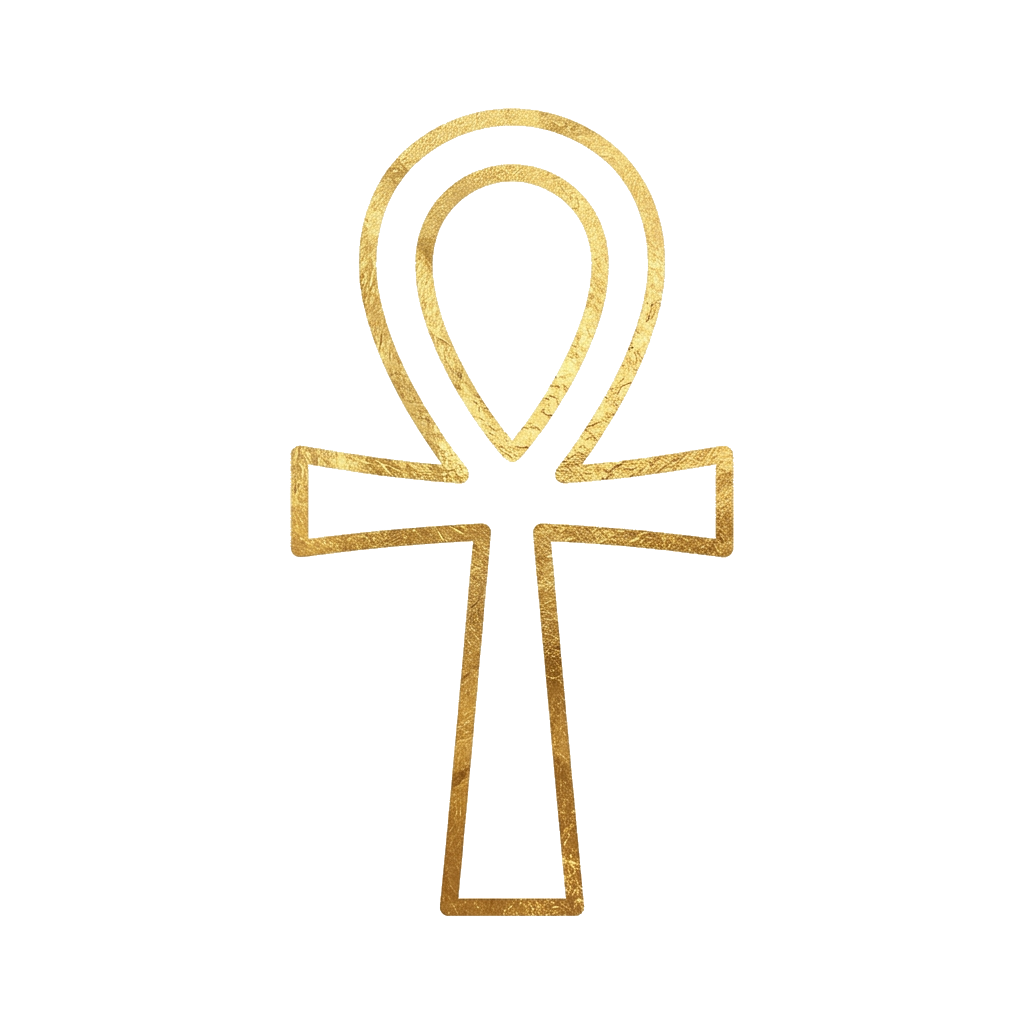
The Ankh consists of a distinctive T-shaped cross surmounted by an oval or teardrop-shaped loop. The vertical shaft extends downward, the horizontal bar crosses it near the top, and the closed loop rises above the crossbar like a head above shoulders or a handle above a key. The proportions vary across periods and contexts, but the essential geometry remains constant: a cruciform base crowned by an enclosed curve.
In its most refined temple carvings, the Ankh possesses an elegant symmetry — the loop perfectly centered, the crossbar extending equally on both sides, the vertical shaft tapering slightly toward its base. The loop itself is not a perfect circle but an elongated oval, sometimes described as egg-shaped or womb-shaped, wider at the top and narrowing where it meets the crossbar. This subtle organic quality distinguishes it from purely geometric forms and suggests the biological and generative associations embedded in the symbol.
Egyptian artists rendered the Ankh in virtually every medium available to them. In stone relief, it appears carved into temple walls at Karnak, Luxor, Dendera, and Abu Simbel — sometimes monumental in scale, sometimes tiny among dense fields of hieroglyphs. In gold and faience, miniature Ankhs served as amulets placed on mummies or worn by the living. In painted scenes, it appears in brilliant polychrome — often gold or turquoise — held aloft by deities or suspended from ritual implements. The Ankh also appears as a freestanding three-dimensional object in bronze, wood, and stone, suggesting it was used as an actual ritual tool in temple ceremonies.
The visual simplicity of the form belies its compositional sophistication. The Ankh can be read as a figure — a stylized human with arms outstretched. It can be read as a landscape — the loop as the sun rising above the horizon line of the crossbar, the shaft as the Nile flowing beneath. It can be read as anatomy — and many scholars have noted its resemblance to female reproductive organs, the loop representing the uterus and the shaft the birth canal. Each reading reinforces the others, creating a visual form that operates on multiple levels simultaneously.
Esoteric Meaning
Egyptian esoteric thought reads the Ankh as the generative union of cosmic polarities — the masculine and feminine principles whose conjunction produces and sustains all life. The loop is the feminine: the womb of Isis, the receptive principle, the enclosure that gestates possibility into form. The vertical shaft is the masculine: the phallus of Osiris, the penetrating principle, the axis that connects the Above to the Below. The crossbar is the horizon line where these two forces meet — the plane of manifestation, the threshold between potential and actuality. Together, they form the hieroglyph for life itself because, in the Egyptian understanding, life is precisely what happens when opposites unite.
This reading is not merely anatomical allegory. The Isis-Osiris mythology encodes a profound metaphysics: Osiris is dismembered — scattered into fragments across the world — and Isis gathers the pieces, reconstitutes the body, and conceives Horus through a union that transcends death itself. The Ankh is the glyph of that transcendent union. It says: what has been separated can be rejoined, what has died can live again, and the force that accomplishes this reunion is the same force that generates life in the first place. This is why the gods hold the Ankh — they are the powers that maintain the unity of opposites upon which existence depends.
The loop of the Ankh also carries the meaning of eternity — a line that has no beginning and no end, that returns perpetually to itself. In this aspect, the Ankh resonates with the Ouroboros, the serpent swallowing its own tail. But where the Ouroboros emphasizes the cyclical nature of time, the Ankh emphasizes the eternal nature of life. The loop does not merely circle — it crowns the cross. Eternity sits above the temporal. The immortal oversees the mortal. Spirit governs matter.
As a symbol of breath, the Ankh connects to the Egyptian concept of the ka — the vital force or life-spirit that distinguishes a living being from a corpse. In countless tomb paintings, deities hold the Ankh to the nostrils of the pharaoh, literally conferring the breath of divine life. This is not merely metaphorical. The Egyptians understood breath as the medium through which spiritual force enters the physical body. When the Book of the Dead describes the restoration of the deceased in the afterlife, the return of breath — symbolized by the Ankh — is the pivotal moment of resurrection.
The Ankh also functions as a mirror symbol. The Egyptian word for mirror, ankh, is identical to the word for life, and actual hand mirrors were frequently crafted in the Ankh's shape. This is not coincidence but doctrine: the mirror reflects the world back to itself, just as consciousness reflects existence back to itself. To hold the mirror-Ankh is to see the self, to know the self, to recognize the divine spark within mortal form. The mirror does not create what it shows — it reveals what is already there. In this sense, the Ankh as mirror is a tool of awakening, not creation.
In Hermetic and Western esoteric traditions that inherited Egyptian symbolism, the Ankh became a glyph of the union of Sol and Luna, the alchemical marriage of sulfur and mercury, the conjunction of fire and water that produces the Philosopher's Stone. The loop is the solar disc; the cross is the four elements of the material world. Spirit descends into matter and, through the crucible of incarnation, is refined and returned to its source. The Ankh, in this reading, is the formula for spiritual transformation itself.
Exoteric Meaning
In its most straightforward public meaning, the Ankh is the Egyptian hieroglyphic sign for 'life.' It appears in royal cartouches, temple inscriptions, and official documents wherever the concept of life, vitality, or well-being is invoked. The formulaic blessing ankh wedja seneb — 'life, prosperity, health' — was appended to the names of pharaohs and appears thousands of times in the surviving textual record. The Ankh in this context functions much as the word 'life' does in modern language: it is so fundamental, so universally relevant, that it permeates every domain of expression.
For ordinary Egyptians, the Ankh was a protective amulet. Miniature Ankhs were worn as pendants, placed in tombs alongside the dead, and incorporated into household objects. The symbol's protective function derived from its association with the gods — to carry the Ankh was to carry a fragment of divine authority, a portable invocation of the life-giving power that the gods wielded in the great temple reliefs. Mothers placed Ankh amulets on children. Healers incorporated them into treatments. The dying received them as passports for the journey ahead.
The Ankh also appeared prominently in royal iconography as a symbol of the pharaoh's divine right to rule. Since the pharaoh was understood as the living embodiment of Horus — the son of Isis and Osiris — the Ankh in the royal hand signified that the ruler held the power of life and death, that sovereignty flowed from the same source as biological vitality. Temple scenes showing gods extending the Ankh to the pharaoh are political theology made visual: divine authority is transferred through the same symbol that represents life itself, because in Egypt, legitimate authority and the power to sustain life were understood as identical.
In the Coptic period, as Christianity spread through Egypt in the early centuries of the Common Era, the Ankh was absorbed into Christian iconography as the crux ansata — the handled cross. Coptic Christians saw in the looped cross a native Egyptian anticipation of the Christian promise of eternal life through the cross of Christ. This adoption was not hostile appropriation but organic inheritance: Egyptian Christians were, after all, Egyptians, and the Ankh's association with resurrection, eternal life, and divine breath mapped naturally onto the theological framework they were adopting. The crux ansata appears in Coptic churches, manuscripts, and funerary art throughout late antiquity, forming one of the clearest bridges between pharaonic and Christian Egypt.
Usage
In ancient Egyptian temple ritual, the Ankh served as both symbol and instrument. Priests held Ankh-shaped objects during ceremonies of consecration, purification, and offering. The Opening of the Mouth ceremony — performed on mummies and statues to restore their ability to breathe, eat, and speak in the afterlife — employed the Ankh as one of its central ritual implements. By touching the Ankh to the mouth and nostrils of the deceased, the officiant enacted the transfer of the breath of life from the divine realm to the prepared vessel of the body.
In funerary practice, Ankh amulets were placed at specific locations on the mummy's wrappings — over the throat, the heart, and the hands — to ensure the deceased retained access to vital force throughout the perilous journey through the Duat, the Egyptian underworld. The Book of the Dead contains spells that explicitly invoke the Ankh as a protective and life-restoring force, to be wielded by the deceased when confronting the guardians of the underworld gates.
In Kemetic revivalist practice today, the Ankh is used in meditation, altar work, and ritual as a focal point for connecting with the neteru — the divine principles or gods of the Egyptian tradition. Practitioners hold or visualize the Ankh during breathing exercises, understanding the loop as the circuit of spiritual energy and the shaft as the channel through which that energy descends into the body. Some modern practitioners use the Ankh as a dowsing or energy-sensing tool, holding it over the body to detect imbalances in the vital field.
The Ankh also plays a significant role in contemporary Western ceremonial magic, particularly in traditions influenced by the Hermetic Order of the Golden Dawn, which incorporated Egyptian symbolism extensively into its grade rituals and implements. In this context, the Ankh may appear on ritual robes, altar cloths, talismans, and consecrated tools, functioning as a general sigil of life-force, spiritual authority, and the union of microcosm and macrocosm.
Outside formal spiritual practice, the Ankh has become one of the most widely recognized symbols in global popular culture. It appears in jewelry, fashion, tattoo art, album covers, video games, and film as a signifier of ancient wisdom, mystery, and power. While much of this usage is aesthetic rather than devotional, it speaks to the symbol's extraordinary capacity to communicate meaning across vast cultural distances. The Ankh does not need to be explained — its form communicates something about life, eternity, and sacred power that registers even without doctrinal context.
In Architecture
The Ankh appears throughout the monumental architecture of ancient Egypt as both decorative motif and functional symbolic element. At the great temples of Karnak, Luxor, Philae, Dendera, and Abu Simbel, the Ankh is carved into column capitals, door lintels, wall reliefs, and ceiling panels. In many cases, the Ankh appears in the hands of deities carved at colossal scale — Isis and Hathor extending the Ankh toward the pharaoh in scenes that span entire walls. These are not decorations but theological programs rendered in stone, asserting that the temple itself is a conduit for the divine life-force that the Ankh represents.
The shape of the Ankh influenced architectural planning in subtler ways as well. Some scholars have noted that the cross-section of certain Egyptian temple plans — a narrow processional corridor opening into a wider transverse hall, with a circular or apsidal sanctuary beyond — echoes the Ankh's form: shaft, crossbar, and loop. Whether this was intentional or a convergent expression of the same spatial logic, the resonance is striking. The temple is the body of the god, and the body of the god is structured like the sign of life.
In Coptic churches built during the early Christian centuries in Egypt, the crux ansata form of the Ankh appears carved into stone screens, painted on walls, and woven into textile hangings. The oldest surviving Coptic monasteries — including those in Wadi Natrun and the Red Sea monasteries of St. Anthony and St. Paul — preserve examples of the Ankh-cross integrated into Christian architectural programs, demonstrating the unbroken continuity between pharaonic and Christian sacred space in Egypt.
In the modern era, the Ankh has been incorporated into Afrocentric and Kemetic-inspired architectural and interior design — appearing as a structural motif in cultural centers, museum installations, and sacred spaces dedicated to African diasporic spiritual traditions. The symbol's architectural presence today signals a conscious reconnection with the oldest continuous civilization in the historical record.
Significance
Five thousand years separate the earliest carved Ankhs from the pendants sold in Cairo's tourist markets today, yet the symbol's core meaning — life, breath, the union that generates existence — has never lapsed. This unbroken lineage from dynastic Egypt to the present day gives it a semantic continuity unmatched by any other symbol from the ancient Near East.
Its significance operates on multiple registers simultaneously. Theologically, it encodes the Egyptian understanding that life is not a random biological event but a divine dispensation — breathed into existence by the gods, sustained through the union of cosmic polarities, and recoverable even after death through proper knowledge and ritual. Philosophically, it embodies the principle that existence arises from the conjunction of opposites — male and female, spirit and matter, eternity and time — and that this conjunction is not a compromise but a creative act. Politically, it anchored the legitimacy of pharaonic rule in the same source that animated biological life, making sovereignty and vitality expressions of the same divine will.
The Ankh's adoption by Coptic Christianity represents one of the most significant cases of symbolic continuity across religious traditions in history. The fact that Egyptian Christians could see their own deepest convictions about resurrection and eternal life already encoded in a symbol three thousand years older than Christianity speaks to the Ankh's capacity to transcend the doctrinal boundaries of any single tradition. It belongs not to one religion but to the human religious imagination itself.
In the contemporary context, the Ankh's significance has expanded to encompass cultural identity and historical reclamation. For many people of African descent, the Ankh represents a connection to the sophisticated philosophical and spiritual achievements of ancient African civilization — a tangible refutation of narratives that locate the origins of complex thought exclusively in Greece or the Levant. The Ankh says: Africa produced one of the most enduring symbols of life, spirit, and transcendence in human history, and its meaning remains vital today.
For practitioners of Western esotericism, the Ankh remains a living symbol — not a museum piece but an operative glyph that concentrates and transmits spiritual force. Its appearance in Hermetic, Rosicrucian, Thelemic, and Golden Dawn contexts testifies to its continued capacity to function as a focal point for meditation, ritual, and contemplative insight. The Ankh endures because it speaks to something that does not change: the human recognition that life is sacred, that it comes from beyond the material, and that its full meaning can only be grasped through the union of what appears to be separate.
Connections
The Ankh connects to the broader Egyptian sacred symbol system, functioning as one element in a coherent symbolic language that also includes the Eye of Horus (protection and wholeness), the Djed Pillar (stability and resurrection), the Scarab (transformation and renewal), and the Was scepter (divine power and dominion). In temple iconography, these symbols frequently appear together — the pharaoh may hold the Ankh and the Was scepter simultaneously, or a column may be decorated with alternating Ankh and Djed motifs. Each symbol contributes a distinct aspect to the total theological statement, and together they constitute a comprehensive visual vocabulary for the Egyptian understanding of divine order.
The Ankh's relationship to the Egyptian deities is not merely illustrative but constitutive. The gods do not carry the Ankh as an accessory; they carry it as an extension of their nature. Isis, as the goddess who reassembled Osiris and conceived Horus beyond death, embodies the Ankh's core meaning — life that persists through and beyond destruction. Osiris, as the god who died and was reborn, is the mythological narrative of which the Ankh is the hieroglyphic compression. Hathor, as the goddess of love, fertility, and joy, carries the Ankh because these are the expressions of life at its fullest. Anubis, as the guardian of the dead, holds the Ankh because his role is to ensure that life's passage through death reaches its proper destination.
The Egyptian Book of the Dead — more properly the Book of Coming Forth by Day — provides the textual framework within which the Ankh's funerary function operates. The spells and declarations in this collection assume that the deceased possesses or can invoke the power of the Ankh to navigate the afterlife, pass through guarded gates, and achieve justification before the tribunal of Osiris. The Ankh is the technology of passage — the key that opens the doors between worlds.
The parallel between the Ankh and the Christian cross deserves careful attention. Both are symbols in which the vertical and horizontal intersect — spirit meeting matter, the transcendent crossing the immanent. Both are associated with death and resurrection. Both function as the central identifying symbol of their respective traditions. The Coptic adoption of the Ankh as the crux ansata was not arbitrary: early Egyptian Christians recognized a genuine structural and theological correspondence between the two forms. This is not to claim that one 'caused' the other, but to acknowledge that the same archetypal pattern — life emerging from the intersection of cosmic polarities, preserved through death, and restored in a transformed state — can generate remarkably similar symbolic forms across independent traditions.
Beyond Egypt, the Ankh resonates with life-symbols from other traditions: the Tree of Life in Kabbalah and Norse mythology, the Caduceus of Hermes, the Vajra of Tibetan Buddhism, and the cross itself in its pre-Christian solar and cosmological forms. Each of these symbols encodes a particular tradition's understanding of the force that animates existence, and the Ankh stands among them as one of the oldest and most concentrated expressions of that universal intuition.
Further Reading
- Egyptian Book of the Dead — The funerary text tradition within which the Ankh functions as a key to the afterlife
- Isis — The goddess whose mythology most fully embodies the Ankh's meaning of life restored through love and knowledge
- Osiris — The god of death and resurrection whose body is the mythological source of the Ankh's power
- Eye of Horus — The complementary Egyptian symbol of protection and restored wholeness
- Djed Pillar — The backbone of Osiris, representing the structural stability that partners with the Ankh's vital force
- Scarab — The solar beetle of transformation, representing the daily renewal of the life-force the Ankh embodies
Frequently Asked Questions
What does the Ankh symbolize?
Egyptian esoteric thought reads the Ankh as the generative union of cosmic polarities — the masculine and feminine principles whose conjunction produces and sustains all life. The loop is the feminine: the womb of Isis, the receptive principle, the enclosure that gestates possibility into form. The vertical shaft is the masculine: the phallus of Osiris, the penetrating principle, the axis that connects the Above to the Below. The crossbar is the horizon line where these two forces meet — the plane of manifestation, the threshold between potential and actuality. Together, they form the hieroglyph for life itself because, in the Egyptian understanding, life is precisely what happens when opposites unite.
Where does the Ankh originate?
The Ankh originates from the Ancient Egyptian tradition. It dates to c. 3000 BCE — present. It first appeared in Ancient Egypt.
How is the Ankh used today?
In ancient Egyptian temple ritual, the Ankh served as both symbol and instrument. Priests held Ankh-shaped objects during ceremonies of consecration, purification, and offering. The Opening of the Mouth ceremony — performed on mummies and statues to restore their ability to breathe, eat, and speak in the afterlife — employed the Ankh as one of its central ritual implements. By touching the Ankh to the mouth and nostrils of the deceased, the officiant enacted the transfer of the breath of life from the divine realm to the prepared vessel of the body.