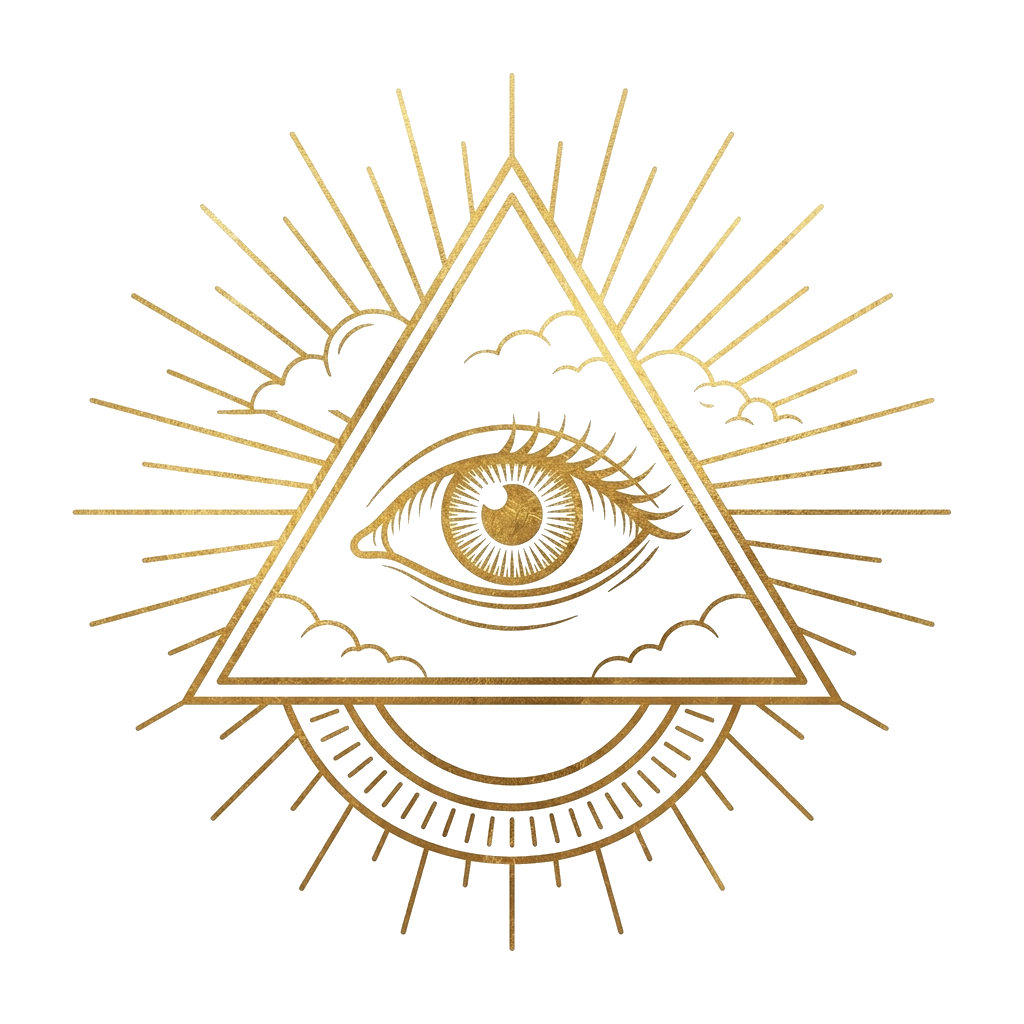
All-Seeing Eye
The Eye of Providence — a symbol with ancient Egyptian roots, Christian theological meaning, Masonic significance, and enduring conspiracy theories, representing divine omniscience and the awakened inner eye.
About All-Seeing Eye
The All-Seeing Eye, also known as the Eye of Providence, depicts a single open eye enclosed within a triangle and surrounded by radiating beams of light — an image that has provoked reverence, suspicion, and fascination in equal measure since antiquity. It depicts a single open eye, usually enclosed within a triangle and surrounded by radiating beams of light or glory. Though most people today associate it with the reverse of the United States one-dollar bill or with Freemasonry, the symbol draws on a lineage far older than either — stretching back to the solar eye cults of ancient Egypt and forward through Christian iconography, Enlightenment philosophy, and esoteric tradition.
At its most essential level, the All-Seeing Eye communicates a single idea: there exists a form of awareness that sees everything, misses nothing, and cannot be deceived. Whether that awareness is understood as God, cosmic consciousness, the awakened third eye, or the light of reason depends entirely on the tradition interpreting it. This multiplicity of meaning is precisely what gives the symbol its enduring power and its capacity to generate both reverence and suspicion.
The symbol's journey from Egyptian temple walls to the back of American currency is a story of appropriation, reinterpretation, and layered meaning. Each culture that adopted the eye infused it with its own theology and metaphysics while preserving the core intuition — that sight, in its highest form, is not passive observation but active, penetrating awareness that illuminates the hidden nature of reality.
The symbol bridges institutional religion, esoteric mysticism, political philosophy, and popular conspiracy culture with unusual directness. Understanding the All-Seeing Eye requires tracing each of these threads independently before seeing how they weave together into the singular, arresting image that has watched over civilizations for more than three thousand years.
Visual Description
In its most common form, the All-Seeing Eye appears as a single human eye — open, alert, and forward-gazing — set within an equilateral triangle. Rays of light or lines of glory radiate outward from the triangle, suggesting luminosity, divine emanation, or spiritual illumination. The eye itself is typically rendered in a naturalistic style, with visible iris, pupil, and sometimes eyelashes, distinguishing it from more abstract ocular symbols.
The enclosing triangle is the most theologically significant element of the composition. In Christian contexts, it represents the Holy Trinity — Father, Son, and Holy Spirit — with the eye signifying God's omniscient gaze. In Masonic usage, the triangle may also represent the delta, a geometric form associated with the Great Architect of the Universe. In Egyptian antecedents, the triangular enclosure is absent; the Eye of Horus appears as a stylized falcon eye with distinctive markings below, representing not enclosure but the wounded-and-restored vision of the sky god.
Variations abound across traditions and centuries. In Renaissance and Baroque Christian art, the eye-in-triangle frequently appears within clouds, resting atop altars, or hovering above scenes of creation, judgment, or blessing. The rays emanating from the triangle range from simple straight lines to elaborate sunburst patterns, often rendered in gold to emphasize the solar associations of divine sight. In some Masonic lodge decorations, the eye appears without the triangle, floating independently as a watchful presence — sometimes weeping, sometimes crowned, sometimes surrounded by a wreath of acacia.
The heraldic version on the Great Seal of the United States, designed in 1782, places the eye-in-triangle atop an unfinished pyramid of thirteen courses, with the Latin motto Annuit Coeptis ("He has favored our undertakings") arching above. This specific arrangement — the radiant eye crowning an incomplete structure — became the most globally distributed version of the symbol after it was printed on the dollar bill beginning in 1935.
In modern esoteric and occult art, the All-Seeing Eye is frequently depicted with additional symbolic elements: serpents coiling around the triangle, lotus flowers blooming beneath it, or the eye itself rendered with a vertical slit pupil to evoke reptilian or non-human intelligence. These contemporary variations reflect the symbol's absorption into conspiracy culture and psychedelic art, where it has taken on meanings its original creators never intended.
Esoteric Meaning
Within esoteric traditions, the All-Seeing Eye represents far more than divine surveillance — it points to the awakened capacity for direct perception that exists latent within every human being. This is the eye that sees not through the body's two physical eyes but through the inner eye of gnosis, the organ of spiritual cognition that the Vedic tradition calls the ajna chakra and the Western esoteric tradition calls the third eye.
In Hermetic and Neoplatonic philosophy, the eye symbolizes the Nous — divine intellect or universal mind — which is simultaneously the source of all creation and the faculty by which creation can be known. The Corpus Hermeticum describes a state in which the initiate's perception expands beyond the physical senses to apprehend the cosmos as a unified, living intelligence. The All-Seeing Eye is the pictorial shorthand for this expanded awareness: not God watching you from above, but the divine awareness within you recognizing itself.
The Masonic interpretation layers initiatory meaning onto this foundation. In Freemasonry, the eye represents the Great Architect of the Universe — the creative intelligence behind manifest reality — but it also represents the Mason's own aspiration to cultivate moral awareness and self-examination. The Masonic eye watches not as judge but as witness: it is the conscience made visible, the reminder that every action, public or private, occurs in the presence of truth. This dual reading — the eye as both transcendent deity and immanent moral faculty — is characteristic of Masonic symbolism, which consistently refuses to separate the divine from the human.
In Kabbalistic interpretation, the eye corresponds to the sefirah of Keter (Crown) or sometimes Chokmah (Wisdom) — the highest levels of divine emanation, where the infinite light (Ein Sof) first contracts itself into a point of awareness. The triangle surrounding the eye maps onto the supernal triad of Keter, Chokmah, and Binah, the three highest sefirot that together form the divine head of the Tree of Life. To behold the All-Seeing Eye, in this framework, is to glimpse the primordial point from which all of creation unfolds.
Across Hindu and Buddhist traditions, the symbolism of the singular open eye maps directly onto the concept of the third eye — the eye of Shiva, the eye of wisdom, the eye that opens when the two ordinary eyes of duality close. The ajna chakra, located between the eyebrows, is the seat of intuitive perception, inner vision, and the capacity to perceive subtle realities invisible to physical sight. When this center is fully awakened, the practitioner is said to possess divya drishti — divine sight — the ability to see past, present, and future, the hidden and the manifest, the real and the illusory, all at once.
The esoteric meaning of the All-Seeing Eye is therefore not about being watched. It is about waking up. The eye is not pointed at you — it is you, or rather, it is the deepest capacity within you, waiting to open.
Exoteric Meaning
In its public and institutional uses, the All-Seeing Eye functions primarily as a symbol of divine providence — the theological concept that God watches over, guides, and sustains creation with benevolent attention. This is the meaning enshrined in Christian churches across Europe, where the eye-in-triangle appears in stained glass windows, altar paintings, and architectural ornamentation as a reminder of God's omniscience and care.
The most globally recognized exoteric use of the symbol is on the Great Seal of the United States, and by extension on the reverse of the one-dollar bill. The seal was designed in 1782 by Charles Thomson, Secretary of the Continental Congress, drawing on proposals from Benjamin Franklin, Thomas Jefferson, and John Adams. The eye atop the unfinished pyramid was intended to represent divine providence watching over the young nation — the same God invoked in the Declaration of Independence as the source of inalienable rights. The unfinished pyramid beneath symbolized the nation's ongoing growth and the work still to be done. The motto Annuit Coeptis explicitly frames the eye as benevolent: "He has favored our undertakings."
Contrary to popular belief, the seal's designers were not all Freemasons. Of the original committee members, only Benjamin Franklin was a confirmed Mason, and the final design was completed by Thomson, who was not. The Masonic connection to the Great Seal is largely a retrospective projection, though the symbolic vocabulary of eye, triangle, and pyramid was certainly familiar to educated men of the Enlightenment period, many of whom moved in overlapping circles of Masonic, Deist, and philosophical culture.
In the twentieth and twenty-first centuries, the All-Seeing Eye has become the single most cited piece of evidence in conspiracy theories about secret societies, the Illuminati, and shadowy global control. The presence of the eye on the dollar bill is routinely interpreted as proof that Freemasons, the Bavarian Illuminati, or some other covert group controls the United States government and, by extension, the world. This narrative has been amplified enormously by the internet, appearing in everything from Dan Brown novels to YouTube documentaries to hip-hop music videos.
The irony is considerable. A symbol originally intended to represent benevolent divine oversight has become, for millions of people, a symbol of malevolent human surveillance. The same image that once reassured believers of God's loving gaze now triggers anxiety about secret power structures and hidden manipulation. This inversion — from providence to paranoia — is itself a fascinating case study in how symbols change meaning as they move through cultures, media, and historical contexts.
Usage
The All-Seeing Eye appears across an extraordinary range of contexts, from sacred architecture to secular currency, from fraternal lodge rooms to corporate branding.
In Christian churches, the eye-in-triangle has been a standard element of ecclesiastical decoration since the Renaissance. It appears prominently in Catholic, Orthodox, and Protestant churches alike — in the pediments above altars, in the centers of stained glass rose windows, on tabernacle doors, and painted into ceiling frescoes. The Aachen Cathedral in Germany, the Church of the Gesù in Rome, and countless parish churches across Europe and the Americas display the symbol. Its meaning in these contexts is unambiguous: God sees all, God knows all, God is present.
In Freemasonry, the All-Seeing Eye is one of the most prominent symbols in lodge iconography. It appears on Masonic aprons, tracing boards, certificates, and above the Master's chair in the East of the lodge room. The earliest known Masonic use dates to 1797, when Thomas Smith Webb included it in his Freemason's Monitor. In Masonic ritual, the eye is presented as a reminder that the Great Architect of the Universe observes all human conduct, and that the Mason should therefore act with integrity even when no human eye watches.
On the United States dollar bill, the eye-in-triangle atop the unfinished pyramid is printed on the reverse of every one-dollar note, making it perhaps the most mass-produced symbol in human history. Approximately 12.7 billion one-dollar bills are in circulation at any given time, each carrying this image. The symbol was added to the bill in 1935 at the direction of President Franklin D. Roosevelt, who was himself a Freemason, though the design originates from the 1782 Great Seal.
In corporate and media contexts, the All-Seeing Eye has been adopted — sometimes ironically, sometimes earnestly — by entertainment companies, fashion brands, and technology firms. It appears in the logos of media companies, on album covers, in music videos, and in film imagery. Its use in these contexts is often deliberately provocative, leveraging the symbol's conspiracy associations for aesthetic effect or as a form of subcultural signaling.
In tattoo and street art culture, the All-Seeing Eye is one of the most frequently requested designs worldwide. Its compact visual form, rich symbolic associations, and capacity for personal interpretation make it ideal for body art. Individuals choose the symbol for reasons ranging from spiritual aspiration to aesthetic preference to ironic commentary on surveillance culture.
In occult and esoteric practice, the eye is used as a meditation focus, a protective talisman, and a symbol of the opened third eye. It appears on altars, ritual tools, and divinatory objects across traditions from Thelema to contemporary witchcraft to new age spirituality.
In Architecture
The All-Seeing Eye is one of the most frequently encountered symbols in Western sacred and civic architecture, spanning from the Baroque period to the present day.
In European churches, the eye-in-triangle appears with remarkable consistency across Catholic, Protestant, and Orthodox buildings from the seventeenth century onward. It typically occupies the highest point of the interior — the apex of the apse, the center of a dome, or the pediment above the main altar — reinforcing its association with divine oversight from above. Notable examples include the eye in the north transept of the Cathedral of Aachen, the radiant eye above the altar of the Church of Saint-Sulpice in Paris, and the eye-in-triangle in the ceiling fresco of the Church of the Gesù in Rome, painted by Giovanni Battista Gaulli.
In Masonic temples and lodge buildings, the eye holds a position of honor in the Eastern wall of the lodge room, above or behind the chair of the Worshipful Master. The Masonic architectural use is both decorative and instructional — the eye serves as a constant visual reference point during ritual, reminding members of the principles being communicated. The Grand Lodge of England, the House of the Temple in Washington, D.C., and countless local lodge buildings worldwide feature the eye in stonework, stained glass, or painted decoration.
In American civic architecture, the All-Seeing Eye appears on government buildings, courthouses, and monuments, often as a direct reference to the Great Seal. The unfinished pyramid with eye appears in the mosaic floor of the Library of Congress, on the facade of the Federal Reserve Bank of Philadelphia, and in various state capitol buildings. These placements reflect the Enlightenment-era vision of the founding generation, which understood divine providence as an appropriate concept for public buildings in a republic.
In cemetery and funerary architecture, the eye appears on gravestones, mausoleum doors, and cemetery gates across Europe and the Americas. In this context, it serves a dual purpose: reminding the living of God's watchful presence and symbolizing the hope that the deceased is now held in divine sight. Masonic gravestones frequently feature the eye alongside other Masonic symbols — the square and compasses, the acacia sprig, the broken column.
Significance
Few symbols travel as freely between cathedral and conspiracy board, between Masonic lodge and dollar bill. The All-Seeing Eye spans religious, philosophical, political, esoteric, and conspiratorial domains while retaining immediate visual recognizability. Its significance can be understood along several axes.
Theological significance: In Christianity and Deism alike, the eye represents the foundational claim that the universe is not blind — that consciousness, intelligence, and moral awareness are woven into the fabric of reality itself. The eye is not merely God's attribute; it is shorthand for the entire theistic worldview, the assertion that creation is witnessed, known, and purposeful. In a secular age, the persistence of the symbol points to a deep human need to feel that existence is observed and meaningful.
Epistemological significance: The eye has always been associated with knowledge — not just seeing but knowing, not just perception but understanding. In the esoteric traditions, the opened eye represents gnosis, the direct experiential knowledge of divine truth that transcends intellectual reasoning. This epistemological claim — that there exists a form of knowing higher than thought — is central to every mystical tradition and is the deeper message behind the symbol's surface.
Political significance: The placement of the All-Seeing Eye on the Great Seal of the United States embedded a mystical symbol at the heart of the world's most powerful secular republic. Whether the founders intended Masonic, Deist, or generically Christian meaning, the effect was to sanctify the American project with the authority of divine witness. The symbol communicates that the nation exists under providential gaze — a claim that has been invoked to support both progressive and reactionary political movements.
Cultural significance: In the twenty-first century, the All-Seeing Eye has become a cultural Rorschach test. To the devout, it means God is watching. To the conspiracist, it means the Illuminati are watching. To the mystic, it means the third eye is opening. To the graphic designer, it means visual power and instant recognition. The symbol's capacity to hold all of these meanings simultaneously — without resolving into any one of them — is the source of its enduring cultural vitality.
Cross-traditional significance: Perhaps most importantly for students of comparative wisdom, the All-Seeing Eye demonstrates how a single visual idea — the open, watchful, all-perceiving eye — arises independently across cultures and epochs. From the Eye of Ra to the Eye of Shiva, from the ajna chakra to the Masonic eye of conscience, the same intuition recurs: that the deepest truth of awareness is not separation but union, not observation from outside but recognition from within.
Connections
Freemasonry — The fraternal tradition that made the All-Seeing Eye one of its most prominent symbols, interpreting it as the watchful gaze of the Great Architect of the Universe. Masonic adoption of the eye in the late eighteenth century cemented the symbol's association with initiatory knowledge, moral self-examination, and the pursuit of light (knowledge) in the face of darkness (ignorance). The overlap between Masonic membership and the American founding generation created the conditions for the eye's placement on the Great Seal.
Ajna Chakra — The sixth energy center in the yogic subtle body system, located between the eyebrows. Known as the third eye, ajna is the seat of intuitive perception, inner vision, and the capacity to perceive reality beyond the dualities of the physical senses. The All-Seeing Eye maps directly onto the concept of the opened ajna chakra — the awakened organ of spiritual sight that perceives the unity underlying all appearances.
The third eye is not exclusive to any single tradition. In Hinduism, it is the eye of Shiva — the eye of destruction and transcendence that burns away illusion. In Buddhism, the urna (the dot between the eyebrows in Buddha images) represents the eye of wisdom. In Taoism, the upper dantian (the energy center in the forehead) is the seat of shen (spirit) and the gateway to higher perception. In Egyptian mythology, the Eye of Horus represents the restored faculty of divine sight. The All-Seeing Eye, in its broadest esoteric reading, is the Western symbol for this universal human capacity.
The symbol also connects to broader themes in Western Esotericism — the Hermetic principle of correspondence ("as above, so below"), the Neoplatonic concept of the Nous (divine intellect), and the Gnostic idea that the deepest knowledge comes not from external authority but from direct inner perception. The eye, in every tradition that has adopted it, points back to the same truth: awareness itself is the deepest reality, and the capacity to see clearly — past illusion, past conditioning, past the limitations of ordinary perception — is the highest goal of human development.
Further Reading
- Manly P. Hall, The Secret Teachings of All Ages (1928) — Comprehensive survey of ancient symbolism, with extensive treatment of the eye in Egyptian, Christian, and Masonic contexts
- Albert Pike, Morals and Dogma of the Ancient and Accepted Scottish Rite of Freemasonry (1871) — Detailed Masonic interpretation of the All-Seeing Eye and related symbols
- Richard S. Patterson and Richardson Dougall, The Eagle and the Shield: A History of the Great Seal of the United States (1978) — Definitive history of the Great Seal design process
- E.A. Wallis Budge, The Gods of the Egyptians (1904) — Standard reference for the Eye of Horus and Eye of Ra mythology
- Alain Daniélou, The Myths and Gods of India (1991) — The third eye of Shiva in Hindu tradition
- Georg Feuerstein, The Yoga Tradition (1998) — Ajna chakra, the third eye, and the yogic framework for inner vision
- David Ovason, The Secret Symbols of the Dollar Bill (2004) — Detailed analysis of the Great Seal imagery and its historical context
Frequently Asked Questions
What does the All-Seeing Eye symbolize?
Within esoteric traditions, the All-Seeing Eye represents far more than divine surveillance — it points to the awakened capacity for direct perception that exists latent within every human being. This is the eye that sees not through the body's two physical eyes but through the inner eye of gnosis, the organ of spiritual cognition that the Vedic tradition calls the ajna chakra and the Western esoteric tradition calls the third eye.
Where does the All-Seeing Eye originate?
The All-Seeing Eye originates from the Composite: Egyptian Eye of Horus/Ra antecedents, Christian Eye of Providence (17th century), Masonic adoption (18th century) tradition. It dates to c. 1500 BCE (Egyptian antecedents) — present. It first appeared in Egypt, Europe, Americas.
How is the All-Seeing Eye used today?
The All-Seeing Eye appears across an extraordinary range of contexts, from sacred architecture to secular currency, from fraternal lodge rooms to corporate branding.