Vegetable Tagine
Moroccan Recipe
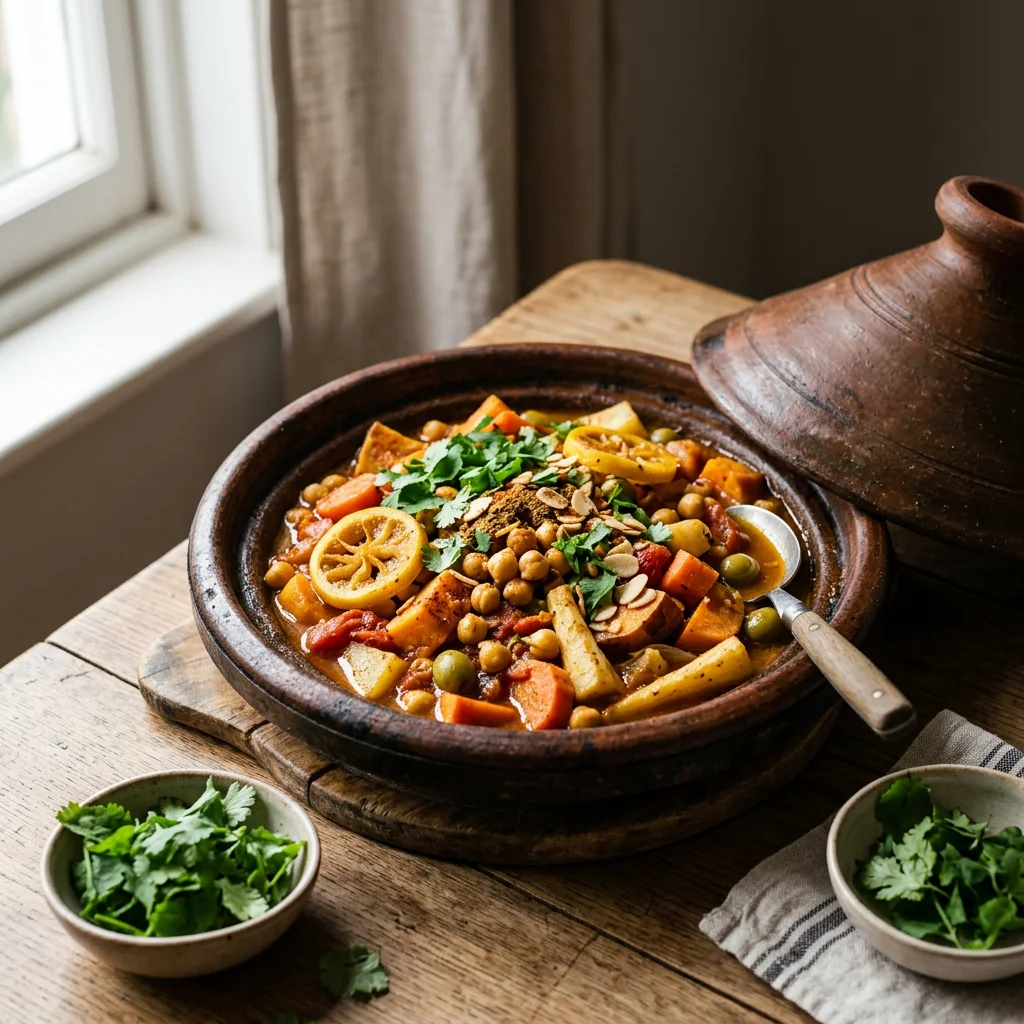
Overview
Vegetable tagine is the slow-cooked heart of Moroccan cuisine — a fragrant stew of root vegetables, chickpeas, preserved lemon, and olives simmered in a complex spice broth until everything melds into something greater than its parts. The dish takes its name from the conical clay pot in which it is traditionally cooked, a vessel designed to capture and recirculate steam, effectively braising the ingredients in their own moisture. The result is vegetables so tender they barely hold their shape, bathed in a sauce that is simultaneously earthy, bright, and deeply warming. In Moroccan homes, tagine is the centerpiece of daily cooking — placed in the middle of the table with a round of warm khobz (bread) for scooping. The preserved lemon and olives are not garnishes but essential components, their briny, fermented tang cutting through the sweetness of slow-cooked carrots and squash. Every household has its own tagine style, passed from mother to daughter, and the spice ratios are rarely written down — they live in the hands and the nose. From an Ayurvedic perspective, this dish is a remarkable example of intuitive dosha balancing. The warming spices — cumin, ginger, cinnamon, turmeric — kindle agni and prevent the heaviness that starchy root vegetables might otherwise cause. The preserved lemon and olives add sour and salty rasas that stimulate digestion, while saffron, one of the most prized herbs in both Moroccan cooking and Ayurvedic pharmacology, brings subtle cooling and mood-elevating properties. Ras el hanout, the legendary Moroccan spice blend containing twenty to thirty spices, functions much like an Ayurvedic churna — a synergistic formulation where each component enhances the others.
Strongly pacifies Vata due to warmth, moisture, and grounding root vegetables. Balances Kapha in moderation due to heating spices. May mildly increase Pitta if spices are heavy-handed.
Ingredients
- 3 tbsp Olive oil
- 2 large Onion (diced)
- 4 cloves Garlic (minced)
- 1 tbsp Fresh ginger (grated)
- 2 tbsp Ras el hanout
- 1 tsp Ground cumin
- 1 tsp Ground turmeric
- 1/2 tsp Ground cinnamon
- 1/4 tsp Saffron threads (steeped in 2 tbsp warm water)
- 3 medium Carrots (cut into thick rounds)
- 2 cups Butternut squash (cubed)
- 1 can (400g) Chickpeas (drained and rinsed)
- 1 whole Preserved lemon (pulp discarded, rind finely sliced)
- 1/2 cup Green olives (pitted)
- 1/4 cup Fresh cilantro (chopped)
- 1 tbsp Honey
Instructions
- Heat the olive oil in a tagine or heavy-bottomed Dutch oven over medium heat. Add the diced onions and cook, stirring occasionally, until soft and translucent, about 6-7 minutes.
- Add the garlic and ginger and stir for 1 minute until fragrant. Add the ras el hanout, cumin, turmeric, and cinnamon, stirring the spices into the onions for another 30 seconds to bloom their flavors in the oil.
- Add the carrots and butternut squash, tossing to coat thoroughly in the spiced onion mixture. Pour in enough water to come halfway up the vegetables (about 1.5 cups). Add the saffron with its soaking liquid and the honey.
- Bring to a gentle simmer, then reduce heat to low. Cover tightly and cook for 35-40 minutes, stirring once or twice, until the squash and carrots are very tender but not falling apart.
- Add the chickpeas, preserved lemon rind, and olives. Stir gently to incorporate without breaking the tender vegetables. Cover and cook for another 10-15 minutes to let the flavors meld.
- Taste and adjust seasoning — the dish should balance sweet (squash, honey), sour (preserved lemon), salty (olives), and warm (spices). If the sauce is too thin, remove the lid and simmer uncovered for a few minutes.
- Garnish generously with fresh cilantro. Serve directly from the tagine with warm crusty bread or fluffy couscous.
Nutrition
These values are estimates calculated from the ingredient list and may vary based on brands, cooking methods, and serving size. Not a substitute for medical or dietary advice.
How This Recipe Affects Each Dosha
Vata
This is an ideal Vata-pacifying dish. The slow-cooked root vegetables are warm, moist, and grounding — three qualities that directly counter Vata's cold, dry, mobile nature. The olive oil and long cooking time ensure the dish is unctuous and easy to digest, while the complex spice blend kindles digestive fire gently. The chickpeas provide protein without the gas-producing quality of harder legumes, especially when slow-cooked.
Pitta
The warming spice blend and preserved lemon make this moderately heating for Pitta. The sweet squash and carrots balance some of the heat, and the olives provide a cooling counterpoint. Pitta types can enjoy this comfortably during cooler months but should reduce ras el hanout and omit honey during summer or Pitta aggravation.
Kapha
The heating spices and pungent qualities help counteract Kapha's natural heaviness, but the starchy root vegetables and chickpeas add substance that Kapha types should balance carefully. The dish is best for Kapha during autumn and winter when extra warmth and nourishment are needed. Reducing the squash and increasing leafy greens can lighten it.
The ras el hanout and warming spices kindle agni steadily without the sharp spike of raw chili heat. The slow cooking pre-digests the vegetables, making nutrients immediately available. Saffron specifically enhances agni while simultaneously cooling pitta — a rare dual action.
Nourishes: Rasa (plasma), Rakta (blood), Mamsa (muscle), Meda (fat)
Adjustments by Constitution
For Vata Types
Increase olive oil to 4 tablespoons and add a handful of Medjool dates in the last 15 minutes. Stir in a tablespoon of argan oil at serving for extra unctuousness. Use extra preserved lemon — the sour taste stimulates Vata's often sluggish appetite.
For Pitta Types
Reduce ras el hanout to 1 tablespoon and omit cinnamon. Replace honey with a squeeze of fresh orange juice. Add extra saffron, which is cooling despite its appearance. Increase the olives and reduce ginger by half. Garnish with fresh mint alongside the cilantro.
For Kapha Types
Replace butternut squash with turnips or cauliflower for lighter vegetables. Increase ras el hanout to 3 tablespoons and add a pinch of harissa paste for extra pungency. Reduce olive oil to 1 tablespoon and omit honey entirely. Use fewer chickpeas and add more leafy greens in the last 5 minutes.
Seasonal Guidance
Best in autumn and winter when the body craves warmth and substance. The root vegetables are at their seasonal peak, and the warming spice blend is perfectly suited to cold weather. In spring, lighten the dish by replacing squash with artichokes and adding spring greens. Not ideal as a summer staple — the heating spices and dense vegetables can aggravate Pitta during hot months.
Best time of day: Lunch or early dinner, when agni can handle the dense, complex flavors. Allow 2-3 hours before sleep.
Cultural Context
The tagine is both a dish and a philosophy of cooking — slow, communal, aromatic. In Morocco, the conical clay pot sits over a charcoal brazier called a kanoun, and every neighborhood has its own communal oven (ferran) where families bring their tagines to slow-cook. The dish reflects Morocco's position at the crossroads of African, Arab, Berber, and Mediterranean cultures, with each group contributing ingredients and techniques. Preserved lemons, a Moroccan invention born of necessity and transformed into an art form, represent the country's genius for fermentation and preservation. The tagine is always shared — placed at the center of the table with bread, each person eating from their section of the communal pot.
Deeper Context
Origins
Tagine cookware and cooking technique descend from Berber (Amazigh) pre-Islamic North African food technology. The conical clay pot is specifically adapted to desert and semi-arid Maghrebi conditions — fuel-efficient, self-basting, durable. Preserved lemon (limoun bouss, fermented in salt for weeks) is a distinctive Maghrebi food-preservation technology that produces unique bitter-aromatic compounds through the long curing. The technique is pre-Islamic Berber; Arab-Islamic arrival in the 7th century added new ingredients but preserved the fundamental cooking architecture.
Food as Medicine
The slow-braise technique makes vegetables and legumes highly digestible — appropriate for weak digestion, elderly populations, and post-illness recovery. Ras el hanout's complex spice blend (20-40 spices in traditional preparations) provides diverse antioxidant and anti-inflammatory compounds. Preserved lemon's long fermentation produces probiotic-related compounds. Saffron supports mood and has modern research validation. A therapeutically-sophisticated traditional preparation.
Ritual & Seasonal Role
Family dinners, Friday couscous alternative, celebration meals, guest hospitality. Year-round. Not religiously ceremonial but deeply tied to Maghrebi domestic food identity. Featured at Moroccan restaurants globally as quintessentially Moroccan.
Classical Pairings & Cautions
Couscous (the classical pairing), crusty bread (khobz), mint tea. Cautions: substantial sodium from preserved lemon; FODMAP issues from chickpeas; saffron in high doses uterine-stimulating (culinary quantities safe); ras el hanout allergies or sensitivities to specific component spices; the tagine clay cookware may release trace lead in some imported pieces — food-grade certification should be verified.
Cross-Tradition View
How other medical and food-wisdom traditions read this dish. Each tradition names the same physiological reality in its own language — the agreements across them are where universal principles live.
Traditional Chinese Medicine
Ras el hanout is complex warming-dispersing; preserved lemon is sour-cooling and moves Liver Qi strongly; chickpeas build Kidney essence; saffron moves Heart Blood; butternut squash is sweet-warm and Spleen-Qi-tonifying. A comprehensive Qi-Essence-and-Blood tonic with Liver-moving accent — TCM physicians would class this as substantial restoration food.
Greek Humoral
Hot-wet sanguine-building. Galenic-suitable slow-cookery preparation — the Hippocratic valuation of extended cookery for digestive accessibility matches the tagine technique precisely.
Ayurveda
Heating virya, sweet vipaka. Pacifies Vata substantially through warmth and unctuousness. Mild Pitta aggravation through saffron-and-spice heat. Kapha-neutral through the vegetable-focused preparation.
Berber Tagine Cookery
Tagine refers both to the conical clay cookware and the dish prepared in it — Berber (Amazigh) pre-Islamic North African cooking technology. The conical lid returns condensation to the pot, creating a self-basting slow-braise environment that works efficiently over minimal fuel (important in historical desert conditions). Preserved lemon (limoun bouss) is a distinctive Maghrebi preservation technology that produces a unique bitter-sour aromatic impossible to duplicate with fresh lemon. Berber-origin cookware that predates Arab-Islamic arrival by millennia.
Chef's Notes
If you do not have a tagine, a Dutch oven works perfectly — the key is low, slow heat with a tight lid to trap steam. Preserved lemons are non-negotiable in this dish; they provide a fermented citrus depth that fresh lemon cannot replicate. You can find them in Middle Eastern markets or make your own by packing lemons in salt and lemon juice for a month. For a richer version, add dried apricots or prunes in the last 15 minutes of cooking. The tagine improves significantly if made a day ahead, as the spices continue to develop overnight.
Frequently Asked Questions
Is Vegetable Tagine good for my dosha?
Strongly pacifies Vata due to warmth, moisture, and grounding root vegetables. Balances Kapha in moderation due to heating spices. May mildly increase Pitta if spices are heavy-handed. This is an ideal Vata-pacifying dish. The warming spice blend and preserved lemon make this moderately heating for Pitta. The heating spices and pungent qualities help counteract Kapha's natural heaviness, but the starchy root vegetables and chickpeas add substance that Kapha types should balance carefully.
When is the best time to eat Vegetable Tagine?
Lunch or early dinner, when agni can handle the dense, complex flavors. Allow 2-3 hours before sleep. Best in autumn and winter when the body craves warmth and substance. The root vegetables are at their seasonal peak, and the warming spice blend is perfectly suited to cold weather. In spring, lighten
How can I adjust Vegetable Tagine for my constitution?
For Vata types: Increase olive oil to 4 tablespoons and add a handful of Medjool dates in the last 15 minutes. Stir in a tablespoon of argan oil at serving for extra For Pitta types: Reduce ras el hanout to 1 tablespoon and omit cinnamon. Replace honey with a squeeze of fresh orange juice. Add extra saffron, which is cooling despit
What are the Ayurvedic properties of Vegetable Tagine?
Vegetable Tagine has Sweet, Sour, Pungent, Salty taste (rasa), Heating energy (virya), and Sweet post-digestive effect (vipaka). Its qualities (gunas) are Warm, Moist, Heavy, Oily. It nourishes Rasa (plasma), Rakta (blood), Mamsa (muscle), Meda (fat). The ras el hanout and warming spices kindle agni steadily without the sharp spike of raw chili heat. The slow cooking pre-digests the vegetables, making nutrients immediately available. Saffron specifically enhances agni while simultaneously cooling pitta — a rare dual action.