Dan Dan Noodles
Chinese Recipe
Overview
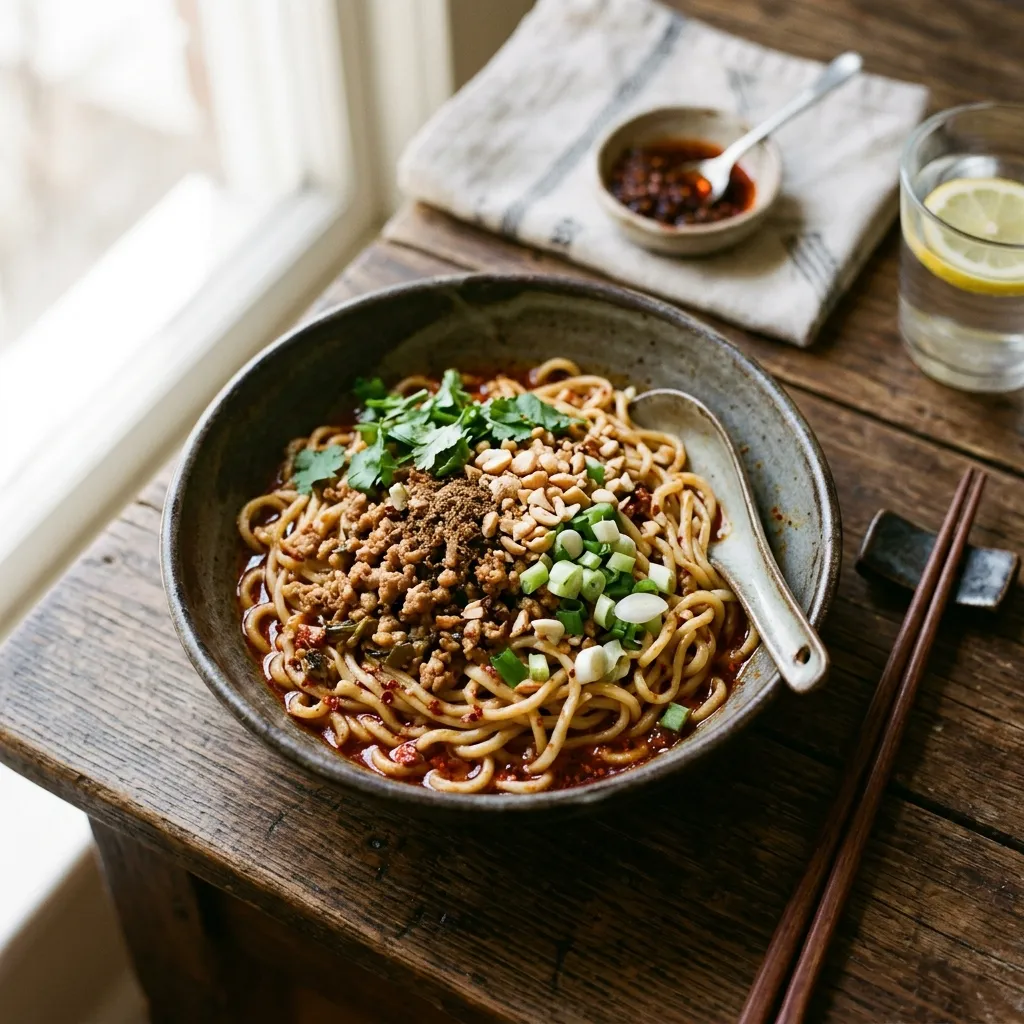
Dan dan noodles (dan dan mian) take their name from the carrying pole (dan dan) that Sichuan street vendors used to balance two baskets — one holding noodles and toppings, the other a charcoal stove for cooking — as they walked through the streets of Chengdu calling out to customers. The dish originated in the mid-19th century and remains the definitive Sichuan street noodle: thin wheat noodles served in a sauce of chili oil, Sichuan peppercorn, sesame paste, soy sauce, and black vinegar, topped with savory pork crumbles cooked with ya cai (Sichuan preserved mustard greens). The genius of dan dan noodles lies in the sauce, which coats every strand with a complex heat that builds but never overwhelms. Sesame paste provides a rich, nutty foundation. Chili oil delivers sustained, slow-building heat. Sichuan peppercorn adds the characteristic numbing tingle. The preserved mustard greens contribute a fermented, slightly funky depth. The pork crumbles, cooked dry and slightly crispy, add protein and textural contrast. Ayurvedically, this dish combines intense pungent heat with the heavy, oily quality of sesame paste and the salt-sour-fermented complexity of preserved vegetables. It is strongly stimulating to agni and circulation, with enough substance from the noodles and pork to provide grounding. The wheat noodles add sweet, heavy, building energy that partially counterbalances the fiery sauce.
Strongly heating and stimulating to digestion. The sesame paste and wheat noodles provide grounding heaviness that anchors the intense spice. Increases Pitta significantly. Reduces Kapha through pungency. Variably affects Vata — warming but potentially overstimulating.
The combination of chili oil, Sichuan peppercorn, and fermented preserved vegetables makes this a powerful ama-clearing meal. Useful for stimulating appetite, promoting circulation, and breaking up congestion in cold, damp conditions.
Ingredients
- 400 g Fresh thin wheat noodles (or dried thin Chinese noodles)
- 250 g Ground pork
- 3 tbsp Ya cai (Sichuan preserved mustard greens) (minced, or substitute zha cai)
- 3 tbsp Chinese sesame paste (zhi ma jiang)
- 3 tbsp Chili oil with sediment (Sichuan-style with chili flakes)
- 2 tbsp Soy sauce
- 1 tbsp Chinese black vinegar
- 1 tsp Sichuan peppercorn powder
- 1 tsp Sugar
- 2 cloves Garlic (minced)
- 3 stalks Scallions (thinly sliced)
- 1 tbsp Shaoxing wine
- 1 tbsp Vegetable oil
- 2 tbsp Roasted peanuts (crushed)
Instructions
- Prepare the sauce: in each of 4 serving bowls, combine equal portions of sesame paste, chili oil, soy sauce, black vinegar, Sichuan peppercorn powder, sugar, and half the minced garlic. Add 2-3 tablespoons of hot noodle cooking water to each bowl later to loosen the sauce.
- Heat the vegetable oil in a wok over high heat. Add the ground pork and stir-fry, breaking it into small crumbles, until the meat is browned and slightly crispy — about 5-6 minutes. The pork should be dry and caramelized, not wet and stewy.
- Add the remaining garlic, Shaoxing wine, and ya cai to the pork. Stir-fry for another 2 minutes until the preserved greens are fragrant and the wine has evaporated. Set aside.
- Bring a large pot of water to a rolling boil. Cook the noodles according to package directions until just tender — fresh noodles take 2-3 minutes, dried noodles 4-6 minutes. Reserve 1 cup of the starchy cooking water before draining.
- Add 2-3 tablespoons of the hot cooking water to each sauce bowl and stir vigorously until the sesame paste emulsifies into a smooth, creamy sauce that coats a spoon.
- Divide the drained noodles among the bowls. Top each with a portion of the crispy pork crumble, sliced scallions, and crushed peanuts.
- Serve immediately — each person tosses their own noodles from the bottom of the bowl to coat them thoroughly in the sauce before eating. The mixing is essential; eating from the top without tossing misses the entire point.
Nutrition
These values are estimates calculated from the ingredient list and may vary based on brands, cooking methods, and serving size. Not a substitute for medical or dietary advice.
How This Recipe Affects Each Dosha
Vata
The sesame paste and wheat noodles provide the heavy, oily, warm qualities Vata needs. The ground pork adds nourishing protein. However, the intense chili oil and Sichuan peppercorn can scatter Vata energy and overstimulate the nervous system. With moderation of the spicy elements, this can be a satisfying Vata meal.
Pitta
Chili oil, Sichuan peppercorn, garlic, and black vinegar create powerful Pitta provocation. The sesame paste adds some cooling balance, but the overall trajectory is strongly heating. Pitta types should avoid this during warm months and limit intake during cooler seasons.
Kapha
The pungent, heating qualities of the spice profile are therapeutic for Kapha — chili oil moves stagnation, Sichuan peppercorn stimulates circulation, and the sharp quality cuts through Kapha's heaviness. The noodles and sesame paste add some weight, but the overall balance favors Kapha reduction.
Powerfully stimulates agni through chili oil, Sichuan peppercorn, and fermented preserved vegetables. The sesame paste coats the digestive tract with a warming, lubricating layer that supports sustained digestion. This is a dish that leaves the digestive fire burning strongly for hours.
Nourishes: Rasa (plasma), Rakta (blood), Mamsa (muscle)
Adjustments by Constitution
For Vata Types
Reduce chili oil by half and replace with extra sesame paste for richness without heat. Omit Sichuan peppercorn or reduce to a pinch. Add blanched bok choy or spinach for grounding greens. Use egg noodles for richer, more lubricating texture.
For Pitta Types
Replace chili oil with sesame oil and a pinch of mild paprika for color. Omit Sichuan peppercorn. Replace pork with ground chicken or crumbled tofu. Use a lighter black vinegar quantity and increase the sesame paste for its cooling quality. Top with cucumber ribbons.
For Kapha Types
Increase chili oil and Sichuan peppercorn generously. Replace wheat noodles with zucchini noodles or shirataki noodles to eliminate the heavy grain element. Skip the peanuts. Add blanched broccoli and shredded cabbage for lighter, more fibrous bulk.
Seasonal Guidance
A cold-weather dish by nature — the intense warming spice profile was designed for Sichuan's damp, chilly winters. The heavy noodles and rich sesame sauce provide insulation. Avoid in summer unless portions are small and the chili is moderated. Spring is acceptable as the warming spices help counter lingering Kapha accumulation.
Best time of day: Lunch when agni is strong, or as a warming dinner on cold evenings
Cultural Context
Dan dan noodles epitomize Sichuan's "xiao chi" (small eats) culture — inexpensive, intensely flavored street food eaten standing or on tiny stools at sidewalk stalls. The dish was traditionally a small bowl, perhaps 4-5 bites, purchased between meals as a snack. The Western convention of serving it as a full entree-sized portion is a significant departure. In Chengdu today, dan dan noodles remain a benchmark dish — food critics and locals judge new noodle shops by their dan dan first, the way a pizzeria is judged by its margherita.
Deeper Context
Origins
Dan-dan noodles trace to Chengdu street-food culture of the 19th century — dan-dan refers to the shoulder-pole (dan) that street vendors used to carry hot noodle carts through the streets. Self-Gong Dan (1841-1917) is sometimes cited as the originator. The Americanized version dropped Sichuan peppercorn until recent rediscovery during the 2010s authentic-Sichuan-cuisine boom led by figures like Fuchsia Dunlop.
Food as Medicine
Capsaicin has extensive modern research support for metabolic stimulation, mucus-clearing, and pain modulation. Sichuan peppercorn's hydroxy-alpha-sanshool has been characterized as a chronic-pain adjunct in recent research. Sesame paste is a classical calcium and mineral source in East Asian diet. The dish is medically functional through its heating and dispersing action, appropriate for cold-damp-stagnation patterns.
Ritual & Seasonal Role
Street food year-round in Sichuan. Sichuan cuisine gained global popularity in the 2010s through the Chengdu food-tourism boom and through Western restaurant culture's discovery of authentic Sichuan (as opposed to Americanized-Chinese) cooking. Not ceremonial, but deeply tied to Sichuan regional identity.
Classical Pairings & Cautions
Cucumber salad, pickled radish, boiled peanuts, a glass of cold beer. Cautions: GERD and acid reflux from capsaicin; Pitta aggravation substantial in hot weather; gluten intolerance precludes wheat noodles (rice noodle substitutions work); sesame allergies; the Sichuan peppercorn numbing effect may surprise first-time eaters.
Cross-Tradition View
How other medical and food-wisdom traditions read this dish. Each tradition names the same physiological reality in its own language — the agreements across them are where universal principles live.
Greek Humoral
Hot-dry intense. A fully choleric preparation by Galenic classification. Suitable only for melancholic-phlegmatic temperaments in hot-dry need — the Sichuan ma-la (numbing-spicy) principle aligns with Galenic ideas about moving stagnation through heat. Choleric and sanguine types would be substantially aggravated.
Ayurveda
Heating virya, pungent vipaka. Aggravates Pitta significantly through chili and Sichuan peppercorn. Kapha-reducing strongly. Vata mixed — the warming qualities help but the sharpness and pungency can aggravate. Not a daily-eating dish by classical Ayurvedic standards; appropriate for cold-damp Kapha weeks only.
Mesoamerican Chili Heritage
Chili peppers in Sichuan cuisine are a 17th-century Mesoamerican arrival via Spanish-Portuguese Manila Galleon trade — Sichuan cuisine without chili did not exist before roughly 1650. The heated Sichuan tradition is four centuries old at most. Before chili arrival, Sichuan ma-la relied entirely on Sichuan peppercorn and ginger-mustard for heat. The marriage of New World chili with ancient Chinese Sichuan peppercorn is what creates the modern ma-la profile.
Sichuan Taoist
Sichuan's spicy cuisine developed partly as a Taoist-monastic response to the region's cold-damp mountain climate — the ma-la (numbing-spicy) combination was believed to drive out internal dampness and restore Yang function. Sichuan peppercorn itself is a Taoist medicinal with specific meridian-opening properties; the hydroxy-alpha-sanshool compound it contains produces a genuine local analgesic-numbing effect that modern research has characterized.
Chef's Notes
Chinese sesame paste (made from toasted sesame seeds) is not interchangeable with Middle Eastern tahini — tahini is made from raw sesame and tastes flat and chalky in this application. If Chinese sesame paste is unavailable, toast tahini in a dry pan until fragrant, then thin with a teaspoon of sesame oil. The chili oil should include the sediment (chili flakes, spices settled at the bottom) — this is where much of the flavor and heat lives. Ya cai gives the authentic Sichuan flavor; if unavailable, zha cai (Sichuan pickled mustard tuber) is the best substitute.
Frequently Asked Questions
Is Dan Dan Noodles good for my dosha?
Strongly heating and stimulating to digestion. The sesame paste and wheat noodles provide grounding heaviness that anchors the intense spice. Increases Pitta significantly. Reduces Kapha through pungency. Variably affects Vata — warming but potentially overstimulating. The sesame paste and wheat noodles provide the heavy, oily, warm qualities Vata needs. Chili oil, Sichuan peppercorn, garlic, and black vinegar create powerful Pitta provocation. The pungent, heating qualities of the spice profile are therapeutic for Kapha — chili oil moves stagnation, Sichuan peppercorn stimulates circulation, and the sharp quality cuts through Kapha's heaviness.
When is the best time to eat Dan Dan Noodles?
Lunch when agni is strong, or as a warming dinner on cold evenings A cold-weather dish by nature — the intense warming spice profile was designed for Sichuan's damp, chilly winters. The heavy noodles and rich sesame sauce provide insulation. Avoid in summer unless po
How can I adjust Dan Dan Noodles for my constitution?
For Vata types: Reduce chili oil by half and replace with extra sesame paste for richness without heat. Omit Sichuan peppercorn or reduce to a pinch. Add blanched bok For Pitta types: Replace chili oil with sesame oil and a pinch of mild paprika for color. Omit Sichuan peppercorn. Replace pork with ground chicken or crumbled tofu. U
What are the Ayurvedic properties of Dan Dan Noodles?
Dan Dan Noodles has Pungent, Salty, Sour, Sweet taste (rasa), Heating energy (virya), and Pungent post-digestive effect (vipaka). Its qualities (gunas) are Warm, Oily, Heavy (from sesame and noodles), Sharp. It nourishes Rasa (plasma), Rakta (blood), Mamsa (muscle). Powerfully stimulates agni through chili oil, Sichuan peppercorn, and fermented preserved vegetables. The sesame paste coats the digestive tract with a warming, lubricating layer that supports sustained digestion. This is a dish that leaves the digestive fire burning strongly for hours.