Why Conversations Keep Going Wrong
The complete program: 14-day protocol, deep type work, nervous system support, and the childhood patterns underneath.
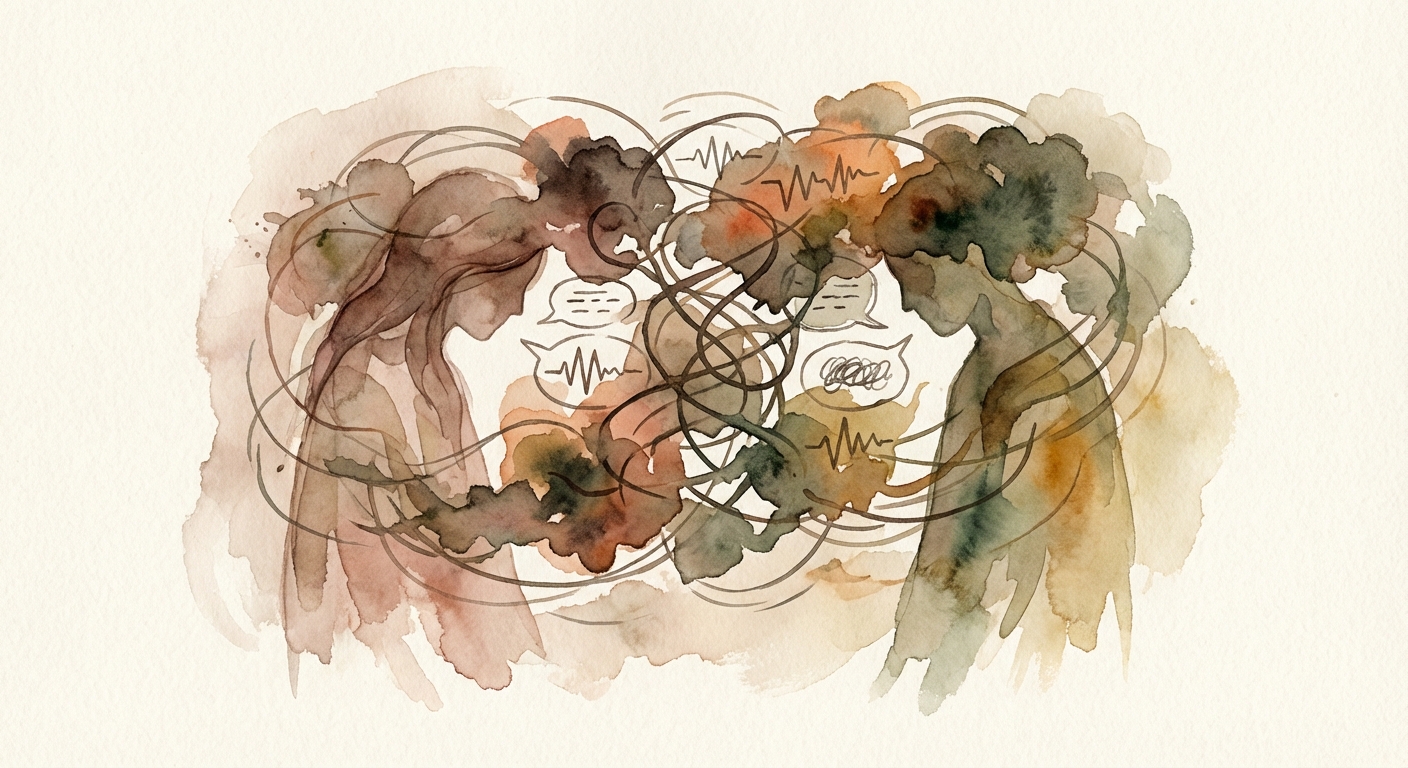
- You say something important and they don't hear it
- Conversations that should take 30 seconds turn into an hour
- You've stopped saying what you really think
- The same misunderstanding happens every time
- You feel more alone after talking than before
Which one sounds like you?
The Scattered Communicator
Talks fast, jumps topics, things come out wrong.
The Sharp Communicator
Direct to a fault. Honesty that cuts.
The Silent Communicator
Goes quiet. Swallows what needs saying.
You're not bad at communicating. You're stuck in a pattern — and each pattern breaks conversations in a different way.
The guide gives you the mechanics of why your conversations keep failing, and a 7-day protocol matched to your type to start changing the cycle.
See your pattern. Get the first step now.
Free. One practice you can start immediately. See if it shifts something.
What's inside
~60 minute read + 14-day protocol. Read on your phone. Instant access.
- Everything in the Communication Guide, plus:
- Full 14-day protocol in 4 phases — foundation, core practice, type-specific work, the deeper layer
- Deep dive into all three types — how each sends, receives, acknowledges, and what to practice
- The incomplete cycle trap — the self-reinforcing mechanism that keeps broken patterns locked
- Nervous system support — breath regulation, herbal support by type, vocal toning
- Relationship rhythms — daily check-ins, weekly clearing, post-conflict repair
- The emotional layer — childhood communication patterns, body-stored blocks, processing old cycles
- Troubleshooting, when professional help is needed, and what to do when one person won't engage
Try this in your next conversation
Here's the one thing from this guide that changes the most conversations. Try it today — you'll feel the difference immediately.
Complete the Cycle
In your next conversation where someone tells you something that matters to them:
- Don't say "I get it" or "I understand." These words end the conversation in your head but not in theirs.
- Instead, say back what you heard — in your own words, with the feeling attached. "So you've been carrying that all week and nobody asked." "You wanted them to notice and they didn't."
- Watch what happens. They'll either relax (cycle complete) or correct you — "No, it's more like..." Either response is progress. The conversation is now moving instead of looping.
This is the step that most communication advice skips. Not listening — acknowledgment. The guide explains why this one mechanical step unlocks everything else, and gives you a 7-day protocol to make it automatic.
Better conversations in 7 days or your money back.
Email hello@satyori.com for a full refund. No questions, no hoops.
Common questions
Will this work if the other person won't change?
Yes. When one person breaks the cycle, the dynamic shifts automatically. You don't need their cooperation.
How is this different from other communication advice?
Most advice says "listen more" or "use I-statements." This explains why those fail — and the one mechanical step that must happen first.
I see myself in more than one type.
Normal. The type you become during a fight is the one that matters most — and the protocol addresses the underlying cycle all three share.
What if it doesn't work?
Better conversations in 7 days or your money back. hello@satyori.com — no questions, no hoops.