Why Conversations Keep Going Wrong
The communication cycle that must complete, the 3 ways it breaks, and a 7-day protocol to start changing the pattern.
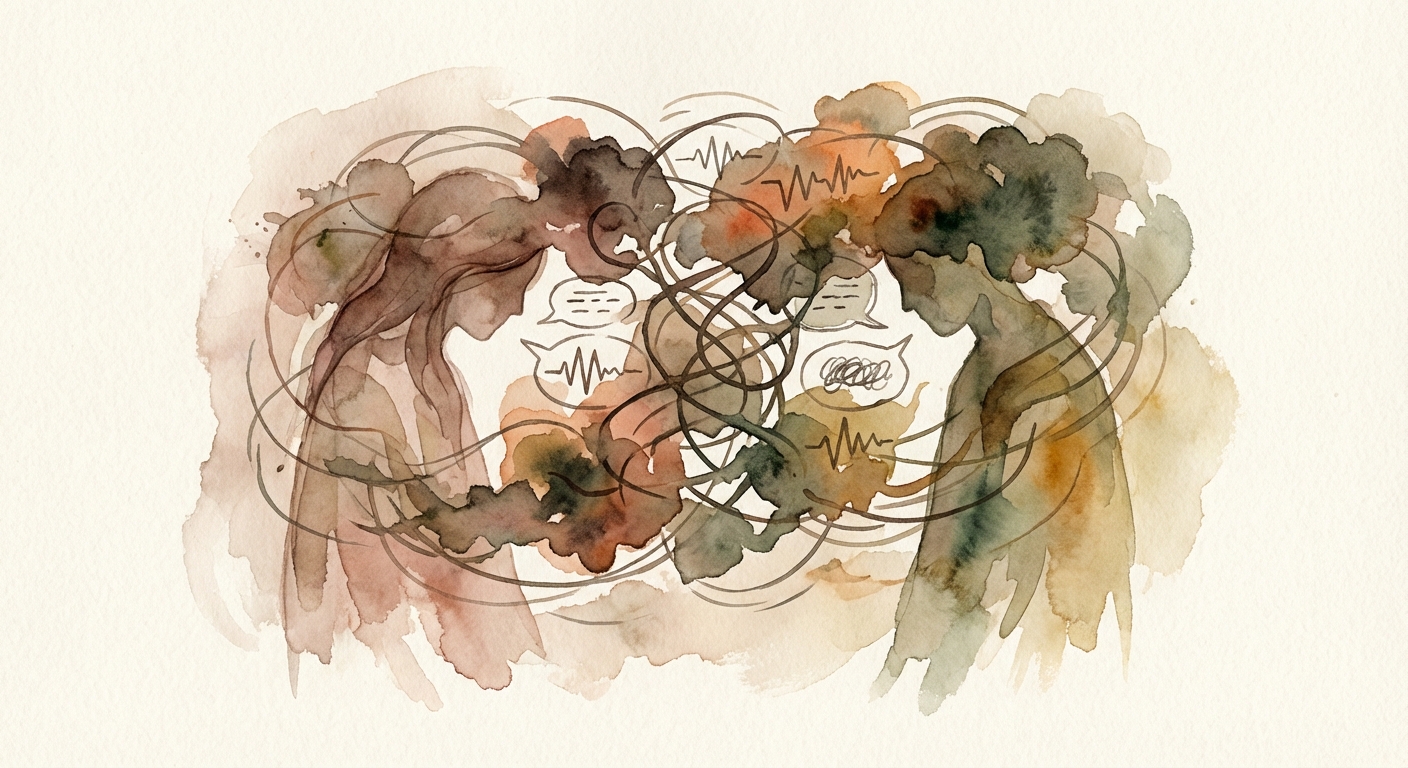
- You say something important and they don't hear it
- Conversations that should take 30 seconds turn into an hour
- You've stopped saying what you really think
- The same misunderstanding happens every time
- You feel more alone after talking than before
Which one sounds like you?
The Scattered Communicator
You talk fast, jump between topics, and lose people halfway through. Important things come out sideways or at the wrong moment. You know what you mean but it never lands the way you intend. Afterward you replay the conversation wondering why you said it like that.
- Talking too fast or too much
- Jumping between topics
- Important things said at wrong times
- Replaying conversations afterward
The Sharp Communicator
Your words have an edge you don't always intend. You cut to the point — but the point cuts people. Conversations escalate because your directness reads as attack. You're not trying to hurt anyone. You're trying to be honest. But honesty without landing feels like a weapon to the person receiving it.
- People say you're harsh
- Conversations escalate quickly
- Directness mistaken for aggression
- Frustration when others won't be straight
The Silent Communicator
You go quiet when things get hard. The words are there but they won't come out — or by the time they do, the moment has passed. You swallow what you really think to avoid conflict. Over time, everything unsaid accumulates into a wall between you and the people you're closest to.
- Going quiet in conflict
- Swallowing what you really think
- Avoiding hard conversations
- Resentment that builds silently
You're not bad at communicating. You're stuck in a pattern — and each pattern breaks conversations in a different way.
The guide gives you the mechanics of why your conversations keep failing, and a 7-day protocol matched to your type to start changing the cycle.
See your pattern. Get the first step now.
Free. One practice you can start immediately. See if it shifts something.
What's inside
~30 minute read + 7-day protocol. Read on your phone. Instant access.
- Why communication fails — the cycle that must complete and the three ways it breaks
- The three communication types — scattered, sharp, and silent — identify yours and stop using the wrong fixes
- The one skill that transforms more conversations than any other (it's not listening)
- Why "I get it, I get it" makes conversations longer, not shorter
- A sequenced 7-day protocol with type-specific practices
- Troubleshooting — when acknowledgment isn't landing, when honesty explodes, when patterns won't break
Try this in your next conversation
Here's the one thing from this guide that changes the most conversations. Try it today — you'll feel the difference immediately.
Complete the Cycle
In your next conversation where someone tells you something that matters to them:
- Don't say "I get it" or "I understand." These words end the conversation in your head but not in theirs.
- Instead, say back what you heard — in your own words, with the feeling attached. "So you've been carrying that all week and nobody asked." "You wanted them to notice and they didn't."
- Watch what happens. They'll either relax (cycle complete) or correct you — "No, it's more like..." Either response is progress. The conversation is now moving instead of looping.
This is the step that most communication advice skips. Not listening — acknowledgment. The guide explains why this one mechanical step unlocks everything else, and gives you a 7-day protocol to make it automatic.
Better conversations in 7 days or your money back.
Email hello@satyori.com for a full refund. No questions, no hoops.
Common questions
Will this work if the other person won't change?
Yes. When one person breaks the cycle, the dynamic shifts automatically. You don't need their cooperation.
How is this different from other communication advice?
Most advice says "listen more" or "use I-statements." This explains why those fail — and the one mechanical step that must happen first.
I see myself in more than one type.
Normal. The type you become during a fight is the one that matters most — and the protocol addresses the underlying cycle all three share.
What if it doesn't work?
Better conversations in 7 days or your money back. hello@satyori.com — no questions, no hoops.