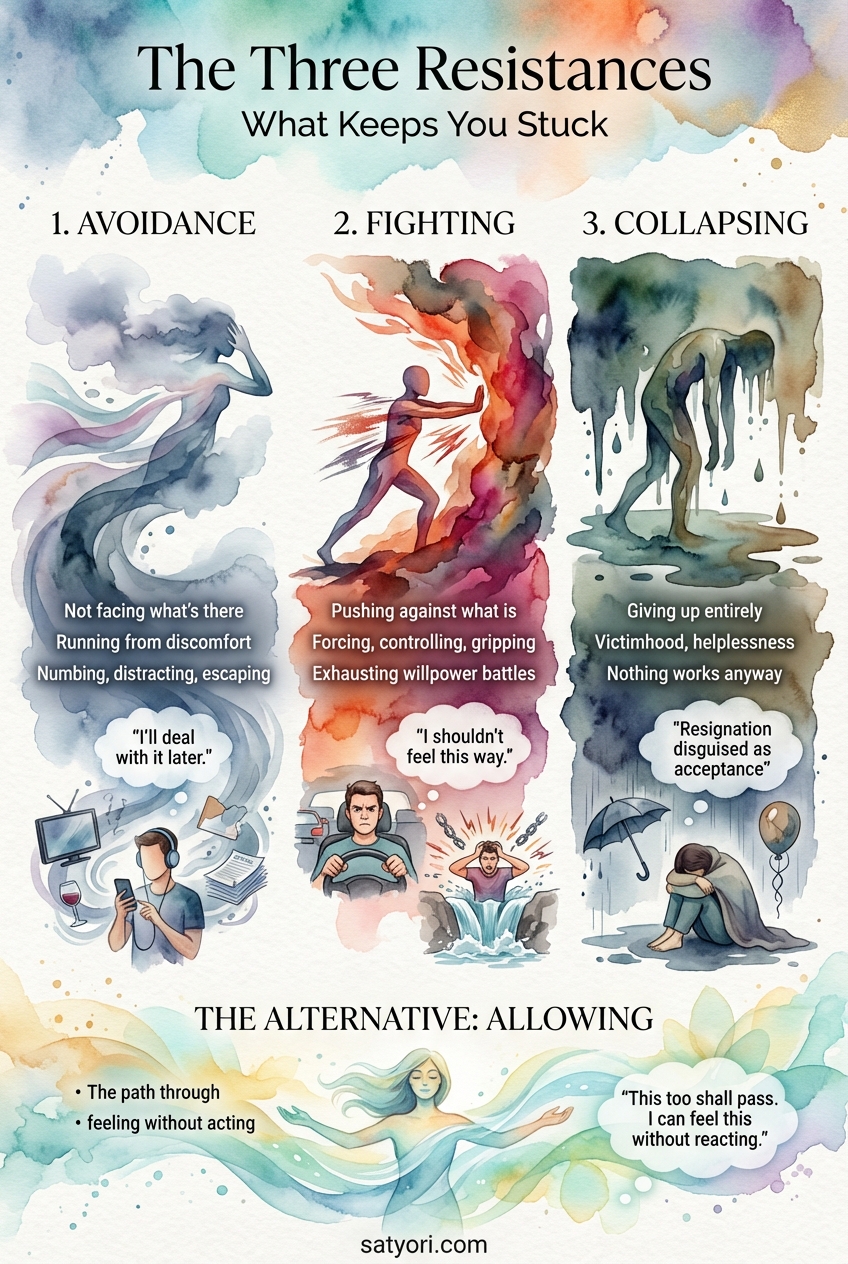
The Three Resistances
When something uncomfortable shows up — a feeling, a situation, a truth about yourself you’d rather not see — you do something with it. Everybody does. Almost nobody just sits with it.
What you do falls into one of three categories. Understanding which one runs you is the beginning of something different.
Avoidance
The first resistance is turning away.
You know something needs your attention. A conversation you keep postponing. A feeling that surfaces and then gets shoved down. A pattern you can see but don’t want to look at directly. Instead of facing it, you find something else to do. You stay busy. You scroll your phone. You pour a drink. You reorganize the kitchen instead of dealing with what’s actually wrong.
Avoidance is elegant. It doesn’t feel like avoidance from the inside — it feels like being practical, staying positive, moving forward. The nervous system learned early that certain things are too much, so it developed a strategy: don’t look.
The cost is accumulation. What you avoid doesn’t leave. It sits there, building pressure. It comes out sideways — as reactions that seem out of proportion to the current situation, as physical tension nobody can explain, as a kind of emotional flatness. Because you can’t selectively numb. If you shut down the painful stuff, the joyful stuff gets dampened too.
Here’s a test. Think of something painful from your past — something real, something that still has weight. Can you hold your attention on it for two full minutes? Not analyze it. Not figure it out. Just be with it. If your attention slides away, if you feel the pull to change the subject in your head, if you suddenly remember something you need to do — that’s avoidance at work. You’re watching the machinery in real time.
People who avoid well don’t know they’re avoiding. They’ve done it so long that it feels like health. “I don’t dwell on things.” “I’m a forward-looking person.” These sound like strengths. Sometimes they are. But when the same unresolved material keeps leaking out — as overreactions, as chronic tension, as relationships that never get past a certain depth — the strategy is showing its cost.
Fighting
The second resistance is pushing against what is.
Instead of turning away from discomfort, you turn toward it — but with force. You try to control it, fix it, overpower it. You grip harder. You make rules. You use willpower to bend reality into what you think it should be.
Fighting feels like strength. It looks productive. Other people might admire your discipline. But there’s a difference between responding to reality and going to war with it.
When you fight what is, you burn enormous energy to stay in the same place. You’re spending your finite capacity holding down something that wants to move. That thing you’re fighting against is usually something that needs to be felt, not defeated. An emotion. A fear. A truth you’re not ready to accept.
Watch for this: “I shouldn’t feel this way.” That’s the fighting response. The feeling is there. It’s real. Telling it to leave is like telling the tide to stop. You can stand on the beach and yell at the water. The water doesn’t care.
People who fight their patterns are often the most exhausted people in the room. They look like they have it together. They don’t. They’re running on willpower, and willpower is a finite resource that gets depleted by everything — decisions, emotions, stress, restraint. When it runs out — and it runs out — the thing they were holding down comes back harder than before, because now there’s accumulated pressure behind it.
The assessment maps which resistance pattern runs your life — and where the charge is strongest.
Take the Free AssessmentCollapsing
The third resistance is giving up.
Not the giving up that comes from wisdom — not surrender. This is the collapse that comes from overwhelm. You tried avoiding. You tried fighting. Neither worked. So you stop trying altogether.
Collapsing feels like acceptance. It uses the same words. “It is what it is.” “I’ve made my peace with it.” “I’ve let it go.” But the tone gives it away. Acceptance has energy in it — a quiet aliveness, a capacity to engage. Collapse is flat. Numb. It’s the system shutting down because the only other option seems to be more pain.
People who have collapsed often don’t realize it. They think they’ve healed. They think they’ve moved on. But moving on requires movement, and collapse has no movement in it. It’s static. If you prod the subject, there’s nothing there — no feeling, no heat, no engagement. That’s not resolution. That’s a shutdown.
The tell is simple. Acceptance feels peaceful. Collapse feels numb. If you’re not sure which one you’re in, you’re probably in collapse. Peace knows itself.
Sometimes collapse becomes an identity. The suffering becomes a strategy — it earns sympathy, it provides excuses, it puts you permanently in the right. Nobody wants to hear that their pain is serving a purpose. But these patterns are common and nearly invisible from the inside, because from the inside they just feel like real suffering.
Most People Use All Three
You’ll recognize yourself in more than one of these. That’s normal. Most people rotate between avoidance, fighting, and collapsing depending on the domain and the intensity.
But one dominates. One is your go-to, the strategy your system reaches for first when something uncomfortable shows up. And it runs so automatically that you probably don’t see it as a strategy at all. It just feels like how you are.
You might avoid in relationships but fight at work. You might fight your health patterns but collapse around money. The resistance shifts depending on the territory. But the primary one — the one that fires before you think about it — that’s worth knowing.
The assessment shows which resistance dominates across 12 life areas — and where a small shift would change the most.
Discover Your PatternThe Alternative: Allowing
There is a fourth option. Allowing means feeling what’s there without doing anything about it. Not running from it. Not fighting it. Not drowning in it. Just being with it.
This is the hardest thing most people will ever learn to do.
The mind has opinions about this. It will tell you that you need to fix the feeling, figure it out, make it stop. It will tell you that sitting with discomfort is pointless, or dangerous, or self-indulgent. These aren’t facts. They’re the mind’s strategies for maintaining its resistance patterns.
When you allow an emotion to move through you without feeding it with stories — without analyzing why you feel it, without building a case about whose fault it is, without planning how to fix it — something happens. It passes. Not in hours. In seconds. Roughly ninety seconds for the raw physiological wave to peak and dissipate. You’ve just never let one run its full course because the resistance kicks in so fast.
Ninety seconds. That’s it. If you don’t feed it.
The reason allowing is hard isn’t that the emotions are too big. It’s that the habit of resisting is too strong. You’ve been doing it your whole life. Avoidance, fighting, or collapsing — your body reaches for the familiar pattern before you even know there was a choice to make.
That’s why awareness comes first. You can’t allow what you can’t see. You have to catch the resistance as it’s happening — notice the urge to check your phone when a feeling rises, notice the impulse to argue when something lands too close to truth, notice the flatness that descends when something feels like too much.
Catching it doesn’t stop it. Not at first. But catching it creates a gap. And in that gap, something new becomes possible. Not a new strategy. Something simpler. The ability to just be there, with what is, without needing to do anything about it.
That gap widens with practice. And everything changes from there.
Where to Go from Here
Recognizing your resistance pattern is the beginning. The Satyori Assessment maps where these patterns show up across your entire life — relationships, work, health, creativity, and more. It shows you not just where you’re stuck, but which patterns are ready to shift.
It takes about 15 minutes and it’s free.