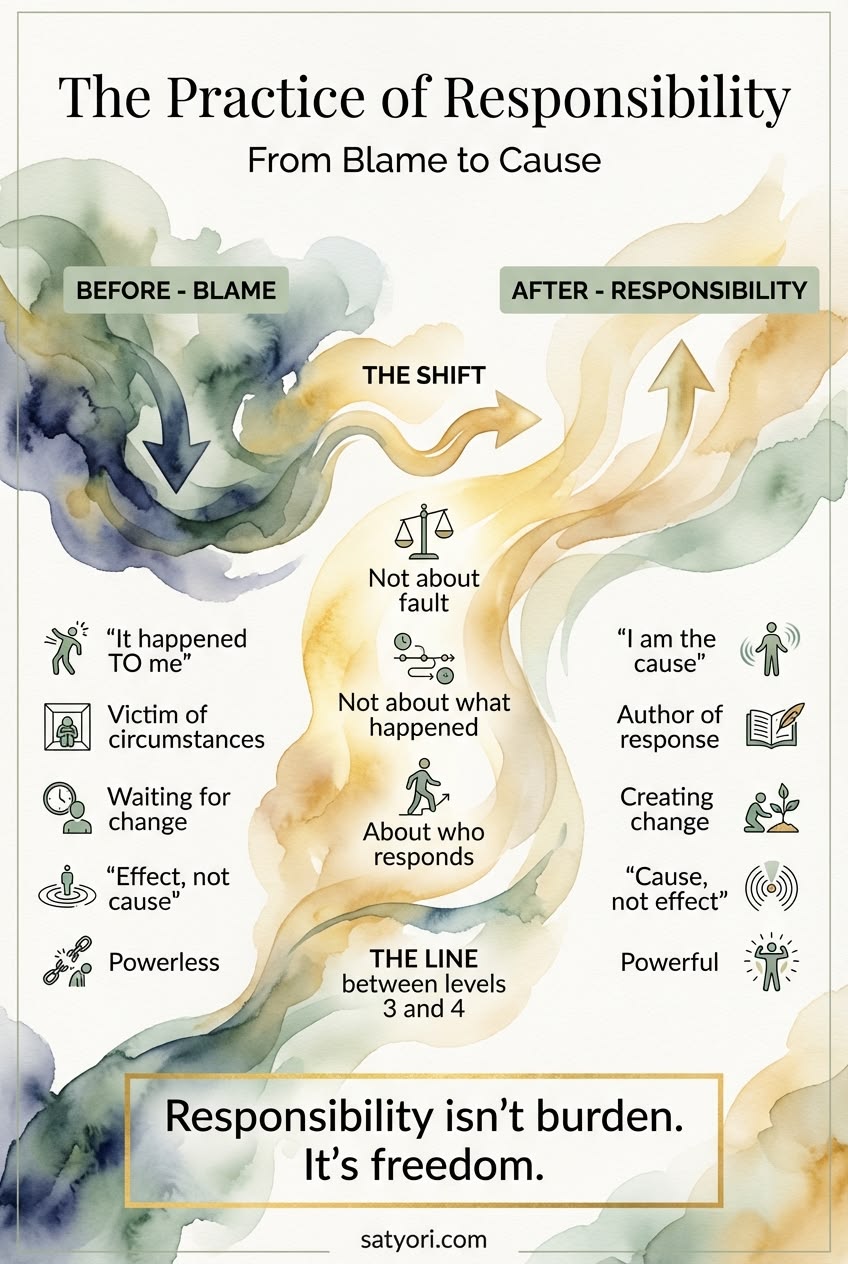
The Practice of Responsibility
There are only two positions you can take in any situation.
Effect: this happened to me. Someone did this. Circumstances caused it. I’m dealing with the fallout of forces outside my control.
Cause: I created this. I allowed this. I chose this — or I chose the things that led to this. I am the author of my response.
That’s it. There’s no middle ground. In any given moment, about any given situation, you’re operating from one of these two positions. Most people are at effect in the areas where they’re most stuck, and they don’t realize the position itself is what’s keeping them stuck.
The Trade-Off Nobody Tells You About
The effect position is comfortable. When something goes wrong and it’s not your fault, you’re off the hook. You don’t have to do anything about it. You can be angry, or sad, or righteous, and all of those feelings are justified because you didn’t cause this. Someone else did. The world did. Your childhood did. Your boss, your partner, the economy, your genetics.
From the effect position, you’re right. And you’re powerless.
From the cause position, you might be wrong — the situation might genuinely not be your fault in any obvious way. But you have options. You can act. You can change something. You can respond instead of react.
This is the trade-off: comfort versus power. The effect position gives you the comfort of innocence and the suffering of helplessness. The cause position gives you the discomfort of ownership and the power to change things.
Most people choose comfort. Then they wonder why nothing changes.
What Cause Is Not
This is where people get stuck, so let’s be precise.
Cause is not blame. Saying “I am cause” does not mean “I deserve what happened.” It does not mean “it’s all my fault.” It does not mean the other person’s behavior was acceptable, or that you should have prevented it, or that you need to feel guilty.
Blame looks backward and assigns fault. Cause looks forward and finds leverage.
A person who was treated badly as a child did not cause that treatment. They were a child. But as an adult, they are cause over what they do with that experience — whether they repeat the pattern, whether they seek help, whether they let the old injury define their present relationships. The original event was not their doing. Their response to it now is.
This distinction matters because without it, responsibility becomes self-punishment. And self-punishment is just another form of the effect position — you’re still a victim, just of your own judgment instead of someone else’s. That’s not responsibility. That’s masochism wearing a growth mindset t-shirt.
The assessment measures where you're operating from cause and where you're stuck at effect — across all 12 life areas.
Take the Free AssessmentHow Effect Sounds
Effect has a vocabulary. Once you hear it, you can’t unhear it.
“They did this to me.” “I didn’t have a choice.” “That’s just how I am.” “It runs in my family.” “I can’t help it.” “If they hadn’t done that, I wouldn’t have had to…” “I was going to, but then…”
Every one of these sentences does the same thing: it removes you from the equation. It takes a situation you’re in and edits you out of the causal chain. The event happened. Other forces were responsible. You were just there.
Cause sounds different. “I chose to stay.” “I allowed that to continue.” “I could have responded differently and I didn’t.” “I created this situation by…” “I notice I keep ending up here, and I’m starting to see how.”
Cause language puts you back in. Not as the villain of the story — as the author.
The Energy Equation
Here’s what nobody talks about: there’s a direct relationship between how much cause you take and how much energy you have.
Every area of your life where you’re at effect drains energy. Not because the situation is bad — because the position is bad. When you’re at effect, you’re monitoring, defending, worrying, resenting. You’re spending energy on the story of what happened and why it’s not your fault. You’re maintaining the emotional posture of a person who has been wronged.
This costs something. It costs a lot, actually.
Every area where you’re at cause generates energy. When you’re at cause, you’re acting. You’re solving. You’re choosing. Even if the situation is harder objectively, the experience of being at cause in it feels completely different from being at effect. At cause, you’re engaged. At effect, you’re enduring.
Think of someone you know who takes responsibility for everything in their life — not compulsively, not as a performance, but genuinely. They own their choices, their mistakes, their situations. How do they seem? Usually energized. Usually clear. Usually moving.
Now think of someone who’s at effect about everything — it’s always someone else’s fault, always bad luck, always circumstances beyond their control. How do they seem? Usually tired. Usually stuck. Usually heavy.
That’s not personality. It’s mechanics.
The Line Between Seeing and Doing
There’s a specific transition point where this shift happens. You can understand responsibility intellectually for years without it changing anything. Most people do. They’ve read the books. They know they should take more ownership. They can explain the concept perfectly.
And they’re still at effect in the areas that matter most.
The line is between seeing your patterns and taking cause over them. Below the line, you observe. You notice your reactions. You see how your childhood shows up in your relationships. You understand your triggers. You have insight after insight after insight.
Above the line, you act from cause. You don’t just see the pattern — you own it. You stop explaining it and start taking responsibility for what you do with it. The understanding is no longer enough. The knowing has to become doing.
This is uncomfortable because below the line, you still get to be a victim of your patterns. They happened to you. Your childhood installed them. You didn’t choose them. Above the line, you’re the one running the patterns. They’re your patterns now. Whatever they were originally, they’re yours. You’re the one keeping them going, and you’re the one who can stop.
Justifications: The Invisible Shield
The mechanism that keeps people at effect is justification. Everyone does it. Almost nobody sees themselves doing it.
A justification takes something you did and repositions it so the cause is somewhere else. “I yelled at my kid because I was stressed from work.” The cause just moved from you to your job. “I haven’t exercised in months because I don’t have time.” The cause moved from you to your schedule. “I lied because the truth would have hurt them.” The cause moved from you to the other person’s feelings.
Each justification is a tiny exit from the cause position. And they accumulate. Enough justifications and you’re living entirely at effect — not because you chose to, but because you justified your way there one small step at a time.
Here’s the part that stings: everyone else’s justifications are obvious. You can see them clearly. The friend who keeps blaming their partner for their unhappiness. The colleague who always has an excuse. The family member who won’t take responsibility for anything.
Yours are airtight.
They have to be. If they weren’t convincing, they wouldn’t work. Your justifications are the ones you can’t see because they’re the ones you’ve built the best case for. They feel like facts, not stories. They feel like reality, not position.
Your justifications are invisible to you — but their effects aren't. The assessment shows where they're running.
See Where You're at EffectThe Spectrum
Responsibility isn’t binary. It’s not all-or-nothing, on-or-off. It exists on a spectrum, and knowing where you sit on that spectrum matters.
On one end: compulsive responsibility. Taking cause for everything — including things that genuinely aren’t yours. Other people’s feelings. The weather at the family reunion. Your partner’s bad day that had nothing to do with you. This looks like responsibility from the outside. It’s actually control. You’re over-functioning to avoid the discomfort of things being out of your hands.
On the other end: avoidant irresponsibility. Dodging cause at every opportunity. Nothing is your doing. Circumstances are always the explanation. You’re always reacting, never initiating. This feels safe. It’s a cage.
In the middle: chosen responsibility. You take cause where it’s yours. You don’t take cause where it isn’t. You can tell the difference — not because you have a formula, but because you’ve practiced enough honest self-observation to know when you’re deflecting and when you’re genuinely not involved.
The free-choice position means you have access to the full range. You can take more cause when the situation calls for it. You can step back when it doesn’t. Responsibility becomes a tool you use, not a weight you carry or a burden you dodge.
Why This Is Freedom
Responsibility as burden is the version most people were taught. Clean your room. Do your homework. Take care of this. It was obligation. It was weight. It was what you had to do, not what you chose to do.
Responsibility as freedom is a different thing entirely.
When you’re at cause in your life, you’re not trapped by circumstances. You’re not waiting for someone to rescue you. You’re not dependent on external conditions changing before you can change. You have agency. You have leverage. You have the ability to act regardless of what’s happening around you.
This doesn’t mean life gets easier. It means you stop being stuck. There’s a difference.
The person at effect waits for the situation to change. The person at cause changes the situation — or changes themselves in relation to it. One of those positions produces movement. The other produces patience that gradually becomes resignation.
Every area of life where you feel trapped is an area where you’re at effect. Not because you’re weak or lazy or broken — because you haven’t taken the cause position yet. The moment you do — genuinely do, not just intellectually acknowledge — options appear that weren’t visible before. Not because they’re new. Because you couldn’t see them from the effect position.
The Practice
You don’t become responsible by deciding to be responsible. You become responsible by practicing.
Start with something small. Pick one area of your life where you’ve been at effect. Where the story is that someone else caused it, or circumstances are to blame, or you didn’t have a choice.
Now ask: how am I cause here?
Not “how is this my fault.” That’s blame, not responsibility. “How am I cause” means: what did I choose, allow, create, or maintain that contributed to this situation? What am I doing right now that keeps it going? What could I do differently?
The first time you ask this honestly, the answer might be uncomfortable. It usually is. That discomfort is the feeling of the effect position losing its grip. It’s the feeling of power returning to a place where helplessness used to live.
Then do it again tomorrow. And the day after that. The practice isn’t a one-time event — it’s a position you return to every time you notice you’ve slipped back into effect. Which you will. Regularly. The old pattern is automatic. The new one requires practice until it becomes automatic too.
Blame is faster than thought. It’s a reflex, not a decision. Someone cuts you off in traffic and you’re at effect before you’ve formed a conscious thought. The practice is inserting a pause between the event and the blame. The event happens. You notice the blame arising. And before it solidifies, you ask: how am I cause?
The pause is the whole game.
What Changes
People who make this shift report something consistent: the world doesn’t change, but their experience of it transforms completely.
The same job, the same relationship, the same body, the same circumstances — but from cause instead of effect. And from cause, everything looks different. Problems become projects. Obstacles become information. Stuck places become choice points.
This isn’t positive thinking. It’s positional. You’re not telling yourself a better story. You’re standing in a different place. And from this place, you can see things that were invisible from the effect position — options, openings, leverage points that were always there but couldn’t be accessed by someone who was waiting for the world to change first.
Responsibility isn’t burden. It’s freedom. The practice is simple, the resistance is enormous, and the shift — when it happens — changes everything that follows.