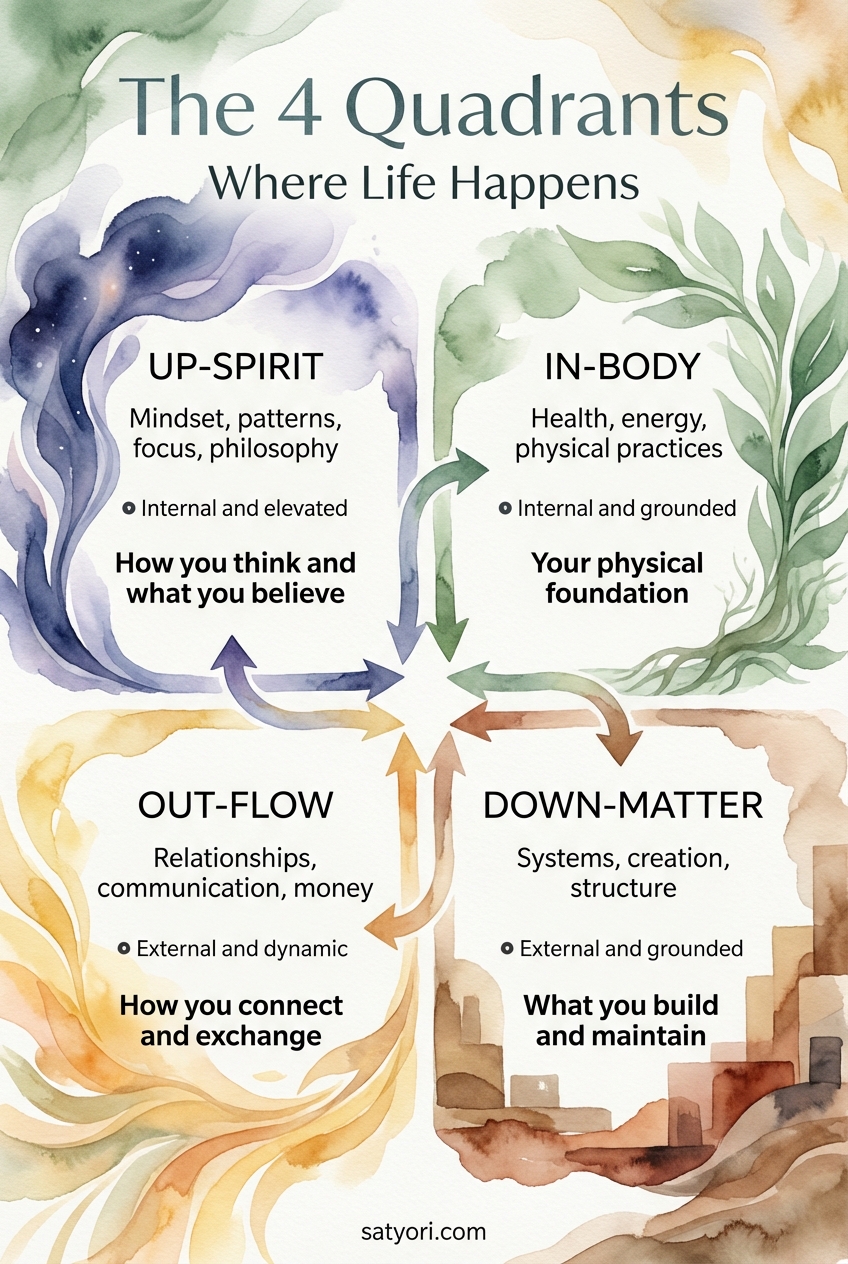
The 4 Quadrants
Your life isn’t one thing. It’s four.
Most personal growth approaches act like you’re on a single track — fix your mindset, or get healthy, or be more productive, or improve your relationships. Pick a lane and grind. But you’re not living on one track. You’re living across four dimensions at once, and your level in each one affects all the others in ways you probably aren’t seeing.
The four quadrants are a map of where life actually happens. And the quadrant you’ve been avoiding is almost certainly where your biggest leverage is hiding.
In-Body: The Foundation
Health. Energy. How you sleep, eat, move, and rest. The physical substrate that everything else runs on.
Most people know their body matters. Fewer people treat it as genuinely foundational — meaning the other three quadrants cannot exceed the body’s capacity to support them. You can’t think clearly when you’re chronically under-slept. You can’t show up honestly in relationships when your nervous system is fried. You can’t build anything sustainable when you’re running on caffeine and adrenaline.
This one seems obvious. It isn’t, because most people acknowledge it intellectually and then proceed to ignore it. They’ll invest hours in a mindset course while sleeping five hours a night. They’ll attend a communication workshop while so wired on cortisol they can’t actually listen. The body is always supporting or undermining everything above it. Always.
When this quadrant is strong, you have a platform. Everything gets easier — not because the challenges disappear, but because you have the physical capacity to meet them. When it’s weak, everything is harder than it needs to be, and you keep looking for the problem everywhere except your body.
Up-Spirit: How You Think
Mindset. Patterns. Focus. The beliefs you carry about yourself and the world — conscious and unconscious.
This is where most self-help lives. Books, podcasts, courses, coaching — almost all of it operates here. And that’s the problem with treating it as the only quadrant. Mindset work without the other three is like building a penthouse with no foundation. You have beautiful insights that don’t connect to anything real. You understand your patterns intellectually and they keep running. You know exactly what you should do and can’t seem to do it.
Up-Spirit governs your mental patterns, your capacity for self-awareness, your focus, and how honestly you observe your own life. When it’s strong, you can see clearly — you notice your patterns, you catch your reactions, you have some space between stimulus and response. When it’s weak, you’re on autopilot and calling it normal.
The assessment measures your actual level across all four quadrants — not where you think you are, but where you're operating from.
Take the Free AssessmentOut-Flow: How You Connect
Relationships. Communication. Money — which is just another form of exchange between people.
This is the dynamic dimension. How you show up with other people. What you say and what you hold back. What you give and what you receive. Where your boundaries are and whether they actually hold under pressure.
People who are strong here but weak in In-Body burn out from overgiving. They’re generous and connected and completely running on fumes. People who are strong in Up-Spirit but weak here have brilliant ideas that never reach anyone. They understand everything and communicate almost none of it. They do the inner work in isolation and wonder why the world doesn’t respond.
Money shows up in this quadrant because money is relational. It’s exchange. How you handle money reflects how you handle exchange with other people — what you think you deserve, what you’re willing to ask for, how comfortable you are receiving.
Down-Matter: What You Build
Your physical environment. Your systems. Your creative output. The tangible structures that hold your life together.
This is the most neglected quadrant. People will spend thousands on mindset coaching while their living space is chaotic. They’ll read books about productivity while their basic systems are broken. They’ll plan endlessly without building anything real.
Down-Matter is where ideas become actual. Your home. Your workspace. Your routines. The things you create and put into the world. When this quadrant is strong, your environment supports what you’re trying to do. When it’s neglected, you’re fighting your surroundings on top of everything else.
There’s a reason your creative output stalls when your space is a mess. There’s a reason ideas stay theoretical when you don’t have systems to execute them. Down-Matter is the ground floor — where thinking becomes doing.
The Pattern Nobody Sees
Here’s what’s interesting. Most people overdevelop one or two quadrants and neglect the rest. And they don’t see it because the overdeveloped quadrant feels like progress.
The Thinker lives in Up-Spirit. Reads constantly. Reflects deeply. Has real insights about themselves and the world. But their body is neglected, their relationships stay at the surface, and their environment is a mess. They understand everything and have built nothing.
The Achiever lives in Down-Matter and Out-Flow. Productive, connected, always busy. But running on fumes physically and hasn’t stopped to examine what they actually believe or want. They’re building efficiently — but sometimes it’s someone else’s version of a good life.
The Healer lives in In-Body and Up-Spirit. Deeply attuned to themselves. Yoga, meditation, therapy, journaling — all the inner work. But they can’t translate any of it into the outer world. Relationships and finances suffer while the inner life flourishes in isolation.
The Connector lives in Out-Flow. Everybody loves them. They’re always helping, always available, always giving. But they have no systems, no physical foundation, and no time for the inner work they keep postponing. Their generosity is running on a deficit.
None of these are wrong. But they’re incomplete. And the neglected quadrants don’t stay quiet — they generate the problems you can’t figure out.
The Thinker wonders why they feel so stuck despite all their insight. The Achiever wonders why success feels hollow. The Healer wonders why the world isn’t responding to their growth. The Connector wonders why they’re exhausted.
The answer is always in the quadrant they’re avoiding.
Your lowest quadrant is running more of your life than you realize. The assessment reveals which one.
Find Your Lowest QuadrantWhy the Lowest Quadrant Matters Most
Your overall level isn’t set by your strongest quadrant. It’s set by your weakest.
A brilliant mind in a broken body doesn’t function at the level of the mind. It functions at the level of the body — with occasional flashes of brilliance that can’t be sustained. Anyone who has tried to do deep creative work while sick or exhausted knows this. The body vetoes everything above its capacity.
This is why capable people feel stuck. They keep investing in what they’re already good at. The Thinker reads another book. The Achiever takes on another project. The Healer goes deeper into practice. The investment feels productive because it’s comfortable. But it doesn’t move the needle. The needle is stuck at the level of the weakest quadrant, and no amount of strength elsewhere changes that.
The leverage point is almost always the quadrant you’ve been avoiding. The one that feels least natural. The one you tell yourself isn’t that important, or that you’ll get to eventually, or that doesn’t apply to you.
It applies to you. That resistance you feel toward it is the clue.
Mapping Your Quadrants
The Satyori Assessment maps your current state across all four quadrants — broken down into 12 specific life areas, three per quadrant. It shows you where you’re strong, where you’re neglecting, and where a small shift would create the biggest change.
Most people are surprised. Not by where they’re strong — they usually know that already. By where they’re weak, and by how much that weakness has been quietly shaping everything else.
It takes about 15 minutes and it’s free.