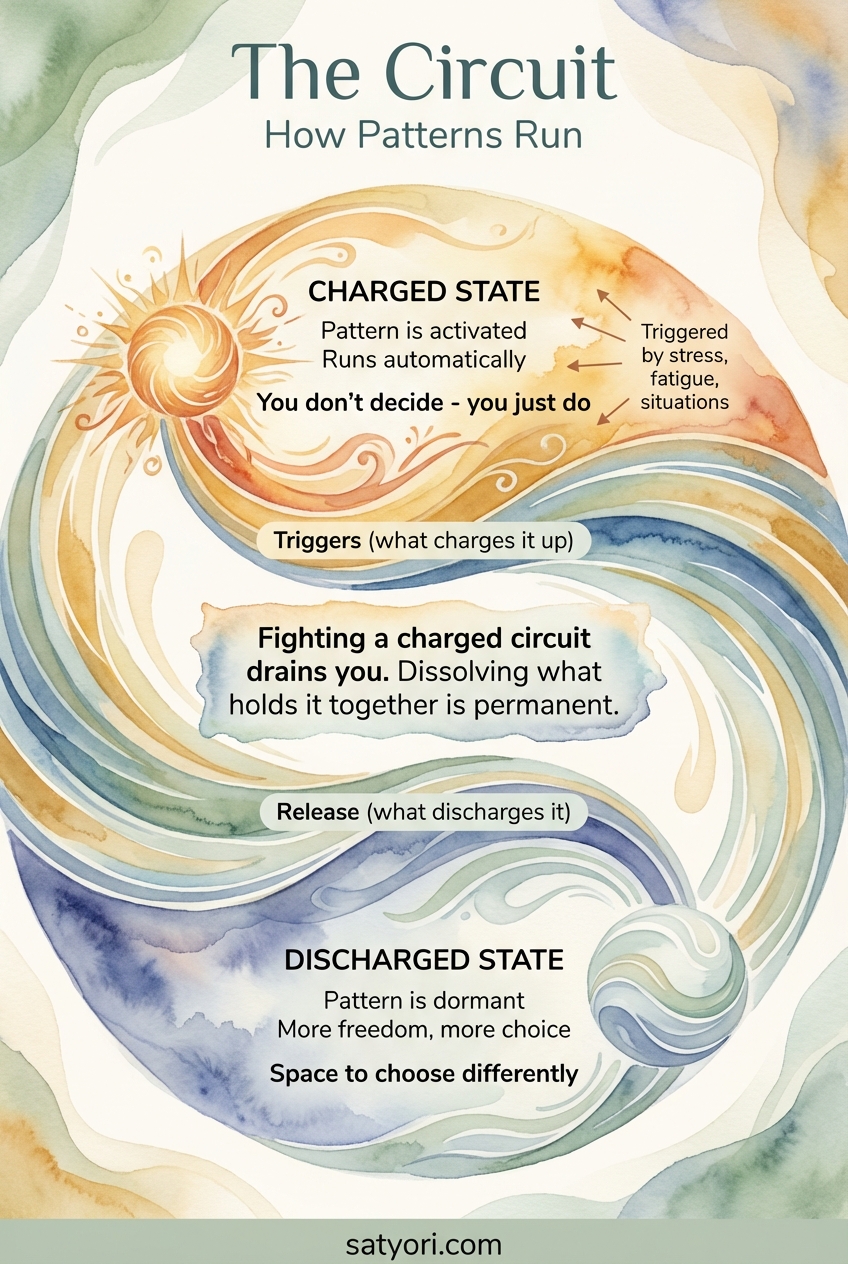
The Circuit
Every unwanted pattern in your life runs like a circuit. It charges up, it fires, and — if you leave it alone — it eventually discharges. Understanding this cycle is the difference between spending years fighting yourself and actually getting free.
Most people don’t understand the cycle. So they fight their patterns at exactly the wrong moment, using exactly the wrong tool, and wonder why nothing changes.
The Charged State
When a circuit is charged, the pattern runs automatically. You don’t decide to do it. You just find yourself doing it.
You don’t decide to snap at your partner when you’re tired. You don’t decide to reach for your phone the moment boredom lands. You don’t decide to shut down when someone criticizes you. The circuit fires, and by the time you notice what happened, it’s already over. There was no gap between the trigger and the reaction. No moment of choice. Just stimulus and response, like a machine.
This is not a moral failing. It’s mechanical. The circuit was wired through experience — usually some combination of repetition, intensity, and timing. Something happened enough times, or happened once with enough force, or happened early enough that you didn’t have the capacity to process it. The pattern installed itself. And now it runs.
Here’s the thing most people don’t see: every circuit was a solution to something real. The kid who learned to shut down during criticism — that was smart. It worked. It reduced the damage at a time when there was no other option. The problem is that the solution outlived the problem. You’re thirty-five years old and still shutting down in meetings because a circuit from age seven is still running the show. The pattern doesn’t know the situation has changed. It doesn’t update itself. It just keeps firing.
What Charges It Up
Every circuit has triggers — specific conditions that activate it. These aren’t random. They’re predictable once you start paying attention.
Stress and fatigue are the most common. When your capacity drops, old circuits take over because they require no effort. They’re automatic. This is why you make your worst decisions when you’re exhausted. The newer, more deliberate patterns need resources to run. The old circuits don’t need anything — they’ve been running for years.
Specific people charge specific circuits. There are people in your life who activate patterns in you that nobody else does. Your mother. Your ex. That one colleague. The pattern isn’t about them, exactly. It’s about what they represent to your nervous system — something unresolved, something that echoes an older situation.
Transitions charge circuits too. The gap between work and home. Between being alone and being social. Between one context and another. In those gaps, the default patterns fire because nothing else has stepped in yet.
None of this is the problem. The triggers are information. They’re showing you exactly where the charge lives.
The assessment maps which circuits are running your life — and where the charge is strongest.
Take the Free AssessmentWhy Fighting Doesn’t Work
Here’s what most people do when they notice a pattern: they try to stop it. They use willpower to interrupt the circuit while it’s firing. White-knuckle through the craving. Suppress the emotional reaction. Force themselves to behave differently than the circuit wants.
This is like trying to stop a river by standing in it. You can hold your ground for a while. But the water doesn’t stop flowing — it just builds pressure behind you.
Fighting a charged circuit is exhausting because it doesn’t reduce the charge. You spend energy. The circuit doesn’t lose any. You’re holding down a spring. The moment you relax — and you will relax, because you have to eventually — it fires again. Sometimes harder than before, because now there’s accumulated pressure.
This is why willpower-based change has a ceiling. You can maintain it as long as you have surplus capacity. The moment life gets hard — illness, stress, loss, disruption — the surplus disappears and the old circuits take over. Every time.
And the fight itself keeps the circuit in place. As long as you’re pushing against it, you’re engaged with it. You’re feeding it attention. You’re reinforcing the connection between the trigger and the reaction by making the trigger something you’re constantly braced against. The fight is a form of attachment. You’re holding the pattern and calling it resistance.
What Actually Discharges It
Instead of fighting the circuit, you dissolve what holds it together.
Every pattern is held in place by something — usually something you haven’t looked at directly. A belief you’ve never questioned. An emotion you’ve been avoiding. A memory you skim past. A conclusion you drew years ago under pressure that became invisible because you stopped noticing it was there.
When you look at that thing — really look, without flinching, without trying to fix it — the charge dissipates. Not because you forced it. Because you removed what was keeping the circuit energized.
This is where most people go wrong. They think “looking at it” means understanding it. It doesn’t. You can understand your patterns perfectly and still be run by them. Plenty of people can describe their issues in clinical detail and nothing changes. Understanding happens in the thinking mind. Discharge happens when that understanding drops deeper — into the body, into the felt experience. When you don’t just know the pattern but feel the thing underneath it.
Release looks like seeing the belief underneath the behavior — not just knowing it’s there, but seeing it operate in real time. It looks like feeling the emotion you’ve been avoiding without acting on it. Letting the wave come, peak, and pass without feeding it a story. It looks like recognizing that the pattern was a solution to an old problem that no longer exists, and feeling that recognition land somewhere deeper than your intellect.
This isn’t something you can think your way into. That’s the frustrating part. But it is something you can create the conditions for.
The Discharged State
When a circuit discharges, the pattern goes dormant. Not suppressed — actually dormant. The trigger happens and nothing fires. Or rather, something new happens where the reaction used to be: space.
A gap opens between the stimulus and your response, and in that gap there’s something that wasn’t there before. Choice.
This is what actual change feels like. Not gritted teeth. Not daily discipline. The quiet absence of compulsion. You walk past the thing that used to control you and feel nothing — or feel curious where you used to feel desperate.
The trigger still exists. The person, the situation, the stress — all still there. But it doesn’t fire the same circuit anymore. You might notice it. You might even feel a faint echo of the old pattern. But the automatic, overwhelming quality is gone.
That’s freedom. Not the freedom of never being triggered — that doesn’t exist. The freedom of having space between the trigger and what you do next.
Most people are fighting circuits they could discharge. The assessment shows you which ones are ready.
Discover Your CircuitsWorking with the Circuit
You can’t discharge a circuit you can’t see. The first step is always awareness — catching the pattern while it’s running, rather than after it’s already fired and the damage is done.
This takes practice. Not because it’s complicated, but because charged circuits are specifically designed to run without your awareness. That’s the whole point of automation — it doesn’t need your permission or attention. The pattern fires, the behavior happens, and you notice ten minutes later when you’re already in the aftermath.
Start by noticing the aftermath. That’s the easiest entry point. After you snapped at someone. After you ate the thing. After you scrolled for an hour. Don’t judge it. Just register: that was a circuit firing. That wasn’t a decision I made. That was something that happened to me because the pattern was charged.
Over time, you’ll start catching it earlier. Mid-fire at first — you’ll notice the pattern while it’s running, even though you can’t stop it yet. Then pre-fire — you’ll feel the charge building, feel the trigger activating, and have a moment before it fires. Each time you catch it, the gap between trigger and reaction widens slightly.
More gap, more freedom.
The Satyori Assessment maps your active circuits across 12 life areas. It shows you where you’re running on autopilot, what’s charging the patterns, and which circuits are ready to discharge.
It takes about 15 minutes and it’s free.