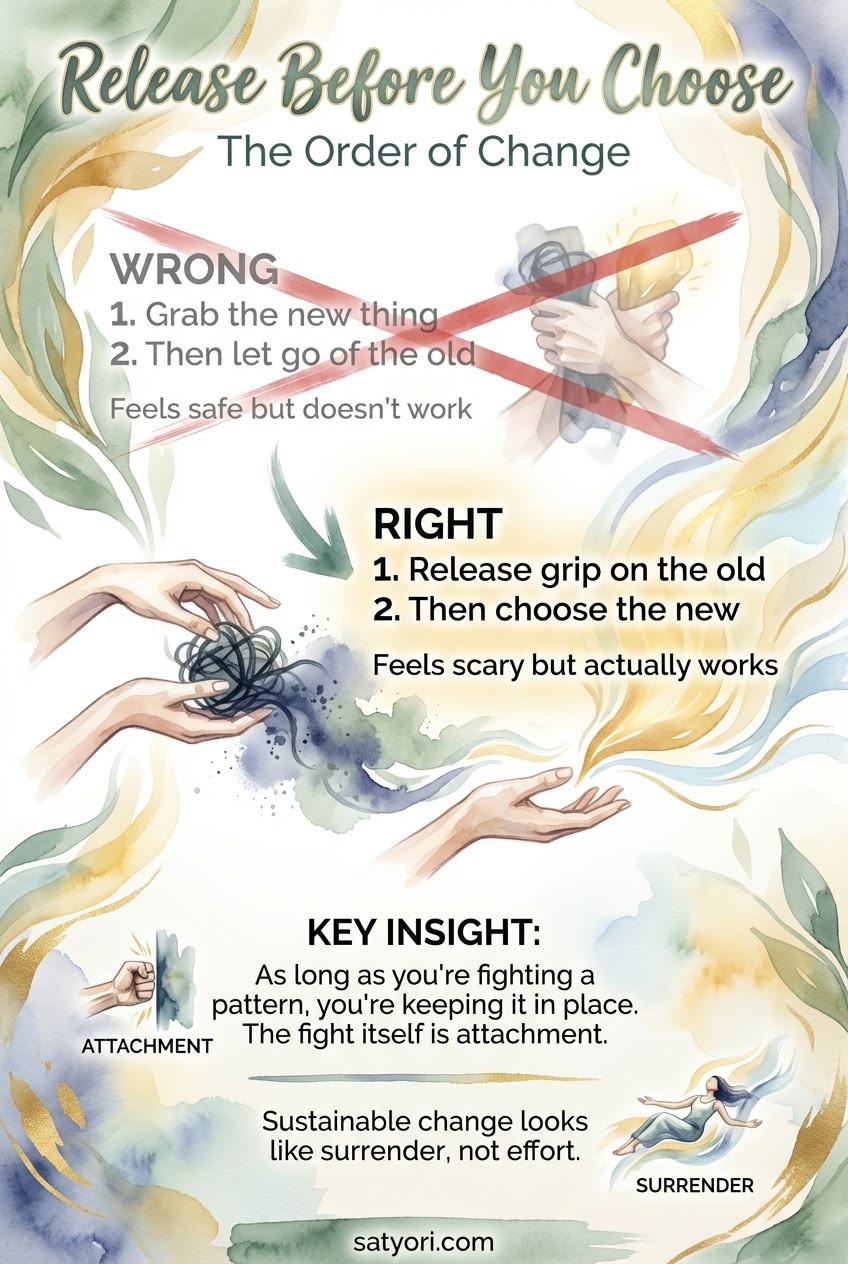
Releasing Before Choosing
Everyone gets the order backwards.
You want to change something — a habit, a pattern, a way of being in the world that isn’t working anymore. The instinct is to grab the new thing first. Find the better approach, adopt the healthier behavior, choose the upgraded version of yourself. Get a solid grip on the replacement before letting go of what you’ve got.
It feels logical. It even feels responsible. Don’t let go of the trapeze until you’ve got the next one in your hand.
But it doesn’t work. And if you’ve ever tried to make a real change this way — not a surface adjustment, but a fundamental shift — you already know it doesn’t work. You just haven’t been able to explain why.
Why Grabbing First Fails
When you try to adopt a new pattern while still holding the old one, you end up fighting on two fronts. You’re using energy to suppress the old behavior and energy to maintain the new one. This is what willpower-based change actually looks like — brute force in two directions simultaneously.
It’s exhausting. And it’s temporary.
Try this: clench your fist as hard as you can. Now, while still clenching, try to pick something up with that hand. You can’t. The grip itself prevents you from reaching for anything else. This isn’t a metaphor about effort — it’s the actual mechanism. The fight against the old pattern occupies the same system that would need to be available for the new one.
People in this position look like they’re trying hard. They are trying hard. That’s the problem. The effort itself is the obstacle.
The Fight Is a Form of Attachment
Here’s what almost nobody sees: fighting a pattern keeps it in place.
When you actively resist something — pushing against it, suppressing it, white-knuckling through the urge — you’re in constant relationship with it. You’re thinking about it. You’re monitoring it. You’re tensing against it. Your nervous system is on alert for it. The pattern has your full attention, just negatively instead of positively.
This is attachment through opposition. You’re connected to the thing you’re fighting just as strongly as you’d be connected to the thing you’re pursuing. The cigarette you’re not smoking occupies the same mental space as the cigarette you are smoking. The pattern you’re suppressing through force runs as a background process, eating energy, waiting for the moment your willpower dips.
And willpower always dips. It’s a finite resource. It depletes across the day, faster under stress, faster when you’re tired. The pattern, on the other hand, is automatic. It doesn’t get tired. It just waits.
This is why New Year’s resolutions fail by February. Not because people lack discipline. Because they’re fighting a charged circuit with a resource that runs out.
What Release Actually Means
Release is not giving up. This distinction matters.
Giving up means the pattern wins and you stop trying. Release means you stop fighting and start looking. You shift from pushing against the behavior to examining what’s underneath it.
Every pattern you’re trying to change is held in place by something. Usually something you haven’t looked at directly. A belief about yourself that you’ve never questioned. An emotion you’ve been avoiding for so long that avoiding it feels like your personality. A conclusion you drew under pressure years ago that became invisible because you stopped noticing it was there.
The pattern is not the problem. The pattern is the symptom. What’s underneath it — the belief, the emotion, the frozen conclusion — is what keeps the circuit energized.
When you look at that thing directly — really look, without trying to fix it, without building a story about it, without using it as evidence for another round of self-improvement — the charge dissipates. Not because you forced anything. Because you removed what was holding the pattern in place.
Your patterns aren't random — they're running on specific circuits. The assessment shows you which ones are driving your life right now.
Take the Free AssessmentThe Ninety-Second Window
There’s a physical component to this that most people don’t know about.
When an emotion arises in the body — real emotion, not the story about the emotion — the chemical cycle lasts about ninety seconds. That’s it. The hormones flood, peak, and clear in roughly a minute and a half.
The reason emotions seem to last hours or days is that you keep restarting the cycle. You feed the emotion a story. You rehearse the argument. You build the case. You analyze whose fault it is. Each round of narrative restarts the chemical clock. The emotion isn’t lasting — you’re retriggering it.
Release means letting one cycle complete without feeding it. The feeling comes. You notice it. You feel it in the body — the tightness, the heat, the contraction, whatever it is. You don’t build a story about it. You don’t analyze it. You don’t plan how to fix it.
Ninety seconds. The wave comes, peaks, and passes.
What’s on the other side is space. Not emptiness — space. Room where the reaction used to be. Room where something different can happen.
This is the gap. And in the gap, you can actually choose.
The Order That Works
So the sequence reverses. Instead of choose-then-release, it’s release-then-choose.
First, you stop fighting the old pattern. Not through resignation — through honest examination. You look at what’s underneath it. You let the emotional charge complete its cycle without feeding it stories. You find the frozen belief or the avoided feeling and you sit with it until it’s just a thing you can see, not a thing that runs you.
Then the grip loosens. Not because you pried your fingers off — because there’s nothing left to grip. The charge is gone. The circuit goes dormant.
And now you can choose. Not from desperation, not as a reaction against the old thing, not as a rebound from the pattern you were fighting. From space. From clarity. From the position of someone who actually has their hands free.
This is why people who’ve done real inner work sometimes make changes that look effortless from the outside. It’s not that the change was easy. It’s that the release was the hard part, and once that was done, the choosing was natural. They weren’t fighting anything anymore.
Why This Feels Dangerous
The reason almost everyone gets the order backwards is that release feels like losing ground.
If you stop fighting the pattern, won’t it take over? If you stop resisting the urge, won’t you give in? If you stop clenching against the old way of being, won’t you revert?
This fear is reasonable. It’s also wrong.
What feels like control — the white-knuckling, the monitoring, the constant vigilance — is not actually keeping the pattern in check. It’s keeping it charged. Every time you fight it, you confirm it as a threat. Every time you resist, you reinforce the neural pathway. The pattern stays alive because you keep engaging with it.
When you release — genuinely release, not just go slack — the pattern doesn’t surge forward. It loses its energy source. The circuit that was running on your resistance has nothing left to push against. It winds down.
This is counterintuitive enough that you probably won’t believe it until you experience it. That’s fine. You don’t need to believe it. You just need to try it once, with one pattern, and notice what actually happens.
The Practice
Pick something small. Not your deepest wound — something manageable. A recurring frustration. A habit you’ve been fighting. A reaction you keep having that you wish you didn’t.
Next time it comes up, don’t fight it. Don’t suppress it. Don’t analyze it. Just notice it. Feel it in your body. Watch what your mind wants to do — the story it wants to build, the blame it wants to assign, the fix it wants to plan.
Don’t do any of that. Stay with the raw sensation for ninety seconds.
See what’s on the other side.
If there’s space — even a little bit — you’ve just experienced the gap between release and choice. That gap is where real change happens. Not through force. Through surrender of the fight.
Sustainable change looks like surrender, not effort. Not surrender to the behavior. Surrender of the war against it. When you stop gripping so hard, you create room for something different to emerge.
The patterns you're fighting hardest are the ones running you the most. The assessment reveals which ones are active.
Find Your Active PatternsWhat Happens Next
The people who resist this idea the most are usually the ones who’ve been fighting the hardest. They have years invested in the effort-based approach. Discipline, willpower, forcing themselves to be different. Letting go of that fight feels like letting go of their entire strategy for self-improvement.
It is. That’s the point.
The old strategy — grab the new, fight the old, use willpower as the bridge — produced exactly the results it was going to produce. Temporary change followed by reversion. Progress followed by relapse. An exhausting cycle that looks like growth but is actually just the same pattern running at higher intensity.
The alternative isn’t passive. Release requires more honesty than fighting ever did. Looking at what’s actually underneath your patterns is harder than suppressing them. Sitting with an emotion for ninety seconds without feeding it a story takes more presence than brute-forcing a behavior change.
But it works differently. The change that comes from release doesn’t need to be maintained through effort. It doesn’t require vigilance. The old pattern isn’t suppressed — it’s discharged. There’s nothing to fight anymore.
You can’t choose freely while still holding on. The order matters.
Release first. Then choose.