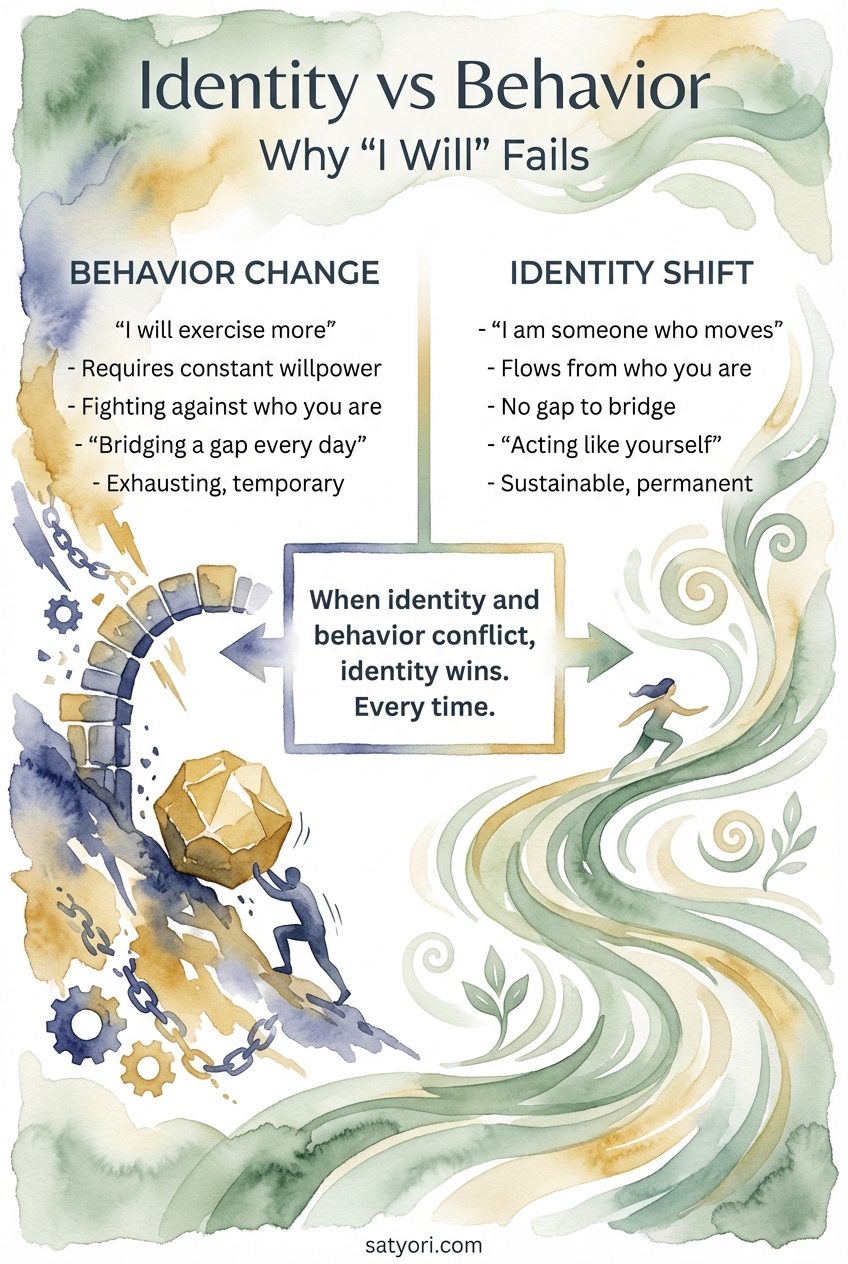
Identity vs Behavior
There are two ways to change. Most people only know one of them. That’s why most change doesn’t last.
The first way is behavior change. You decide what you should do differently and then you try to do it. “I will exercise more.” “I will stop procrastinating.” “I will be more patient.” You make a plan. You set reminders. You grit your teeth and try harder.
The second way is identity shift. Something changes in how you see yourself, and the behavior follows without effort. Not because you’re forcing it. Because it’s what someone like you naturally does.
The difference between these two is the difference between pushing a boulder uphill every day and discovering the hill was optional.
Why Behavior Change Exhausts You
Behavior change requires willpower. And willpower is a finite resource — not metaphorically, actually finite. Every decision you make, every emotion you manage, every impulse you override draws from the same limited pool. Your capacity to direct your attention is measurable. It runs out.
When you try to change behavior that contradicts your identity, you’re spending that resource all day long. If you see yourself as someone who doesn’t exercise, every workout is a rebellion against your own self-concept. You can sustain the rebellion for a while — weeks, maybe months. But eventually the resource depletes. Not because you’re weak. Because you’re trying to override a system that never gets tired, using a tool that does.
Your identity operates like a thermostat. It has a set point — a picture of “who you are” — and it automatically corrects any deviation back to that set point. When you try to change behavior without changing the set point, you’re opening windows in a heated building. You can temporarily change the temperature. But the system detects the deviation and fires up to compensate. The thermostat wins because it never sleeps.
This is why 92% of New Year’s resolutions fail. Not because people lack discipline. Because willpower was never the right tool for the job.
The assessment maps the gap between your current identity and how you're actually operating — across 12 life areas.
Take the Free AssessmentWhat Identity Shift Looks Like
“I will exercise more” is a behavioral commitment. A promise you have to keep. Every morning you wake up and have to convince yourself again.
“I am someone who moves” is a description of what’s already true.
Notice the difference. The first requires a daily fight. The second doesn’t require anything — you’re just being yourself.
When identity and behavior conflict, identity wins. Every time. This isn’t theory — watch anyone who “fell off the wagon.” They didn’t run out of willpower. Their identity reasserted itself. The thermostat kicked in.
A person who identifies as “someone who moves” doesn’t need motivation to take a walk. Skipping it feels wrong — the way skipping a meal feels wrong. Not discipline. Identity.
Look at smokers. The person who “wants to quit smoking” keeps smoking. The person who “isn’t a smoker” doesn’t reach for cigarettes. Same environment, same access, completely different behavior. The difference is where the thermostat is set.
Or look at the lottery winner who goes broke within three years. Their financial situation changed but their identity didn’t. They still knew themselves as someone who struggles with money. The system corrected back to the set point — through lifestyle inflation, bad investments, giving money away. The thermostat always wins.
Why You Can’t Fake It
But you can’t just say “I am someone who moves” and have it be true. You know when you’re lying to yourself. Affirmations don’t work for the same reason — repeating “I am confident” to a mirror doesn’t change the part of you that learned to be afraid. It just adds a layer on top. The original program is still running underneath, and it’s stronger than the affirmation because it has experience behind it.
Knowing you have a splinter doesn’t remove the splinter. You can understand exactly where it is, why it hurts, and how it got there. But the splinter stays in until you actually extract it. Most self-improvement is just examining the splinter more closely. Getting better at describing it. Meanwhile, the splinter is exactly where it was.
Real identity shift requires something uncomfortable: seeing the identity you’re actually carrying. Not the one you show the world. Not the aspirational one you put in your journal. The operational one — the one running when you’re tired, stressed, rejected, or alone.
How Identity Actually Forms
You didn’t choose your current identity. It was assembled through experience — much of it experience you couldn’t understand or evaluate at the time.
A kid gets mocked for asking a question in class. Twenty years later, they sit silent in meetings and call themselves “an introvert.” Another kid watches parents fight about money. As an adult, they can’t seem to save anything, and they call it “bad with money.”
These aren’t character traits. They’re conclusions drawn under pressure, often in childhood, that hardened into identity over time. They run automatically, outside awareness, generating behavior that matches an identity you never chose. And they feel so fundamental that questioning them feels like questioning who you are.
That’s the trap. The identity feels like bedrock — the deepest truth about you. But it’s software. Programs that were written under specific conditions, which can be rewritten under different ones. You weren’t born believing you’re bad with money or unlovable or not athletic. These things were installed through experience. And what was installed can be un-installed, given the right conditions.
Most people are operating from an identity they never chose. The assessment reveals where yours is running you.
See Your Real PatternsThe Spectrum of Change
Change exists on a spectrum of depth:
Surface level: Tactics and hacks. “Put your running shoes by the bed.” Works for about a week.
Habit level: Systems and routines. “Exercise at the same time every day.” Works for months. Breaks under stress.
Belief level: Reframing your story. “I’m the kind of person who values health.” Works longer, but beliefs can be overridden by deeper patterns.
Identity level: Seeing and releasing what was actually running you. “I built a sedentary identity because stillness felt safe. It’s not serving me anymore.” This is where permanent change happens.
Most self-help operates at surface and habit levels. Some therapy reaches beliefs. Very few approaches go to identity — because it requires a capacity most people haven’t developed. The ability to look at yourself without flinching. Without explaining. Without making it somebody else’s fault.
Where to Start
You don’t start with the identity shift itself. You start by noticing where you’re fighting yourself.
Notice where you use willpower to do things that should be natural. Notice where the same resolutions keep failing. Notice where you feel exhausted from trying to be someone you apparently aren’t.
Those are the places where your identity and your behavior are misaligned. The exhaustion isn’t telling you to try harder. It’s telling you to look deeper. Something is holding the old identity in place, and that something can be found.
The Satyori Assessment maps these patterns across your whole life — relationships, health, money, creativity, and more. It shows you where the identity-behavior gap is widest, and what’s actually driving it.
It takes about 15 minutes and it’s free.